IN A NUTSHELL Author's Note...Humanity stands at a crossroads where the choices we make—and the values that guide them—will determine whether future generations inherit a flourishing planet or a diminished one. The One Health & Wellbeing concept, the Earth Charter Principles, and ecocentrically reframed UN SDGs together offer a coherent, ethical, and scientifically grounded pathway for realigning human societies with the Earth’s life-support systems. As the 1 HOPE–TDR initiative demonstrates, transforming learning across all societal levels is not simply an educational aspiration but a civilisational imperative. By embracing interconnectedness, shared 'meaning-making' and responsibility, alongside a renewed ethic of care for all life, humanity can begin to build a just, sustainable, and peaceful world—one in which we finally learn to live in harmony with the planet that sustains us...

By George R. Lueddeke, PhD
Global Lead, International One Health for One Planet Education & Transdisciplinary Research Initiative (1 HOPE–TDR)
United Kingdom
The Global Polycrisis
Reframing Learning through One Health & Wellbeing for a Sustainable Earth
A World at Breaking Point
Humanity is living through a period of profound and accelerating transformation, much of it driven by extractive, growth-driven economic models and opportunistic power structures that disregard the limits of the Earth’s life-support systems. Climate instability, biodiversity collapse, geopolitical tensions and democratic erosion, water scarcity, pollution, zoonotic spillover, widening inequalities, and rapid technological disruption are converging into a “perfect storm” of unprecedented scale. These forces are no longer isolated trends—they are mutually reinforcing symptoms of a deeper imbalance between human societies and the natural world.
At the heart of this imbalance lies an educational crisis. Our learning systems still reflect a worldview built on human supremacy, compartmentalised knowledge, and economic growth as the overriding societal priority. This worldview—grounded in human exceptionalism and uncritical technological optimism—has become dangerously misaligned with the planet’s ecological boundaries. Societies today operate without a coherent moral compass in an era defined by existential risk, continuing to function within a mindset shaped by humancentrism (“it’s all about us”), fragmentation, and persistent short-termism—echoes of the pre-Copernican belief that the Earth was the centre of the universe.
Modern education systems—particularly universities—have not yet fully grasped the gravity of this historical moment. A widening gap has emerged between the complexity of cascading global challenges and society’s capacity to understand and respond to them. Increasingly, as institutions are being pushed “to replace education with indoctrination,” decision-makers recognise that transforming learning across all societal levels is essential to securing a more just, inclusive, sustainable, and peaceful future for both current and future generations.
Learning at a Crossroad: Transforming Our Worldview
Yet higher education continues to operate within an outdated paradigm that privileges disciplinary silos, credentialism, institutional competition, and market-driven logic. These traditions undermine the ecological literacy, ethical insight, and transdisciplinary collaboration essential for navigating civilisation-scale crises. If education does not evolve, societies will struggle to evolve with it. Put simply, the world cannot be “saved from itself” unless the systems that shape human understanding and decision-making are transformed.
It is in this context that this article examines the emergence and purpose of the International One Health for One Planet Education & Transdisciplinary Research Initiative (1 HOPE–TDR). Developed to bridge the widening gap between global risks and societal capacity, 1 HOPE–TDR provides a values-based, ecocentric, regionally coordinated framework for rethinking how societies learn, govern, and collaborate during an era of planetary upheaval (Fig. 1). Through the integration of One Health & Wellbeing, Earth Charter ethics, and an ecocentric reframing of the UN Sustainable Development Goals, the initiative offers foundations for a transformative shift in global learning—and ultimately, in humanity’s relationship with the Earth.
Figure 1. 1 HOPE–TDR Overview
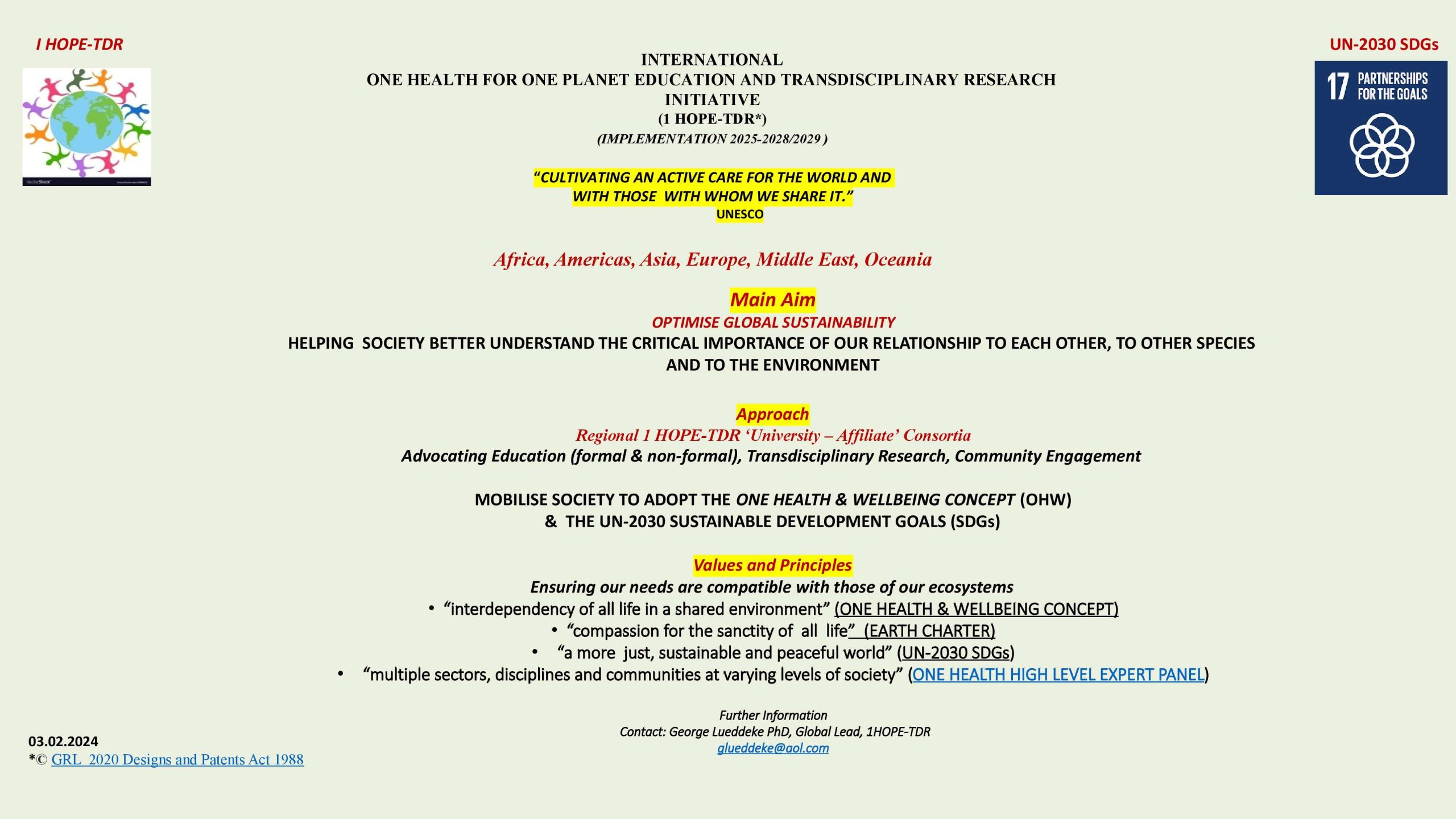
© 2020 George R. Lueddeke
Adapted from Survival: One Health, One Planet, One Future (2020)
Evolution of an Integrated Knowledge Ecology
A vital step in this transformation is the creation of an integrated knowledge ecology—an understanding of the “interconnectedness of all things” that embraces diverse zones of knowledge extending far beyond academia. These include natural, political, economic, cultural, social, and ethical domains that shape human–Earth relations.
As Emeritus Professor Ronald Barnett (UCL Institute of Education) reminds us, universities and higher education generally carry ‘responsibility not only in sustaining any such ecology’ but also, more importantly, to strengthen it. By attending to all ecological zones, universities and all other education / research system providers can realise their full potential as institutions with an active concern for the whole Earth — even the universe — and ensure that they remain “constantly adaptable to new circumstances as the world moves forward.
Rethinking the Human–Earth Relationship
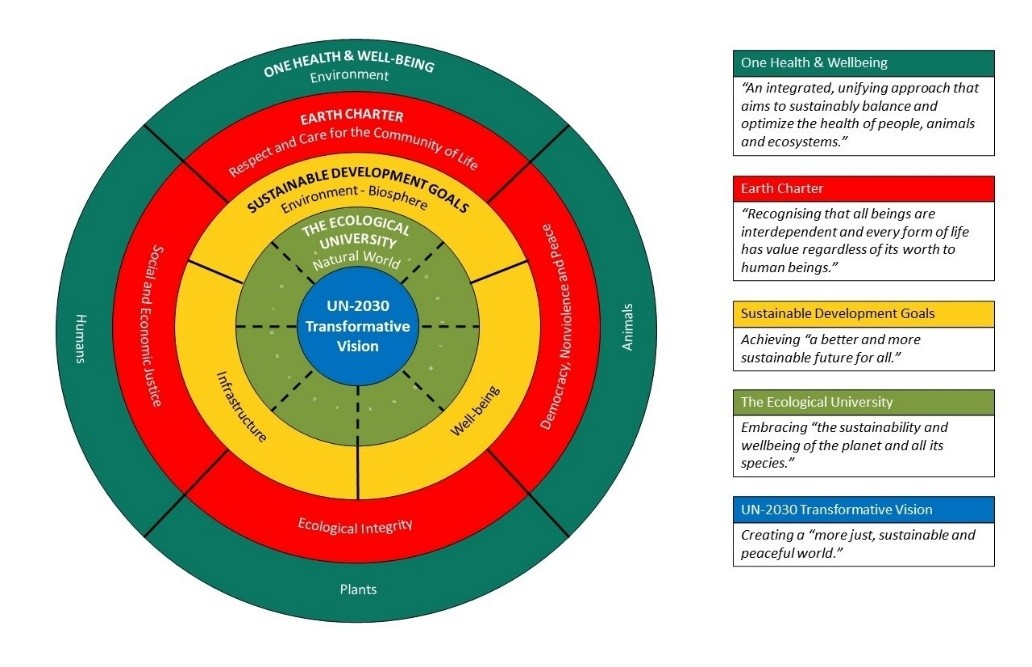
It is within this expanded context that 1 HOPE–TDR has taken shape. Recognising that systems-level challenges require systems-level solutions, the initiative brings together the life, natural, physical, and social sciences (including ethics), the humanities, and global policy frameworks to catalyse a shift toward ecocentric, integrated learning and leadership.
As shown in Figure 2, the initiative is built on Barnett’s ecological zones framework and is supported by three mutually reinforcing pillars:
- The One Health & Wellbeing (OHWB) concept
- The Earth Charter principles
- A reframed ecocentric reorientation of the UN Sustainable Development Goals
Figure 2. 1 HOPE–TDR Conceptual Building Blocks
The One Health & Wellbeing Concept
The OHWB concept offers a scientific and holistic understanding of how human health is inseparable from the wellbeing of non-human animals, plants, ecosystems, and planetary processes. It exposes the illusion that human prosperity can be achieved independently of nature. OHWB demonstrates that:
- the climate emergency is fundamentally a health and wellbeing emergency (all life).
- biodiversity loss threatens food systems, water quality, and economic stability.
- ecosystem degradation accelerates the emergence of infectious diseases.
Beyond its scientific grounding, OHWB invites a new ecological consciousness—one that recognises interdependence as the organising logic of life on Earth and underscores the urgent need for a new global all-life narrative.
The Earth Charter — Turning Conscience into Action
The Earth Charter complements this scientific foundation with a moral and ethical framework for building a just, sustainable, and peaceful world. Its four pillars—respect for the community of life, ecological integrity, social and economic justice, and peace—offer a much-needed ethical compass for a fractured world. They remind us that sustainability is fundamentally an ethical project requiring responsibility, compassion across species, and cultures grounded in reciprocity and care.
Reframing the UN Sustainable Development Goals Ecocentrically
Although the SDGs remain largely humancentric in structure, they provide a crucial platform for shifting toward an ecocentric worldview that recognises the interdependence of people, other species, and the Earth’s systems. None of the goals can be realised unless the planet’s life-support systems are stabilised.
Ecocentrism does not diminish human development; rather, it recognises that development is impossible if ecosystems collapse. Reframing the SDGs in this way aligns them with:
- the scientific reality of planetary boundaries, and
- the ethical commitments of the Earth Charter.
Together, OHWB, the Earth Charter, and ecocentrically-reframed SDGs form the triad that underpins 1 HOPE–TDR—providing the philosophical, ethical, and operational foundations for rethinking learning systems worldwide.
The One Health & Wellbeing Mandate for Systemic Transformation
By embedding these three core building blocks across policy, education, governance, decision-making, and practice, societies can begin to realign human activity with the wellbeing of the Earth and all interconnected life-support systems.
Drawing on foundational works such Survival: One Health, One Planet, One Future including the Ten Propositions for Global Sustainability (Box), and Universities in the Early Decades of the Third Millennium: Saving the World from Itself? ,the integrated conceptual framework offers a coherent pathway for navigating converging existential risks. These elements strengthen the global sustainability narrative by connecting ethical responsibility, systems thinking, and transdisciplinary research with a shared commitment to safeguarding both present and future generations.
The future is not predetermined. It is shaped by the values we teach, the knowledge we cultivate, and the courage with which we act. If humanity is to “save the world from itself,” learning must lead the way.
Box: Ten Propositions for Global Sustainability
WHAT IF?
- We recognised the Earth as a living community whose health and wellbeing underpin humanity’s future.
- We shifted from a humancentric to an ecocentric worldview, aligning human development with the planet’s life-support systems.
- Education at all levels prioritised ecological literacy, ethics, and systems thinking as the foundations for sustainable societies.
- Universities became ecological, civic, and globally responsible institutions — serving future generations as well as present communities.
- Governments adopted integrated One Health & Wellbeing approaches across all departments, policies, and ministries.
- Economies were reoriented toward regeneration, circularity, and long-term planetary wellbeing rather than short-term profit.
- Youth and future generations held a central role in shaping governance, innovation, and societal priorities.
- Science and Indigenous Knowledge informed one another to guide decisions that respected Earth’s limits and cultural diversity.
- Global collaboration replaced competition — connecting nations, disciplines, civil society, and business in service to a sustainable Earth.
- We adopted a shared ethic of care — towards each other, other species, and the planet — anchored in the OWB and Earth Charter values and principles.
(© 2020 *Adapted from Lueddeke, G. R. (2020). Survival: One Health, One Planet, One Future.)
Building a Global Architecture for Learning Transformation
Informed by years of foundational development and driven by the imperative to optimise global sustainability, 1 HOPE–TDR advances several essential shifts:
- from human-centred health to the wellbeing of all species and ecosystems;
- from individualism to learning with, from, and for one another;
- from fragmented knowledge to integrative, transdisciplinary learning;
- from passive knowledge transmission to collaborative knowledge creation;
- from institution-centred models to deeper community engagement;
- from vested interests and power dynamics to altruism, compassion, and truth.
Anchored in these principles, 1 HOPE–TDR is establishing continental and regional steering committees and sub-regional coordinating groups to lead major regionally owned grant proposals under a shared theme:
One Health & Wellbeing for the Earth: Learning for Sustainability.
These committees engage multidisciplinary and multisector stakeholders, with strong emphasis on youth and marginalised communities. Dedicated secretariats—currently the University of Education, Winneba (Africa); the Institute of Hygiene and Tropical Medicine, NOVA University Lisbon (Europe); and the Institute for Advanced Studies, Federal University of Rio de Janeiro (Latin America and the Caribbean [LAC])—provide coherence and regional leadership. Plans are underway to extend initiatives to India, Southeast Asia, Oceania, and the Middle East.
Why Learning Must Be Reframed for a Sustainable Future
This wave of coordinated regional developments may represent one of the more significant global shifts now emerging in sustainability efforts. Increasingly, leaders recognise that learning is the master key—the mechanism through which worldviews evolve, values transform, institutions adapt, and societies discover new pathways forward. Learning is not confined to classrooms; it occurs in communities, governments, civil society, workplaces, homes, and rapidly expanding digital environments.
Concluding Comments
Humanity stands at a crossroads where the choices we make—and the values that guide them—will determine whether future generations inherit a flourishing planet or a diminished one. The One Health & Wellbeing concept, the Earth Charter Principles, and ecocentrically reframed UN SDGs together offer a coherent, ethical, and scientifically grounded pathway for realigning human societies with the Earth’s life-support systems. As the 1 HOPE–TDR initiative demonstrates, transforming learning across all societal levels is not simply an educational aspiration but a civilisational imperative. By embracing interconnectedness, shared ‘meaning-making’ and responsibility, alongside a renewed ethic of care for all life, humanity can begin to build a just, sustainable, and peaceful world—one in which we finally learn to live in harmony with the planet that sustains us.
About the Author

George Lueddeke, PhD is Global Lead of the 1 HOPE–TDR initiative, advancing ecocentric-focused One Health & Wellbeing education and transdisciplinary research - rising above discipline silos. A recognised education developer, adviser, and author  across higher and medical education, population health, sustainability, and learning transformation, he writes and speaks widely on global risks and systemic solutions. He champions a just, sustainable, and peaceful future for all life on the planet. (Brief Bio)