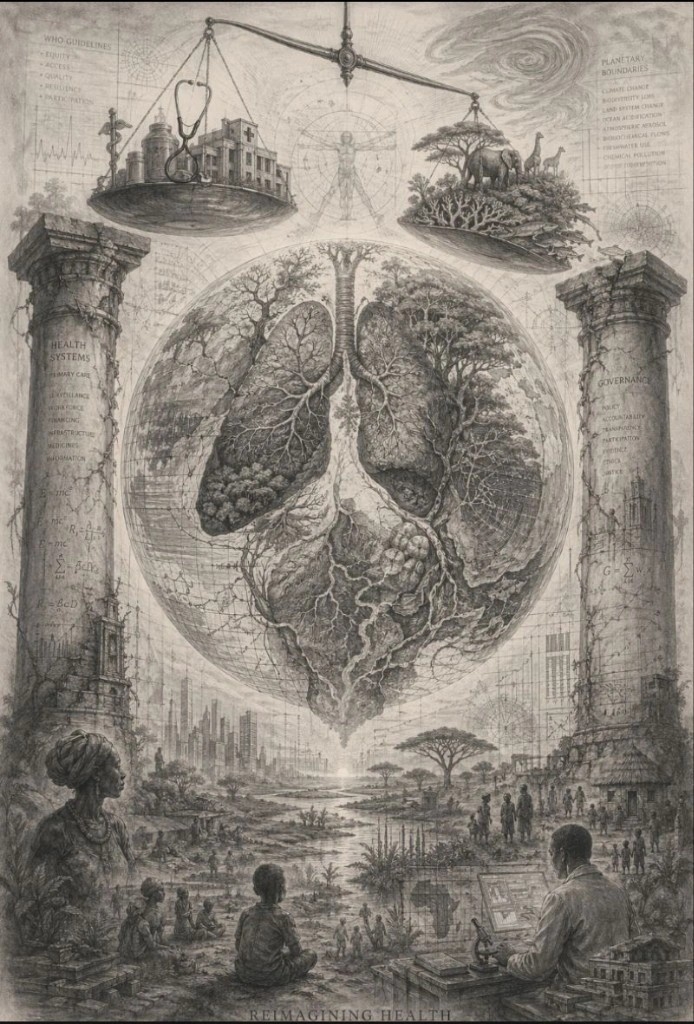
From Fragmentation to Architecture: A One Health Bretton Woods Framework for Climate-Resilient Health Systems

IN A NUTSHELL
Author's Note 
Despite unprecedented advances in biomedical science, digital health, and climate risk analytics, global health systems continue to underperform in the face of converging crises. This paradox—where knowledge accumulates but outcomes stagnate—reflects a deeper systemic failure: the absence of integrated governance, aligned incentives, and operational delivery architectures.

This paper proposes a One Health Bretton Woods Framework, a unified conceptual model that integrates human, animal, plant, and ecosystem health within a financing and governance architecture designed for implementation at scale. Drawing on emerging evidence from implementation science, climate resilience financing (including performance-based instruments), and digital health adoption studies, we introduce the concept of Trust-Adjusted Implementation (TAI)—a systems-level determinant explaining why technologies and policies fail to translate into real-world outcomes.

We argue that future resilience will depend not on discovery, but on the institutionalization of incentive-compatible, trust-validated, and performance-linked delivery systems. This framework positions One Health not as a coordination paradigm, but as a governance and financing doctrine, analogous in ambition to the post-war Bretton Woods system

 By Kalolo Chitembo

Crisis Expert/ Emergency Medicine Specialist/ Health Economist/ Global Health Advocate/ Climate and ONE HEALTH Researcher

Zambia

By the same Author on PEAH: HERE

From Fragmentation to Architecture

A One Health Bretton Woods Framework for Climate-Resilient Health Systems


Introduction: The Implementation Paradox in Global Health

Global health has entered an era of epistemic saturation. Surveillance systems detect outbreaks in near real-time, climate models predict vector shifts with increasing precision, and digital health technologies promise universal access.

Yet, system failures persist.

Recent analyses across implementation science and global health governance converge on a central diagnosis:

the constraint is no longer knowledge, but delivery.


This failure is most visible at the intersection of:

Climate shocks disrupting food and health systems

Zoonotic spillovers linked to ecological degradation

Underperforming health systems despite increased financing


The prevailing paradigm—fragmented across sectors, institutions, and financing streams—cannot manage these interdependencies.

We argue that the global system is facing a structural equivalent of the pre-1944 economic order:

fragmented, uncoordinated, and incapable of managing systemic risk.


Conceptual Shift: From One Health Coordination to One Health Governance

One Health has traditionally been framed as a coordination mechanism across:

Human health

Animal health

Environmental systems


However, this framing is insufficient.

We propose a shift toward One Health as a governance architecture, defined by:

System Integration

Biological systems (human, animal, plant) are treated as interdependent infrastructure, not sectoral domains.

Institutional Alignment

Global and regional institutions must operate within a shared incentive and accountability framework.

Financing Integration

Climate, health, and agricultural financing must converge into performance-linked investment systems.

The Trust-Adjusted Implementation (TAI) Model

A central contribution of this paper is the formalization of Trust-Adjusted Implementation (TAI).

Model Definition

Delivery = f (Evidence × Incentives × Infrastructure × Trust)

Where:

Evidence = scientific and technical knowledge

Incentives = financial and policy alignment

Infrastructure = physical and digital systems

Trust = behavioral and institutional adoption


Empirical Basis

Recent qualitative and systems-level studies demonstrate that:

Clinicians resist autonomous AI diagnostics but adopt decision-support tools

Algorithmic bias reduces trust and adoption in diverse populations

Infrastructure mismatches (e.g., cloud dependency) undermine system reliability

Administrative burdens (dual data entry) inhibit integration


These findings indicate that trust is not a soft variable—it is a binding system constraint.


Financing the System: From Input-Based to Performance-Based Architectures

Traditional global health financing is characterized by:

Input-based disbursement

Short-term project cycles

Fragmented funding streams


This model is misaligned with system-level resilience.

Performance-Based Financing

Emerging instruments—such as resilience bonds and parametric insurance—demonstrate a shift toward:

Payment for verified outcomes

Risk transfer mechanisms

Integration of ecological and health metrics

Implications for One Health

A One Health Bretton Woods system would:

Link financing to ecosystem integrity, disease prevention, and food system resilience

Integrate climate risk into health system financing

Incentivize cross-sector outcomes rather than siloed outputs


Digital Infrastructure: The Case for Decentralized, Edge-Based Systems

Digital health has been widely promoted but unevenly adopted.

Evidence indicates that successful systems in resource-constrained environments share key characteristics:

Edge computing (offline functionality)

Mobile-first interfaces

Human-centered design

Localized data validation


Implication

Digital infrastructure must be treated as public health infrastructure, analogous to water or energy systems.


Institutional Architecture: Toward a One Health Bretton Woods

We propose a multi-layered governance system:


Global Layer

Norm-setting and coordination

Pandemic preparedness

Climate-health integration


Regional Layer

Sovereignty and pooled capacity

Regional manufacturing and surveillance systems


National Layer

Implementation and service delivery

Institutional capacity building


Cross-Cutting Layer

Data governance

Financing alignment

Trust architecture


Policy Implications for Emerging Economies

For countries in Sub-Saharan Africa, including Zambia, this framework enables:

Health Sovereignty

Reduced dependence on external response systems through local capacity.

Climate Resilience

Integration of agriculture, water systems, and health infrastructure.

Economic Stability

Use of innovative financing instruments to mitigate fiscal shocks.

Digital Leapfrogging

Adoption of decentralized AI and mobile-first systems.


Discussion: From Doctrine to Implementation

The analogy to Bretton Woods is deliberate.

The original Bretton Woods system created:

Institutional stability

Financial coordination

Predictable economic governance


Today’s global health and climate challenges require a similar transformation.

However, unlike Bretton Woods, this system must be:

Decentralized

Digitally enabled

Ecologically grounded


Conclusion

The future of global health will not be determined by new discoveries alone.

It will be determined by whether the international community can construct systems that:

Align incentives

Integrate institutions

Build trust

Deliver outcomes


The failure of global health is not knowledge—it is governance, incentives, and implementation architecture.

A One Health Bretton Woods framework offers a pathway forward.


News Flash 661: Weekly Snapshot of Public Health Challenges

News Flash Links, as part of the research project PEAH (Policies for Equitable Access to Health), aim to focus on the latest challenges by trade and governments rules to equitable access to health in resource-limited settings

Dusky grouper (Epinephelus marginatus)

News Flash 661

Weekly Snapshot of Public Health Challenges


Register today: In conversation with Tom Fletcher, UN Under-Secretary-General for Humanitarian Affairs and Emergency Relief Coordinator, about the most pressing humanitarian and conflict issues facing the United Nations today, and what role the UK can play. 20 April 2026 Event location: Hybrid — Chatham House and Online

Webinar registration: Youth Co-creation Guide Launch Apr 21, 2026

Webinar registration: Integrated Long-term Care in Europe: Learning from the BUILD, LeTsCare and Laurel Projects: Results and Reflections on Policy and Practice Apr 30, 2026

Interview: Francisco Mendina PhD Candidate Western University, Canada  by Daniele Dionisio 

Governing Biological Risk in an Era of Climate Instability: Integrating One Health into Macroprudential Policy Architecture  by Kalolo Chitembo

From supply to strategy: leveraging central medical stores experiences and information for health system strengthening

Safeguarding Health For People With Intellectual And Developmental Disabilities: Absent Federal Leadership, Others Must Step Up

When the medicine runs out: AMR, antibiotic shortage, and the children being left behind

One Million More People to Get HIV ‘Miracle’ Drug Lenacapavir as US, Global Fund Expand Access

Effect of donor exclusion criteria on blood safety and volume of donations: a systematic review of modelling studies

HRR813. THERE IS NO TYRANNY MORE CRUEL THAN THAT WHICH IS EXERCISED UNDER THE SHADOW OF THE LAW AND IN THE NAME OF JUSTICE. (Montesquieu)

Shifting Global Health R&D Funding: Opportunities in a Changing Landscape

Health Taxes and the IMF: Are Support and Reform Aligned?

Rich countries slash development aid in a short-sighted move with long-term global consequences

Global CSOs welcome launch of Borrowers’ Platform at IMF-World Bank Spring Meetings

Online University Throws a Lifeline to Afghan Women Shut Out of Education

Civil Society Launch a Campaign Against Extractive Industry Exploitation and Land Grabs

Did badly designed aid rules lead to a rise in child marriage?

Restitution of findings in humanitarian research: Guidance note

UNPO Collaborates with Munk School of Global Affairs and Public Policy on Determining the Narrative: The Use of Narratives, (Mis)Information, and Media for Unrepresented Nations and Peoples in the 21st Century

Iran war could plunge 32 million into poverty, says United Nations

Beyond the battlefield: The global ripple effects of the Iran war

Sudan’s Catastrophic Civil War Enters Fourth Year

Millions of people in Sudan surviving on one meal a day as food crisis deepens, NGOs say

From genocide to countless acts of solidarity: Documenting three years of war in Sudan

Donors pledge 1.5 bn euros as Sudan marks three years of war

‘Water Nobel’ winner Madani calls for focus on water crisis at COP31

Indian wastewater rife with drug resistance genes

Delhi Has a New Plan to Fight Its Toxic Air, But Will it Deliver?

Human rights and the rights of Nature are linchpins for truly sustainable development

Why Peatlands Matter: Britain’s Overlooked Carbon Store


Interview: Francisco Mendina PhD Candidate Western University, Canada

IN A NUTSHELL
Editor's note
PEAH had the pleasure to interview Mr Francisco Mendina as a doctoral candidate at Western University in London, Ontario, Canada, who is conducting, under the supervision of Dr. Elysee Nouvet, a research study exploring how humanitarian healthcare professionals conceptualize and practice solidarity in contexts of crisis, conflict, and care. The study has received ethics approval from Western University, and in this capacity Mendina also serves as a staff member of the Global Health Solidarity Project Network as a Wellcome Trust funded research alliance implemented by the University of Ghana and led by Prof. Caesar Atuire at the University of Ghana and the University of Oxford, with six Co-Investigators in Australia, South Africa, Canada, Costa Rica, USA and Austria 

By Daniele Dionisio

PEAH – Policies for Equitable Access to Health

  INTERVIEW

Francisco Mendina

PhD Candidate Western University

Ontario, Canada 


PEAH: Very pleased to meet you Mr Mendina. Just to introduce yourself, share, please, concise information on your professional background

Mendina: Hi Daniele, thank you for the warm invitation. I am pleased to meet you as well. I am currently a third-year PhD student in Health Information Science at Western University, where I also serve as a teaching assistant and graduate student fellow with the Global Health Solidarity Network. My research, supervised by Dr. Elysee Nouvet, aims to understand how humanitarian healthcare professionals who have worked in prolonged conflict settings understand and enact the concept of solidarity.

My path to this work has been shaped by a longstanding interest in community health and humanitarian contexts. During my undergraduate studies at McMaster University — where I completed a Bachelor’s degree in Life Sciences with a minor in Community Engagement — I began volunteering with global health and community health organizations, which sparked my interest in how health systems serve vulnerable and underserved populations. This interest deepened during my Master’s degree in Management of Applied Sciences in Global Health Systems at the University of Western Ontario, where an internship gave me firsthand exposure to the humanitarian healthcare space and affirmed my commitment to working at the intersection of health equity and community engagement.

Prior to beginning my doctoral studies, I worked as a Program Coordinator for HIV/AIDS Support Services at an AIDS Services Organization in York Region, Ontario. In this role, I oversaw project planning, individual case management, and health promotion initiatives, including organizing and leading community education workshops. Across these experiences — from undergraduate volunteering to professional coordination — I developed a deep appreciation for community-centred approaches to health, which continues to inform my doctoral research today.

PEAH: As maintained in the Global Health Solidarity Project brief…The Challenge Efforts to promote greater health equity for all have been accompanied by an increase in calls for solidarity, especially during crises such as the Covid-19 pandemic. However, at the global level, these appeals to solidarity have produced meagre results. Common conceptions of solidarity in global health are ambitious but ambiguous and under-theorised, making them inadequate and insufficient in providing the clear goals and tools needed to operationalise solidarity…’  In this connection, what are your thoughts in more detail?

Mendina: The challenge resonates with what motivated my own research. In reviewing the humanitarian healthcare literature, I consistently found solidarity being called to have a more central role — particularly in calls for more horizontal, inclusive, and politically engaged humanitarian responses — yet rarely defined. Authors across disciplines conceptualize the term differently. Humanitarian organizations themselves use the term in varied and sometimes contradictory ways. The result is a concept that is rhetorically powerful but operationally vague.

Additionally, to my knowledge, there are no studies that have sought to understand how those actually working on the front lines of humanitarian healthcare — the people navigating these principles in real time, under real constraints — understand or enact solidarity. That gap is significant and urgent.

This urgency is compounded by the tensions solidarity introduces in practice. Some scholars have argued that solidarity implies political alignment or a challenge to structural injustice, thereby placing it in direct tension with the principle of neutrality — a foundational humanitarian commitment understood as essential to ensuring access to affected populations and the safety of frontline workers. If solidarity is being called upon to have a more central role in humanitarian healthcare, we need to understand what it actually means to those navigating these realities on the ground, and what the practical implications of different understandings might be for access, safety, and operational effectiveness. That is precisely the gap my research seeks to address.

PEAH: Some in-depth information now concerning the Project objectives

Mendina: This study aims to generate empirical knowledge about how humanitarian healthcare workers who have worked in prolonged conflict settings understand and enact solidarity.

The study is organized around two interconnected objectives. The first is to understand how frontline humanitarian healthcare workers construct and make sense of solidarity in relation to neutrality — a foundational humanitarian principle, and an increasingly contested one, that commits organizations to refrain from taking sides in conflict. This relationship matters because some scholars have positioned solidarity as in direct tension with neutrality.

The second objective is to examine how understandings of solidarity are enacted in practice: how they intersect with workers’ experiences of accessing populations, navigating questions of personnel safety, and managing the ethical demands of frontline work in complex emergencies.

Together, these objectives are designed to produce the kind of grounded, experience-near knowledge that is currently missing from the literature.

PEAH: Relevantly, what about the Project approach?

Mendina: The study takes an interpretive, qualitative approach. Data is collected through semi-structured interviews with humanitarian healthcare workers who have experience in prolonged conflict settings. These interviews are designed as open-ended conversations, allowing participants to speak to their experiences in their own terms rather than being guided toward predetermined definitions of solidarity or neutrality.

Methodologically, the study is grounded in an abductive logic of inquiry, which is well-suited to concepts like solidarity that are vague, contested, and differently understood across contexts. Rather than testing a fixed theory, the approach remains responsive to the tensions, contradictions, and surprises that emerge from participants’ accounts, allowing meaning to develop iteratively through engagement with the data. Analysis is conducted through reflexive thematic analysis, with attention to moral reasoning, ethical complexity, and the situated nature of participants’ experiences.

PEAH: And as for the expected outcomes?

Mendina: This study will contribute to a nuanced account of how solidarity in the eyes of Humanitarian Healthcare workers interacts with competing demands such as neutrality, safety, and access, and how it is enacted or contested in practice. Rather than assuming solidarity is inherently transformative, the study asks what it means, produces, and complicates. Findings will inform ethical frameworks, training, and organizational policy while contributing to broader academic conversations on humanitarian reform.

PEAH: So compounded, your work contributes to ongoing debates around the role of neutrality and solidarity in humanitarian healthcare. Do you have anything to say about this?

Mendina: Yes, exactly. It is a timely project, and it has been energizing to receive positive comments about the topic and project as a whole. The interviews have been incredibly engaging and I am excited for the next steps of the project and the ongoing conversations about solidarity in the humanitarian healthcare space.

PEAH: How much progress has made your research so far?

Mendina: At the time of this interview, we have conducted 14 semi-structured interviews.

PEAH: And what would you need to better support the Project?

Mendina: The opportunity this interview provides is itself a meaningful form of support, and I am grateful for it. At this stage, one of the most valuable things for the project is visibility, reaching humanitarian healthcare professionals who may be willing to share their experiences, and broader audiences who care about the future of humanitarian action. If readers of PEAH are working in or connected to the humanitarian healthcare space, I would warmly welcome the conversation.

PEAH: In the interest of a wider audience, would you be happy to share information on the project research in French or Spanish language as well upon request?

Mendina: I am happy to share more information and speak about this project with folks who are interested. For those who may want to connect with me on linked in, it is:  www.linkedin.com/in/francisco-mendina

PEAH: Thank you Mr Mendina for your exhaustive answers and very deserving humanitarian commitment 

Readers are invited to comment on the content and suggestions of this interview


Governing Biological Risk in an Era of Climate Instability: Integrating One Health into Macroprudential Policy Architecture

IN A NUTSHELL
Author's Note 
Climate change, biodiversity loss, and health system fragility are increasingly converging into a unified domain of systemic risk. However, global governance frameworks remain structurally fragmented, treating environmental, epidemiological, and economic risks as discrete phenomena. This misalignment limits the capacity of states to anticipate and absorb compound shocks.

This paper argues that biological risk—defined as the interaction between ecological disruption, pathogen dynamics, and human vulnerability—should be incorporated into macroprudential governance frameworks. Drawing on recent evidence linking climate change to increased mortality, disease transmission, and economic loss, we propose a shift from sectoral policy responses to integrated resilience modelling.

We introduce the Integrated Sovereign Resilience Index (ISRI), a composite indicator designed to quantify national capacity to withstand biologically mediated shocks. The ISRI integrates five domains: climate exposure, epidemiological risk, health system surge capacity, biodiversity integrity, and food system stability. We situate this index within a broader One Health Nexus Governance framework, which embeds biological variables into fiscal policy, sovereign risk assessment, and development financing.

We further outline policy mechanisms for operationalization, including climate–health stress testing, prevention-aligned financing, and the integration of One Health principles into treasury-level decision-making.

We conclude that resilience must be reframed as a core economic variable rather than a sectoral outcome. States that internalize biological risk into governance systems will be better positioned to maintain stability under accelerating climate pressures.

This work contributes to ongoing research on climate change, zoonotic disease dynamics, and One Health governance in sub-Saharan Africa, with a focus on policy integration and economic resilience

By Kalolo Chitembo

Crisis Expert/ Emergency Medicine Specialist/ Health Economist/ Global Health Advocate/ Climate and ONE HEALTH Researcher

Zambia

  Governing Biological Risk in an Era of Climate Instability

Integrating One Health into Macroprudential Policy Architecture


Introduction

The accelerating convergence of climate change, ecological degradation, and population health risks represents a fundamental challenge to contemporary governance systems. While each domain has been extensively studied, their interactions remain insufficiently integrated into policy and economic decision-making frameworks.

Climate change is projected to contribute to millions of additional deaths and substantial economic losses over the coming decades, driven by heat exposure, food insecurity, and the expansion of infectious diseases. Concurrently, biodiversity loss is increasing the probability of zoonotic spillover, while health systems—particularly in low- and middle-income countries—remain under-resourced to manage large-scale shocks.

Despite these trends, institutional responses remain fragmented. Ministries of finance, health, and environment operate within distinct analytical frameworks, limiting the capacity to model and manage compound risks. This fragmentation constitutes a structural vulnerability.

The One Health approach, which recognizes the interconnectedness of human, animal, and environmental health, offers a conceptual foundation for integration. However, its implementation has largely been confined to technical coordination rather than systemic governance reform.

This paper advances the argument that biological risk must be incorporated into macroprudential policy architecture. We propose a measurable framework—the Integrated Sovereign Resilience Index (ISRI)—and outline institutional pathways for embedding One Health principles into economic governance.

The Convergence of Biological and Economic Risk

The relationship between environmental change and health outcomes is increasingly well established. Rising temperatures are associated with increased mortality, reduced labour productivity, and heightened strain on health systems. Climate variability is altering the geographic distribution of vector-borne diseases such as malaria and dengue, exposing new populations to infection.

At the same time, land-use change and biodiversity loss are intensifying human–animal interactions, increasing the likelihood of zoonotic spillover events. These processes are not independent; they interact to produce cascading risks that affect both population health and economic stability.

Economic analyses suggest that climate-related disruptions could significantly reduce global output over the coming decades. Importantly, these impacts are not limited to physical infrastructure or agricultural productivity. Health-related effects—including increased disease burden and reduced workforce participation—constitute a major component of economic loss.

However, these risks are not systematically incorporated into sovereign risk assessments or macroeconomic models. Financial systems typically evaluate exposure to climate risk through physical and transition pathways but rarely account for epidemiological dynamics or health system capacity. This omission limits the accuracy of risk pricing and investment decision-making.

From One Health to Macroprudential Governance

The One Health framework provides a critical conceptual basis for integration but requires expansion into governance and financial systems. We define macroprudential biological governance as the incorporation of ecological and health variables into national economic policy and risk management structures.

This shift entails three key transformations:

Analytical integration: linking climate, health, and ecological data within unified modelling frameworks

Institutional alignment: embedding One Health principles across ministries, particularly finance and planning

Financial internalization: incorporating biological risk into budgeting, debt management, and investment decisions

Such integration would enable governments to anticipate compound risks and allocate resources more effectively.

The Integrated Sovereign Resilience Index (ISRI)

Conceptual Framework

The ISRI is designed to quantify a country’s resilience to biologically mediated shocks by integrating exposure and capacity variables across five domains:

  1. Climate Exposure (CE)

Indicators include temperature extremes, precipitation variability, and frequency of extreme weather events.

  1. Epidemiological Risk (ER)

Captures disease burden, vector distribution shifts, zoonotic spillover potential, and surveillance system coverage.

  1. Health System Surge Capacity (HSSC)

Includes healthcare workforce density, infrastructure availability (e.g., ICU beds), and emergency response capability.

  1. Biodiversity Integrity (BI)

Measures ecosystem stability, habitat loss, and human–wildlife interface intensity.

  1. Food System Stability (FSS)

Assesses agricultural resilience, supply chain robustness, and nutritional security.

Functional Form

The ISRI can be expressed as:

ISRI = (CE × ER) / (HSSC + BI + FSS)

Where:

Higher values indicate greater systemic vulnerability

Lower values reflect stronger resilience capacity

Operational Utility

The ISRI enables:

Cross-country comparison of resilience capacity

Integration into sovereign credit risk analysis

Targeting of development financing

Monitoring of policy effectiveness over time

Policy Integration Pathways

  1. Climate–Health Stress Testing

Governments should incorporate epidemiological and health system variables into macroeconomic stress-testing frameworks. This includes modelling scenarios involving simultaneous climate shocks and disease outbreaks.

  1. Prevention-Oriented Financing

Public finance systems should shift from reactive expenditure to preventive investment. This includes funding for surveillance systems, primary healthcare, and ecosystem protection.

  1. Risk Transfer Mechanisms

Parametric insurance and other risk financing tools can provide rapid liquidity in response to climate-related shocks. Expanding these mechanisms to include health triggers would enhance systemic resilience.

  1. Institutional Reform

Embedding One Health units within finance ministries would facilitate cross-sectoral coordination and ensure that biological risks are considered in fiscal decision-making.

  1. Multilateral Alignment

International financial institutions and development partners should incorporate resilience metrics such as ISRI into lending frameworks and policy conditionalities.

Implications for Low- and Middle-Income Countries

Low- and middle-income countries face disproportionate exposure to climate and biological risks while having limited adaptive capacity. Integrating resilience into economic governance offers an opportunity to align development pathways with long-term stability.

In regions such as sub-Saharan Africa, investments in health systems, climate adaptation, and biodiversity conservation can generate co-benefits across multiple sectors. However, achieving this integration requires access to financing, technical capacity, and institutional reform.

Conclusion

Biological risk is no longer a peripheral concern; it is central to economic stability and governance. The convergence of climate change, ecological disruption, and health system vulnerability necessitates a shift from fragmented policy responses to integrated resilience frameworks.

The Integrated Sovereign Resilience Index provides a practical tool for operationalizing this shift, enabling governments and financial institutions to quantify and manage systemic risk more effectively.

Embedding One Health principles into macroprudential governance represents not only a scientific and policy imperative but also a strategic necessity in an era of accelerating climate instability.

The Progressive Power of Data and Algorithms, and Their Effect on Human Life Loss Due to Geopolitical Tensions, Military Spending, and Global Injustice

IN A NUTSHELL
Author's Note 
The increasing integration of algorithmic infrastructures in defense and financial systems is transforming global power dynamics. Platforms such as Palantir Technologies and BlackRock’s Aladdin concentrate data analysis, predictive modeling, and decision-making capabilities at a planetary scale. This process generates asymmetrical advantages that amplify structural inequalities. The Sustainable Health Equity Movement (SHEM) estimates that over 16 million deaths annually are attributable to unjust inequities.

This article examines how the expansion of algorithmic power, combined with everyday citizen participation in data generation and financial flows, contributes to power concentration and the loss of human life. Community autonomy strategies are proposed as mitigation mechanisms, and potential futures are considered, including scenarios with bionic “humanks” capable of emitting and receiving information oriented toward power and control dynamics

By Juan Garay

Co-Chair of the Sustainable Health Equity Movement (SHEM)

Professor/Researcher of Health Equity, Ethics and Metrics (Spain, Mexico, Cuba, Brazil)

Founder of Valyter Ecovillage (valyter.es)

By the same Author on PEAH:see HERE

The Progressive Power of Data and Algorithms, and Their Effect on Human Life Loss Due to Geopolitical Tensions, Military Spending, and Global Injustice

From Passive Consumers Contributing to Lethal Inequity Dynamics to Sovereign, Resilient Communities Gradually Detached from the Global Toxic Nexus


Introduction

Global power no longer relies solely on physical resources or military capacities, but increasingly on the ability to collect, process, and anticipate information through algorithmic systems. The transition from industrial economies to data-driven economies has created a new form of power concentration: predictive power.

This change is evident in specific platforms. In defense and security, Palantir Technologies integrates massive datasets to produce real-time operational analyses. Its evolution into systems such as Palantir AIP (Artificial Intelligence Platform) demonstrates the gradual replacement of human judgment with algorithmic decision-making in critical contexts, where computational speed diminishes the role of the “human-in-the-loop.”

In finance, platforms like BlackRock’s Aladdin —along with Vanguard and State Street— analyze and model between 20 and 25 trillion dollars in assets. These infrastructures not only manage investments but also influence global capital flows and economic and social priorities.

PwC’s Sizing the Prize report estimates that artificial intelligence could generate up to $15.7 trillion in global economic value, highlighting the growing gap between those who control data and analytical capabilities and the rest of society.

Conceptual Framework

A systemic perspective integrates three dimensions:

Algorithmic infrastructures in defense and finance as sources of predictive power.

Global health inequities, based on SHEM, WHO, and Global Burden of Disease estimates.

Indirect citizen participation, through data generation and economic flows.

AI is analyzed not as an isolated tool but as a component of complex power accumulation systems capable of shaping decisions, perceptions, and human lives.

Results and Analysis

Concentration of Analytical Power

Current platforms operate at unprecedented scales. In defense, they integrate satellite, drone, and sensor data. In finance, they model global scenarios and guide multi-trillion-dollar investments, generating asymmetrical predictive advantages.

Geopolitical and Military Implications

AI has become a strategic element in global competition, driving a technology race that increases military spending (SIPRI, 2024) and diverts resources from social sectors to control and defense infrastructures.

Impact on Inequities and Human Life Loss

Over 16 million deaths annually are attributable to structural inequalities (SHEM, WHO 2023, World Bank 2023). AI amplifies these inequities if its orientation is not aligned with the common good (PEAH, 2025).

Citizen Participation in the System

The use of mobile devices, social networks, digital payments, and global consumption generates data flows that feed algorithmic systems. Individual savings, channeled through banks and investment funds, also indirectly contribute to concentrated power.

Feedback Cycle of Power

Data and capital concentration

Development of advanced algorithmic capabilities

Increased geopolitical and financial control

Reinforcement of structural inequities

This cycle directly impacts global health by influencing resource allocation and social determinants of life.

Discussion

AI has the potential to improve knowledge and efficiency in health, but when it operates within concentrated power systems, it amplifies inequalities.

Historically, the relationship between people and power has evolved:

Empires and feudal systems: coercive contributions (slavery, tribute, conscription).

Progressive democracy: formal political relations from the Renaissance to universal suffrage.

Industrial Revolution and the 20th century: economic contribution through labor, goods consumption, and services.

21st century: massive and often unconscious digital contribution feeding global algorithmic systems.

Power has transitioned from religious, military, and political to industrial and commercial, and finally to algorithmic and data-based, increasingly shaping human freedom and conditioning the common good. Traditional educational and political structures lose influence relative to these systems, and future generations may interact with even more sophisticated control systems, including bionic “humanks” capable of emitting and receiving information oriented toward power dynamics.

Conclusion

Algorithmic infrastructures in defense and finance redefine global power and the relationship between society and data. Citizens contribute directly and indirectly—often unconsciously—to power concentration and human life loss.

History shows that public contribution has evolved from coercive to political, then economic, and now digital, consolidating power capable of shaping perceptions, behaviors, and global priorities. The result is a reduction in human freedom and the potential to generate the common good.

Community-based alternatives grounded in autonomy, resilience, and the local provision of basic needs—such as low-consumption, high-harmony eco-villages—can serve as counterbalances. The challenge lies in redirecting technological systems toward equity, freedom, and collective well-being.

References

World Health Organization. Global Report on Health Equity and Research & Development. 2023.

World Bank. Tracking Universal Health Coverage: 2023 Global Monitoring Report. 2023.

PEAH – Policies for Equitable Access to Health. Artificial Intelligence and Global Health Inequities. 2025. https://www.peah.it/2025/09/15065/

PwC. Sizing the Prize: What’s the real value of AI for your business and how can you capitalise?

BlackRock. Annual reports and Aladdin platform documentation.

Fichtner, J., Heemskerk, E., & Garcia-Bernardo, J. (2017). Hidden Power of the Big Three?

Karp, A., & Zamiska, N. (2023). The Technological Republic.

Marmot, M. et al. (2020). Health Equity in England.

Piketty, T. (2014). Capital in the Twenty-First Century.

SIPRI (2024). Global Military Expenditure Database.

WHO (2008, 2025). Social Determinants of Health.

Global Burden of Disease Study (IHME).

Sustainable Health Equity Movement (SHEM), internal analyses.

News Flash 660: Weekly Snapshot of Public Health Challenges

News Flash Links, as part of the research project PEAH (Policies for Equitable Access to Health), aim to focus on the latest challenges by trade and governments rules to equitable access to health in resource-limited settings

female Parrotfish (Sparisoma cretense)

News Flash 660

Weekly Snapshot of Public Health Challenges


WHO and France shift One Health vision to action with new high-impact initiatives

Flurry of Pledges at G7 One Health Summit

The Inside Track: the pope, the Force and the hope

MMI Webinar Series | Community Health Workers: Building Blocks of Primary Healthcare REGISTER HERE

Interview with Danielle Jones on the development of tools to help family physicians address social determinants of health and advance health equity

The Lancet Regional Health Africa

Identification of priority areas for cholera control, Cameroon

Strengthening immunisation programmes in Africa through implementation science

Management of hepatitis C infections among Rohingya refugees, Bangladesh

The benefits of investments to combat HIV, tuberculosis, and malaria for primary healthcare from 2000 to 2023: An economic modeling analysis

Our LEN is here. Now for quality checks in Ireland

Hope for control of a centuries-old epidemic

Superbugs on your plate: how antimicrobial resistance spreads through food

Small Companies to Bear Brunt of Trump’s 100% Medicine Tariff

AI is reshaping drug development — but who will benefit?

The AI revolution in African healthcare: Are we building castles on sand?

The Communication Gap: Why Digital Health Governance in LMICs Needs a Strategic Shift

Sudan’s collapsed health system: why community-led structures are now the backbone of survival

Aid groups warn Iran war is hindering food and medicine from reaching millions

Gaza: Israeli entry restrictions cause critical shortage of medical supplies

How Middle East Conflicts Influence Health System Implementation in Sub-Saharan Africa  by Kirubel Workiye Gebretsadik

HRR812. THE RECOGNITION THAT THERE IS CERTAIN HUMAN RIGHTS LANGUAGE THAT NEEDS TO SHIFT IS IMPORTANT. (Ben Phillips, Patreick Gathara)

Global super-rich may have hidden $3.55tn from tax officials, says Oxfam

A Brief History of Homelessness in the U.S.

Senegal president signs tough new anti-LGBT law doubling jail terms

Mediterranean migrant deaths mounting towards 1,000 in 2026: UN

When Seeds Carry Memory: On Indigenous Spirituality, Biodiversity Conservation, and Sustainable Food Systems in Wayanad

Irrigation a must for smallholders in changing climate

From Dialogue to Delivery: The Pacific’s Climate Mobility Moment

GCF Board agrees on roadmap to updated strategic plan for 2028-2031


How Middle East Conflicts Influence Health System Implementation in Sub-Saharan Africa

IN A NUTSHELL
Author's note
 

This article examines how current Middle East conflicts reshape health system implementation across Sub-Saharan Africa and explores adaptive strategies for building resilience and sustainability


By Kirubel Workiye Gebretsadik

Medical Doctor, Ras Desta Damtew Memorial Hospital

Addis Ababa, Ethiopia

By the same Author on PEAH:see HERE

Geopolitical Tensions and Public Health

How Middle East Conflicts Influence Health System Implementation in Sub-Saharan Africa


Introduction

The persistent geopolitical frictions involving the United States, Israel, and Iran—now degenerated into outright war—all the more continue to reverberate across global systems. Beyond energy and security implications, these dynamics subtly but profoundly affect international cooperation, financial flows, and ultimately, the advancement of equitable public health in Sub-Saharan Africa (SSA).

This article examines how Middle Eastern instability reshapes health system implementation across SSA and explores adaptive strategies for building resilience and sustainability.

Global Ripples of Regional Conflict

The interplay between Middle Eastern instability and global development manifests through several interconnected channels:

  • Energy Market Volatility: Fluctuating oil prices drive inflation and erode healthcare budgets in import-dependent African economies.
  • Aid Redistribution: Security imperatives can reorient donor priorities, diverting funds from long-term health initiatives to humanitarian or defense-related spending.
  • Migration Pressures: Instability-induced displacement affects not only the Middle East but also transit and destination regions in Africa, straining public health infrastructure.
  • Supply Chain Disruptions: Pharmaceutical and medical supply shortages—exacerbated by trade bottlenecks—disproportionately affect countries with limited domestic manufacturing capacity.

Impact on Sub-Saharan Africa’s Health Systems

Economic and Financial Strains

Global uncertainty can reduce international health funding and increase operational costs within domestic systems. Rising fuel prices inflate healthcare delivery expenses, while volatile logistics costs impede the reliable distribution of essential medicines. Reduced predictability in donor support further complicates long-term health sector planning.

Systemic Pressures

The cascading economic effects limit fiscal space for public health investment, constrain workforce retention, and disrupt ongoing reforms toward Universal Health Coverage (UHC). In some cases, global competition for medical commodities heightens inequities between wealthier and lower-income regions.

Strategic Adaptations for Resilience

Sub-Saharan governments and stakeholders are responding with a mix of pragmatic and innovative strategies to mitigate dependence and enhance autonomy:

Diversification of Partnerships

South–South Cooperation: Broadening collaboration with Latin America, Asia, and other developing regions to reduce reliance on Western donors. Regional Integration: Strengthening collective action through African Union and regional economic communities. Private Sector Engagement: Expanding investment opportunities for domestic and international partners in health infrastructure and innovation.

Strengthening Local Production

Pharmaceutical Manufacturing: Encouraging regional drug production hubs and scaling up generic manufacturing. Medical Equipment Assembly: Supporting technology transfer and local assembly of basic devices. Skills Development: Establishing training programs for technicians, engineers, and health professionals to sustain growth in local industries.

Advancing Digital Health and Innovation

Telemedicine Expansion: Leveraging mobile health applications to reach isolated populations and optimize scarce resources. Data and AI Utilization: Applying predictive analytics for outbreak forecasting, resource allocation, and system monitoring. Health Information Systems: Promoting interoperability and digital health record frameworks to enhance service continuity.

Toward Resilient and Sustainable Health Systems

A multi-layered approach—short-, medium-, and long-term—is essential to counter the ripple effects of geopolitical turbulence.

Short-term:

  • Strengthen emergency preparedness through strategic stockpiles and crisis-response protocols.
  • Optimize existing resources by prioritizing high-impact, low-cost interventions.

Medium-term:

  • Expand primary care networks and community health worker programs.
  • Invest in leadership, research capacity, and health workforce development.

Long-term:

  • Institutionalize UHC-oriented financing models, such as community-based health insurance.
  • Foster integration between traditional and modern healthcare systems to enhance accessibility.

Policy Recommendations

For African Governments

  1. Deepen Regional Cooperation: Build collective resilience under African Union and regional community frameworks.
  2. Invest in Domestic Capacity: Prioritize local pharmaceutical and equipment manufacturing.
  3. Engage Diverse Partners: Expand diplomatic and financial partnerships beyond traditional donors.
  4. Accelerate Digital Transition: Integrate technology in service delivery, surveillance, and management.

For International Partners

  1. Sustain Development Commitments: Avoid reallocation of funds from fragile health systems.
  2. Support Knowledge Exchange: Promote technology transfer and capacity building.
  3. Adopt Flexible Funding Modalities: Enable programs to adapt amid geopolitical or economic shocks.
  4. Design Crisis-Resilient Programs: Embed contingency planning within global health initiatives.

Future Outlook

Despite global uncertainty, opportunities for transformation abound:

  • Innovation Acceleration: Disruptions can catalyze cost-efficient technologies and new delivery models.
  • Regional Self-Reliance: Strengthened regional production capacities build long-term sustainability.
  • Digital Transformation: The leap toward digital health can enhance access and efficiency across SSA.

However, challenges persist—most notably, funding shortfalls, human resource migration, and continuing supply chain vulnerabilities. Addressing these requires sustained global solidarity grounded in the principle of health equity.

Conclusion

Geopolitical instability, while distant, reverberates sharply in Sub-Saharan Africa’s health systems. The region’s resilience will hinge on strategic diversification, technological innovation, and inclusive governance—anchored by a shared global responsibility to preserve health equity amid an evolving world order.


News Flash 659: Weekly Snapshot of Public Health Challenges

News Flash Links, as part of the research project PEAH (Policies for Equitable Access to Health), aim to focus on the latest challenges by trade and governments rules to equitable access to health in resource-limited settings

Bearded fireworm (Hermodice carunculata)

 News Flash 659

Weekly Snapshot of Public Health Challenges


Gaza and the End of a Moral Order: Energy, Power, and the Emergence of a Post-Hegemonic World—and the Prospect of a New Global Life Expectancy Decline  by Juan Garay 

The United Nations Needs a Secretary-General of Courage, Not Convenience 

As Iran war drags on, food and medicine for millions is stuck in limbo

Iran war complicates WHO’s emergency medical supply routes

HRR811. TRADE-OFFS AND CHALLENGES IN IMPLEMENTING A RIGHTS-BASED APPROACH TO DEVELOPMENT

The New Compact in Action: What Would It Take to Align Aid and Domestic Health Financing?

More Countries Refer to Refugees in Health Policies, but Access and Data Gaps Persist

UNPO on Baloch and Sindhi Peoples: Accountability, Self-Determination, and the Structural Roots of Exclusion

MSF report finds there are no safe places for women and girls in Darfur

People’s Health Dispatch Bulletin #116: The health fallout of US imperialism

Filling Africa’s early-stage funding gap, one angel investor at a time

How Germany Is Externalizing Its Shortage of Health Care Workers

Inside Rwanda’s Push to Bring Surgery Within Reach

Antimicrobial Resistance in Conflict-Affected Settings: Field Realities, Operational Challenges & Policy Insights

From WHO Endorsement to Implementation: TB REACH grantees evidence on Scaling Near Point-of-Care TB Testing

Manufacturing medicines for NTDs, with Dr Stephen Robinson

Eliminating Cervical Cancer is a Global Health Equity Challenge

Liberia stalls on lead rules, with children at risk

Challenges Confronting State Regulation Of Health Care Prices: Ten Questions

Gilead refuses to sell groundbreaking HIV prevention drug to MSF

What Doctors Want You to Know About Cicada, the Latest COVID-19 Variant

Seeing Everything from Nowhere: A Human Rights Assessment of the United Nations Food and Agriculture Organization’s Data Governance

Estimated effects of food taxes and subsidies on health, economics, and equity in Australia: a modelling study

Why Health Taxes Alone Won’t Fix Malnutrition in Poor Countries

Hundreds of thousands of Rohingya refugees in Bangladesh face food aid cuts

When Seeds Carry Memory: On Indigenous Spirituality, Biodiversity Conservation, and Sustainable Food Systems in Wayanad

EMA consults on virtual control groups to help reduce animal use in medicines development

Modernising our approach to tackling the rising wildfire threat

US has caused $10tn worth of climate damage since 1990, research finds

Climate change is altering Saharan dust – and Europe is downwind