IN A NUTSHELL Editor's notePEAH is pleased to publish a manuscript here as the first part of a two-part posting based on the new edition of Ted Schrecker and Clare Bambra's book How Politics Makes Us Sick: https://link.springer.com/book/10.1057/978-1-349-96127-6

Emeritus Professor of Global Health Policy, Newcastle University
By the same Author previously on PEAH: see HERE
Neoliberal Epidemics, part 1
“The Inequality Machine”
“The inequality machine is reshaping the planet,” wrote the editor of Le Monde Diplomatique in 2013. The following year Christine Lagarde, then Managing Director of the International Monetary Fund, warned that: “There has been a staggering rise in inequality – 7 out of 10 people in the world today live in countries where inequality has increased over the last three decades. … If we are not careful, the ghosts of the 19th century will haunt the 21st century.” (The irony that the IMF had done so much to create the increase in inequality in low- and middle-income countries through its structural adjustment programs was apparently lost on her.) Those ghosts now haunt much of the world, with far-reaching implications for health inequalities.
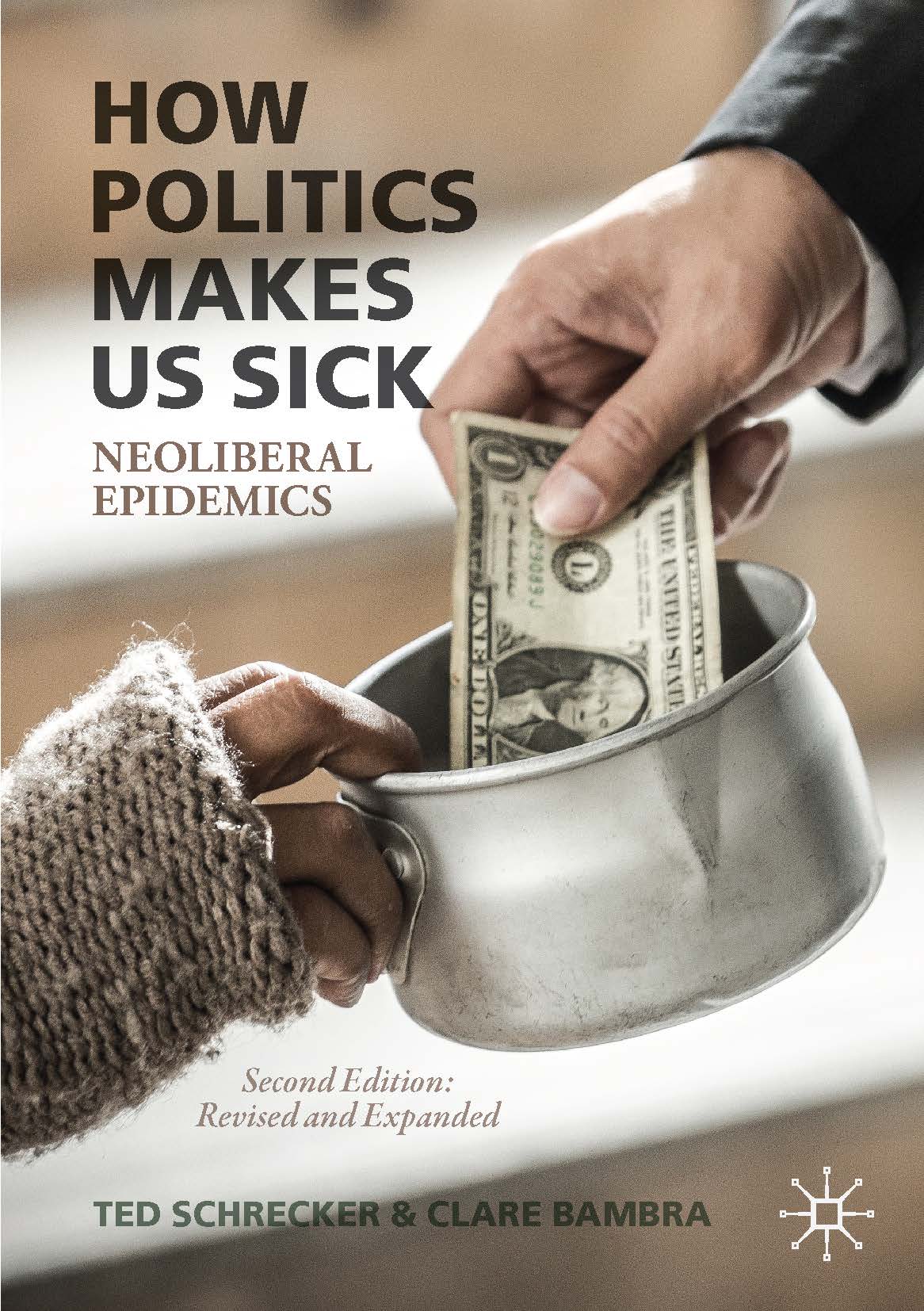
In 2025 colleague Clare Bambra and I published the second, expanded edition of our book How Politics Makes Us Sick: Neoliberal Epidemics. A decade of accumulated evidence since the first edition appeared in 2015 further supported our core argument that health inequalities driven by interconnected epidemics of inequality, insecurity and austerity can only be explained with reference to neoliberalism, which by the mid-1990s had become “the central ideological force in the Western world”1 and if anything has since strengthened its hold on political imaginations and political processes alike. As in the book, most of the examples used here are drawn from the United States and the United Kingdom, the two large rich countries that have travelled farthest down the neoliberal path. They are not outliers so much as warnings of what is to come – a point to which we in Canada do not pay nearly enough attention.
The reach of the inequality machine is truly global, as documented in the indispensable World Inequality Report 2022. Gabriel Zucman won the 2023 John Bates Clark medal of the American Economic Association, and is one of the lead researchers at the World Inequality Lab, which produced the Report. He has shown the scale of the machine’s impact by calculating that the wealth of the world’s US dollar billionaires (about 2,900 households, roughly one in a million worldwide in 2024) grew from a figure comparable to 3 percent of global GDP in 1987 to almost 14 percent in 2024. In the United States, New York Times journalists recently reported that the number of billionaires increased from 200 in 2004 to more than 900 in 2025, enabled most recently by rising share prices and the personal and corporate income tax cuts passed during the first Trump administration (and now extended).
At the other end of the economic spectrum, a 2020 RAND Corporation study concluded that: “Fundamentally, the majority of workers did not share in the benefits of economic growth to any significant degree” between 1975 and 2018. Far from trickling down, the benefits of growth in the US were trickling upwards: labour market changes and tax policy redistributed at least US$47 trillion from the bottom 90 percent of the income distribution to the top 10 percent. A later update found that the trend intensified between 2018 and 2023. Many workers for 20 large US service sector employers like Wal-Mart are paid so little that they are eligible for food stamps (government vouchers for groceries) and Medicaid (the public health insurance program for the very poor). In its annual survey of US households, the Federal Reserve Board found in 2023 that “13 percent of all adults said they would be unable to pay” an emergency expense of $400 “by any means,” including borrowing or selling assets.
In the United Kingdom the number of workers on zero-hours contracts, which guarantee no minimum hours of work in a given week, more than quintupled from 168,000 is 2010 to 1,059,000 in 2020. The number of people living in destitution, the most extreme form of poverty, more than doubled from 1.55 million in 2017 to 3.8 million in 2022. And in Canada one-quarter of the population “lived in households that reported experiencing some form of food insecurity” in 2023, including almost half the country’s single-parent households. One in ten residents of Toronto, Canada’s largest city, visited a food bank at least once in 2023 – this in a country where the top one-thousandth (0.1 percent) of the country’s households own more than 11 percent of the country’s overall wealth.
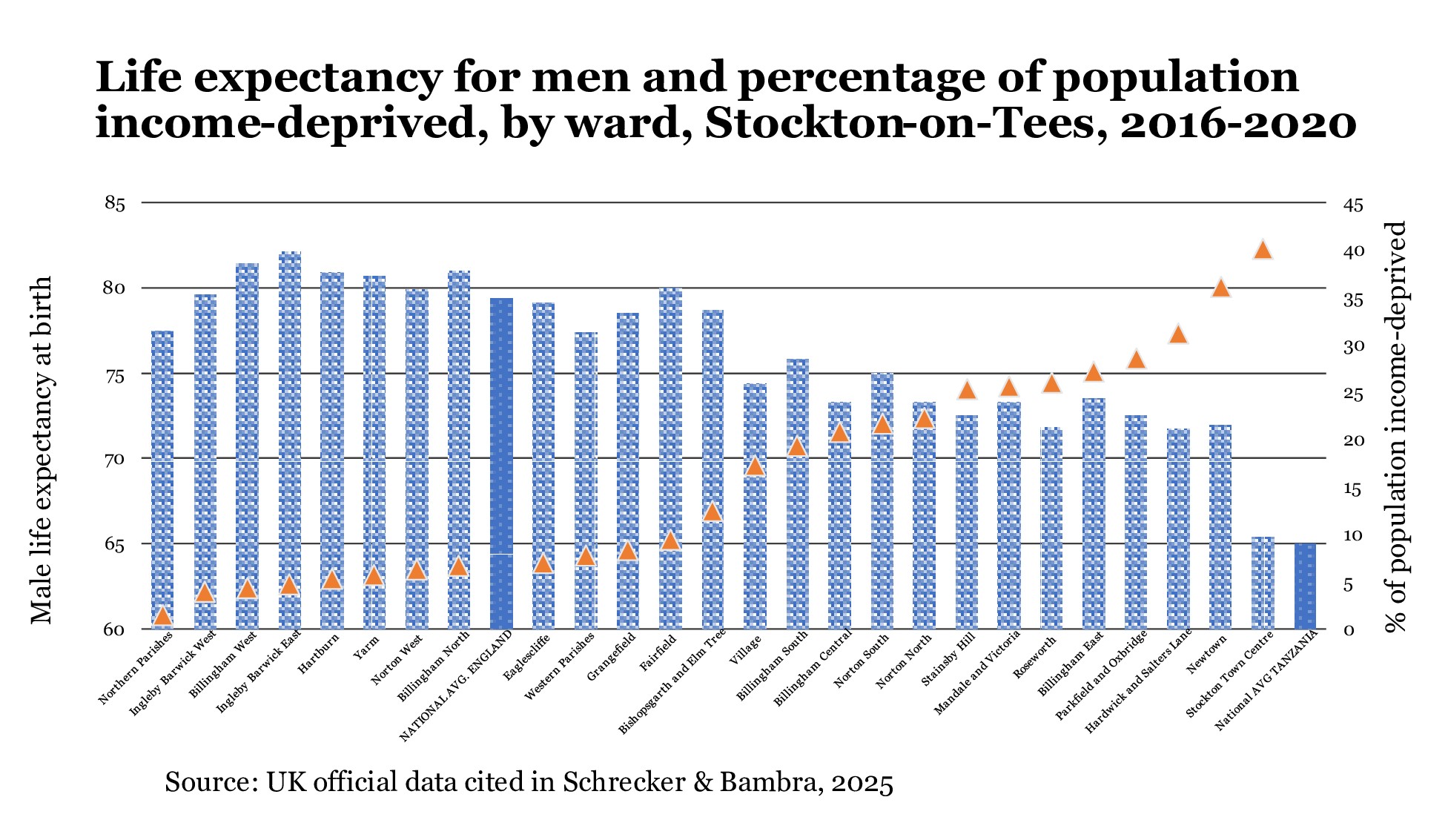
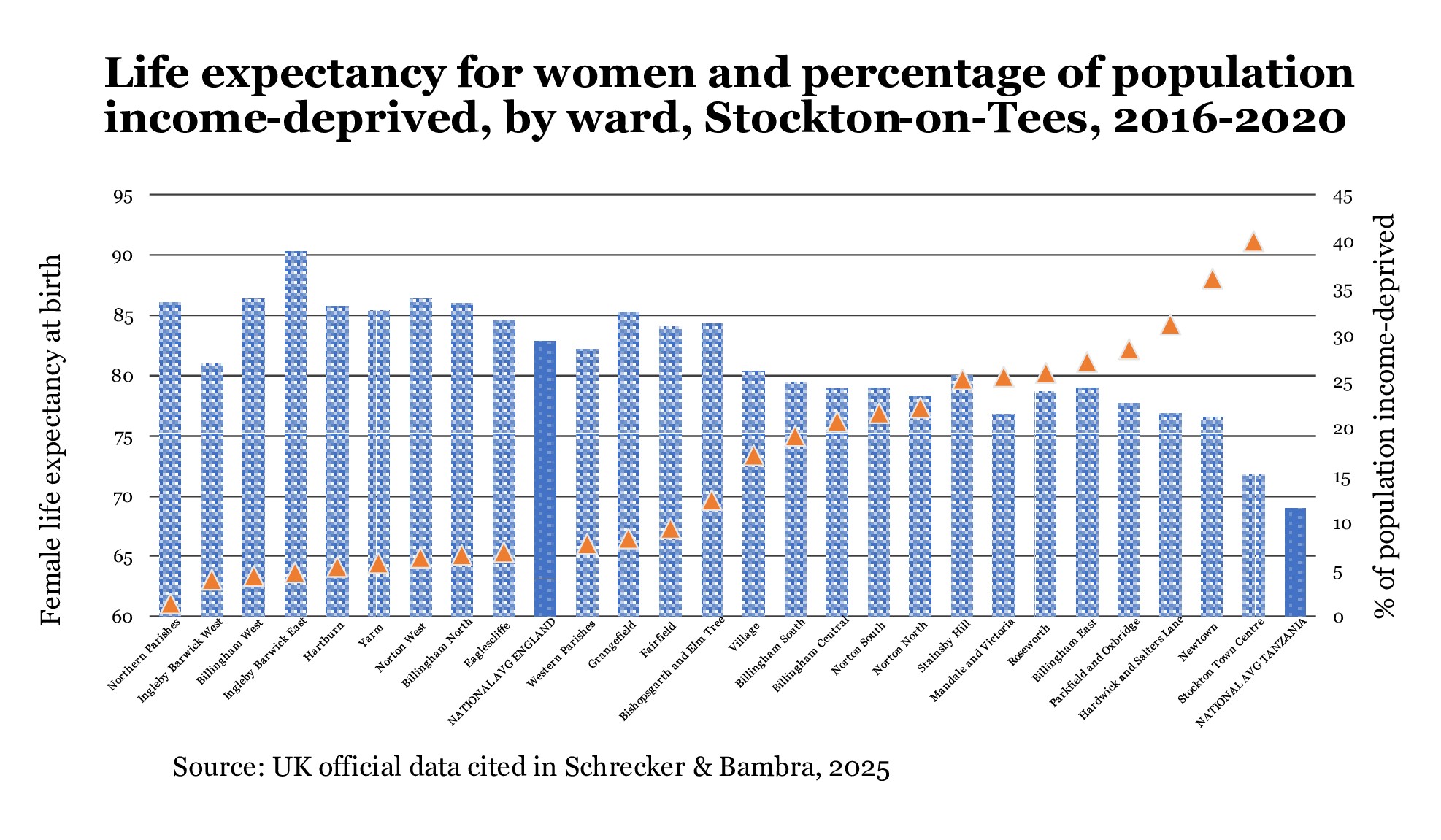
What has all this to do with health? In Stockton-on-Tees, a small deindustrialized city described by the BBC in 2018 as “England’s most unequal town,” the pre-pandemic difference in life expectancy between wards (small areas with populations of a few thousand) was comparable to the difference in national average life expectancy between England and Tanzania. The graphs show a strong correlation between lower life expectancy and a more deprived population (triangles, right-hand vertical axis) – a socioeconomic gradient that is almost ubiquitous. In the US, where the effects of material deprivation are compounded by a long history of racial segregation and a health care system that rations most care on the basis of ability to pay, life expectancy differences are as high as 30 years.
Sir Michael Marmot, who chaired the World Health Organization’s Commission on Social Determinants of Health, wrote with colleagues in 2010 that: “It is hard to see how even ideologically driven commentators could think that having sufficient money to live on is irrelevant to health inequalities.” (Sir Michael is a perennial optimist.) Beyond obvious impacts of material deprivation such as food and housing insecurity, a variety of pathways connect “low social position” with negative health outcomes by way of what a far-reaching review by Dame Margaret Whitehead and colleagues called “loss of control over destiny.” A central point of our book is that neoliberalism is indispensable to explaining who ends up in low social positions, and how.
The physiological dimensions of chronic high levels of stress are crucial to understanding the pathways identified by Whitehead and colleagues, even as stress remains studiously neglected by most public health researchers – showing that they urgently need to rethink their entire methodological armamentarium. The World Health Organization’s failure to consider poor socioeconomic circumstances as a risk factor for noncommunicable diseases in an action plan targeting mortality reductions by 2025 is another demonstration. Above and beyond quotidian stresses associated with (for example) balancing multiple insecure jobs, unaffordable groceries and housing, and inadequate or nonexistent non-automotive transport, a broader loss of control arises from a political world where outcomes are increasingly predetermined by oligarchs and symbiotic semi-permanent political classes. How these dynamics will play out in the near future is the topic of the second part of this posting.
Notes
[1] A. Przeworski et al., Sustainable Democracy (Cambridge: Cambridge University Press, 1995), p. 5. The book reported the findings of a multidisciplinary group of social scientists assessing the prospects for democracy after the fall of the Soviet Union.