IN A NUTSHELL Author's NoteThis article reflects the evolution of a line of research developed over recent years within the framework of the Sustainable Health Equity Movement (SHEM). The conceptual proposal presented here has been deeply inspired by the Cuban experience and by more than three decades of professional, academic and international cooperation with Cuban institutions, universities, researchers, health professionals and local communities. The author firmly believes that Cuba's long-standing commitment to universal health care, education, solidarity and social justice represents a valuable contribution to global thinking on human development. At the same time, the current challenges faced by the country provide an opportunity to further strengthen these principles through innovation, local development, scientific cooperation and new approaches to sustainable public policy evaluation. This work is therefore offered in a spirit of respect, dialogue and shared learning. It does not advocate a particular political or economic model. Rather, it seeks to contribute to the scientific discussion on how societies can better transform available resources—both territorial and globally shared—into health, human capabilities, social equity and sustainable well-being for present and future generations

By Juan Garay *
Former Head of European Union Cooperation in Cuba (2017–2023)
Visiting Professor of Sustainable Equity in Cuban universities including ELAM, UCLV and UNAH
Co-Chair of the Sustainable Health Equity Movement (SHEM)
By the same Author on PEAH: see HERE
Sustainable Health Equity
A Scientific Framework for Strengthening Human Development Drawing on Cuba’s Experience and Contemporary Challenges
With profound respect and gratitude for their enduring commitment to health, education, solidarity and social justice.

May this work contribute, however modestly, to strengthening those principles in the face of today's challenges, while fostering dialogue, shared learning and cooperation among all those working towards a healthier, fairer and more sustainable future.
I. Abstract
Background
The twenty-first century faces the unprecedented challenge of advancing human well-being while simultaneously promoting social equity and environmental sustainability. Although economic growth, human development and health equity have traditionally been assessed through separate frameworks, there remains a need for integrated approaches capable of evaluating how effectively societies transform available resources into sustainable improvements in people’s lives. Cuba’s long-standing commitment to universal health care, education and social justice, together with the challenges it currently faces, provides a particularly valuable context for exploring such approaches.
Objective
To present the conceptual foundations of Sustainable Health Equity (SHE) and introduce the Sustainable Health Equity Tools (SHET), an open methodological toolbox designed to assess the capacity of societies to transform territorial resources and shared global public goods into health, human capabilities and sustainable well-being, illustrating its relevance through the Cuban experience.
Methods
The proposed framework integrates the capabilities approach, the social determinants of health, sustainable development, ecological economics and the concept of global public goods into a unified analytical perspective. It introduces the Sustainable Health Equity Space (SHES) as a reference model combining indicators of health outcomes, resource availability, equity and sustainability. SHET is designed for application at international, national and local levels, enabling the identification of good practices, inefficiencies and opportunities for evidence-informed policy improvement.
Results
Sustainable Health Equity provides a multidimensional framework for understanding development beyond economic performance alone. By focusing on societies’ capacity to transform available resources into healthy, equitable and sustainable lives, SHET supports comparative analyses across countries and within territories, facilitating public policy evaluation, local development and international cooperation. The Cuban experience illustrates both the enduring value of investment in universal social policies and the importance of continuously strengthening innovation, territorial development and sustainable governance in response to evolving global challenges.
Conclusions
Sustainable Health Equity offers a scientific framework that integrates health, equity, sustainability and human development within a unified perspective. Through the Sustainable Health Equity Tools (SHET), it provides practical instruments to support evidence-informed decision-making, participatory governance and continuous institutional learning. While inspired in part by Cuba’s experience, the framework is intended for broad international application and invites further empirical validation, interdisciplinary collaboration and the progressive development of new analytical tools that contribute to the common good.
Keywords: Sustainable Health Equity; Human Development; Health Equity; Sustainable Development; Social Determinants of Health; Human Capabilities; Public Policy; Global Public Goods; Artificial Intelligence; International Cooperation; Cuba.
II. Introduction
Humanity is entering an era in which health, social equity, environmental sustainability and technological change are becoming increasingly interconnected. Climate change, biodiversity loss, demographic transitions, widening inequalities, geopolitical tensions and the rapid expansion of artificial intelligence are reshaping the conditions under which societies pursue human development. These challenges call for analytical frameworks capable of integrating multiple dimensions of well-being and guiding public policies towards long-term resilience and the common good (1–8).
Over recent decades, important advances have been made in understanding development beyond economic growth alone. The capabilities approach has highlighted the importance of expanding people’s substantive freedoms (1,2), while the social determinants of health framework has demonstrated that health outcomes largely depend on the social, economic and environmental conditions in which people are born, grow, live, work and age (3). Similarly, the Sustainable Development Goals (SDGs) have emphasized the interdependence of human development, environmental sustainability and social justice (4). Nevertheless, these perspectives have generally evolved through separate conceptual and methodological traditions, and there remains a need for approaches that integrate them into a common operational framework.
This article proposes Sustainable Health Equity (SHE) as an integrative scientific framework for understanding how societies transform available resources into healthy, equitable and sustainable lives. Rather than focusing exclusively on economic production or income distribution, SHE evaluates the capacity of societies to convert both territorial resources and shared global public goods into human capabilities, population health and sustainable well-being across generations.
To operationalize this framework, the paper introduces the Sustainable Health Equity Tools (SHET), an open methodological toolbox designed to support evidence-informed policy analysis at international, national and local levels. Within this toolbox, the Sustainable Health Equity Space (SHES) provides a multidimensional analytical model for comparing health outcomes with the resources available to achieve them, allowing the identification of reference experiences, structural inefficiencies, resource deficits and situations of unsustainable resource concentration.
Although conceived as a universally applicable framework, the present paper draws extensively on the Cuban experience. For more than six decades, Cuba has demonstrated that sustained investment in universal health care, education and social protection can achieve remarkable social outcomes despite severe economic constraints. At the same time, the country currently faces complex demographic, economic and geopolitical challenges that require continued innovation, territorial development and institutional learning. These circumstances make Cuba an especially relevant context for exploring approaches that seek to strengthen social justice while improving efficiency, sustainability and resilience.
Rather than evaluating a particular political or economic model, this article seeks to contribute to a broader scientific discussion on the principles that enable societies to translate available resources into human well-being. In this sense, Cuba is presented neither as an exception nor as a model to be replicated, but as a valuable source of experience from which internationally relevant lessons may be drawn.
The objectives of this paper are therefore threefold: (i) to present the conceptual foundations of Sustainable Health Equity; (ii) to introduce the Sustainable Health Equity Tools (SHET) and the Sustainable Health Equity Space (SHES) as practical instruments for policy analysis; and (iii) to illustrate their potential contribution through the Cuban experience while exploring their broader relevance for international cooperation, sustainable development and the governance of global public goods.
III. Conceptual Framework: Sustainable Health Equity
The concept of equity has traditionally been understood as the absence of unfair and avoidable differences in health, opportunities or access to essential services (1–3). While this perspective has profoundly influenced public health and social policy over recent decades, contemporary global challenges call for a broader understanding of equity that also incorporates sustainability, resilience and intergenerational responsibility.
This paper proposes Sustainable Health Equity (SHE) as a new conceptual framework for understanding equity in the twenty-first century. Rather than considering equity solely as the fair distribution of outcomes or opportunities, SHE defines equity as the capacity of societies to transform available territorial resources and shared global public goods into healthy, replicable and sustainable lives for present and future generations.
This definition introduces several complementary dimensions.
First, equity depends on the availability of resources, including natural assets, human capacities, institutional quality, scientific knowledge, financial resources and global public goods.
Second, equity depends on the efficiency and quality of transformation processes, through which societies convert these resources into health, education, capabilities, environmental sustainability and social well-being.
Third, equity requires that these achievements remain replicable and sustainable, ensuring that present gains do not compromise opportunities for other populations or future generations.
Consequently, Sustainable Health Equity is not defined by the absolute quantity of resources available, nor solely by the distribution of those resources, but by the capacity to achieve the highest attainable and sustainable levels of human well-being with fairness, solidarity and ecological responsibility.
This perspective also shifts attention from competition for scarce resources towards collaboration in generating and protecting shared global public goods, including scientific knowledge, climate stability, biodiversity, peace, digital commons and ethical governance of artificial intelligence. These collective assets increasingly determine the capacity of all societies to achieve equitable and sustainable development.
Within this framework, economic growth is understood not as an end in itself but as one possible means of expanding human capabilities and improving sustainable well-being. Likewise, technological innovation acquires value insofar as it contributes to reducing inequities, strengthening human dignity and protecting planetary systems.
The Cuban experience illustrates many of these principles. Decades of sustained investment in universal education, health care and social protection demonstrate the capacity of public policies to generate high levels of human development under conditions of limited material resources. At the same time, current demographic, economic and environmental challenges highlight the importance of continuously strengthening local innovation, institutional adaptability and sustainable governance while preserving the country’s enduring commitment to social justice and solidarity.
Sustainable Health Equity therefore provides both a normative vision and an operational foundation for evaluating how societies translate available resources into durable improvements in human well-being.
IV. Sustainable Health Equity Tools (SHET): An Operational Framework for Policy Analysis
The conceptual framework of Sustainable Health Equity (SHE) is operationalized through the Sustainable Health Equity Tools (SHET), an open methodological toolbox designed to support evidence-informed decision-making, policy evaluation and continuous institutional learning across different geographical and administrative levels.
Rather than proposing a single composite index, SHET provides a flexible set of analytical tools that enable societies to evaluate how effectively available resources are transformed into sustainable human well-being. This approach recognises that development pathways differ across countries and territories, while maintaining a common conceptual basis for comparison and shared learning.
The methodological framework is founded on three complementary analytical dimensions.
Resource Availability refers to the territorial and globally shared assets available to support human development. These include natural resources, financial capacity, infrastructure, scientific and technological knowledge, institutional quality, social capital, ecosystem services and access to global public goods such as climate stability, peace, international cooperation and digital knowledge.
Transformation Capacity describes the effectiveness with which societies convert these resources into population health, education, human capabilities, social cohesion, environmental sustainability and quality of life. This dimension incorporates the efficiency, equity, resilience and governance of public policies and institutions.
Sustainable Outcomes evaluate whether the resulting levels of well-being are not only high, but also socially equitable, environmentally sustainable and replicable over time without compromising opportunities for future generations or other populations.
Together, these dimensions provide a comprehensive framework for analysing the relationship between available resources and achieved well-being, moving beyond conventional measures based solely on economic production or expenditure.
Within SHET, the central analytical instrument is the Sustainable Health Equity Space (SHES) (Figure 1). SHES graphically represents the relationship between available resources and achieved levels of sustainable well-being, allowing territories to be classified according to their relative performance.
Rather than ranking territories in a linear manner, SHES identifies different development situations that require different policy responses. Territories located within the Sustainable Health Equity Zone demonstrate an effective and sustainable transformation of available resources into human well-being. Other territories may present resource deficits, indicating insufficient resources to achieve expected outcomes; transformation inefficiencies, where available resources are not translated into corresponding improvements in well-being; or resource accumulation, where high levels of resource availability coexist with outcomes that are either inefficient or ecologically unsustainable.
This analytical perspective shifts policy attention from simply increasing resource availability towards improving the quality, equity and sustainability of transformation processes. It also facilitates the identification of reference experiences from which other territories may learn, fostering collaboration rather than competition.
The SHET toolbox is designed to operate across multiple scales. Internationally, it enables comparisons among countries facing different development trajectories. Nationally, it supports analyses of regional and sectoral inequalities. Locally, it assists municipalities and communities in identifying strengths, constraints and opportunities for improving sustainable well-being according to their own contexts.
Importantly, SHET is conceived as an open and evolving methodological framework. As new scientific evidence, technologies and social priorities emerge, additional indicators and analytical modules can be incorporated while preserving the conceptual coherence of Sustainable Health Equity. In this sense, SHET is intended not as a static measurement system but as a living scientific platform supporting continuous learning, participatory governance and adaptive public policy.
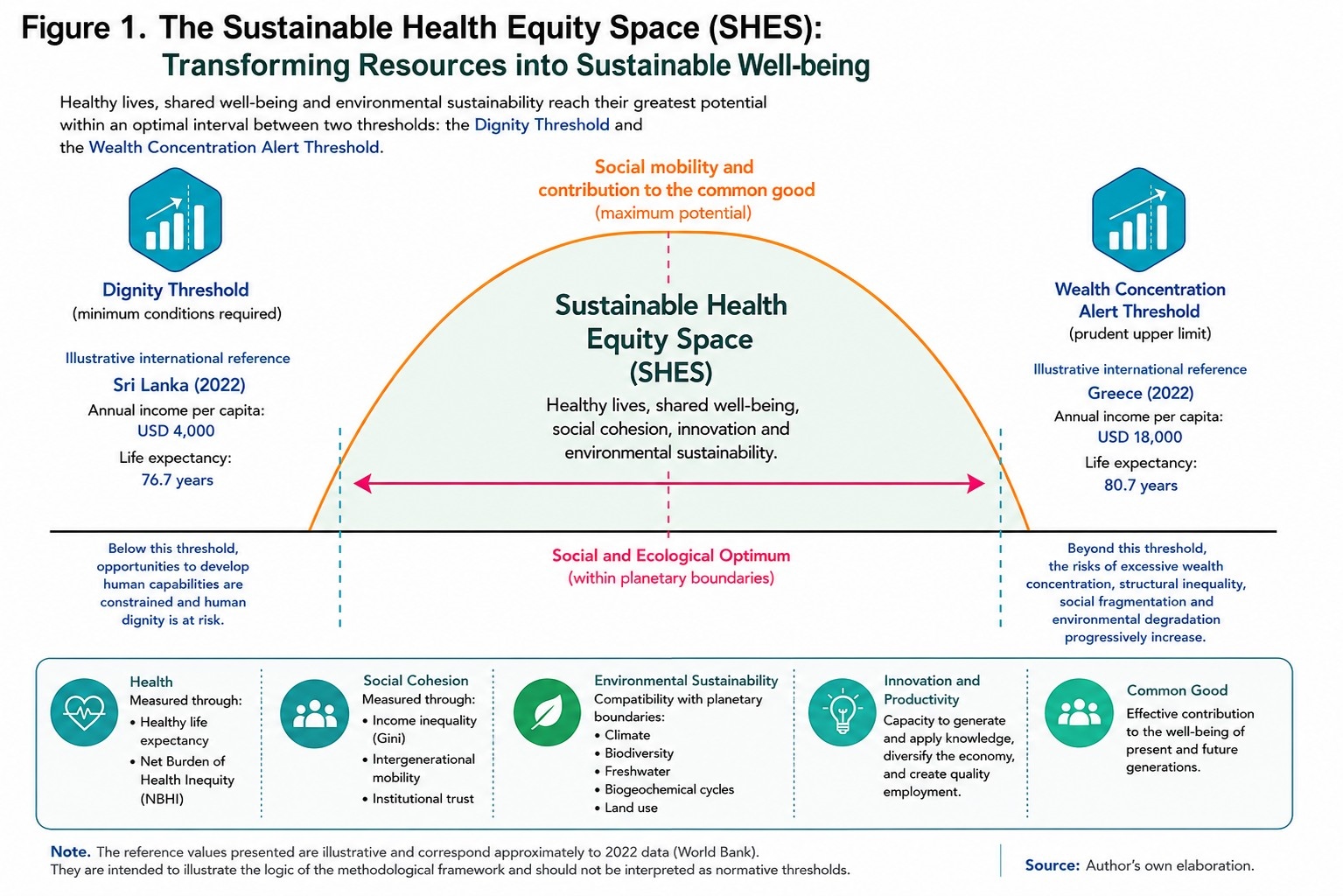
Figure 1 synthesises the conceptual architecture of Sustainable Health Equity. It illustrates the optimal space within which societies transform territorial resources and shared global public goods into healthy, dignified, replicable and sustainable lives, while respecting both minimum dignity requirements and ecological and social limits associated with excessive resource concentration.
V. Applying Sustainable Health Equity to Cuba’s Contemporary Challenges
Cuba occupies a distinctive position in the global landscape of human development. For more than six decades, the country has maintained a strong commitment to universal health care, education and social protection, achieving levels of health and human development that compare favourably with those of many countries with substantially greater economic resources. These achievements have been widely documented and continue to provide valuable lessons for global health and social policy.
At the same time, Cuba currently faces a complex combination of demographic, economic, environmental and geopolitical challenges that increasingly influence the sustainability of these achievements. Population ageing, migration, economic constraints, climate-related risks, technological transformation and changing patterns of international cooperation require continuous adaptation while preserving the constitutional principles of equity, solidarity and universal social rights.
Within this context, Sustainable Health Equity (SHE) offers a complementary analytical perspective. Rather than evaluating political or economic systems, it seeks to understand how available resources can be more effectively transformed into sustainable well-being while safeguarding the ethical foundations that have historically characterised Cuban social development.
The Sustainable Health Equity Tools (SHET) provide practical instruments for analysing these processes across different territorial scales. At the national level, SHET can support the assessment of how resources, public policies and institutional capacities contribute to health, human development and environmental sustainability. At provincial and municipal levels, the framework enables a more detailed understanding of local diversity, recognising that territories with similar resource endowments may achieve markedly different outcomes depending on governance, social participation, innovation and institutional effectiveness.
Particularly relevant is the application of the Sustainable Health Equity Space (SHES) to municipal analysis. By comparing resource availability with indicators of sustainable well-being, municipalities can be grouped according to their relative performance.
Some municipalities may constitute Sustainable Health Equity reference areas, achieving excellent health and social outcomes despite modest resource availability through effective local governance, strong community participation and the sustainable management of natural and social assets. These experiences may provide valuable lessons for other territories.
Other municipalities may exhibit transformation gaps, where relatively abundant resources do not translate into comparable improvements in population well-being, suggesting opportunities to strengthen institutional performance, coordination and policy implementation.
Conversely, some municipalities may experience resource constraints, where favourable governance and social commitment are limited by insufficient material or financial resources. In such cases, SHET can help identify priorities for territorial investment and intergovernmental solidarity.
Finally, SHES also makes it possible to identify territories where resource availability exceeds levels compatible with equitable and environmentally sustainable development, highlighting opportunities to improve efficiency, strengthen solidarity and optimise the allocation of resources for the benefit of society as a whole.
Beyond territorial classification, the principal value of SHET lies in promoting collective learning. Rather than ranking municipalities according to success or failure, the framework encourages dialogue among territories, enabling local experiences, innovations and good practices to be shared across the country.
In this regard, institutions dedicated to local development and territorial innovation—such as the Centre for Local and Community Development (CEDEL) and the broader scientific and institutional networks working on sustainable local development in Cuba—could play an important role in supporting participatory implementation, methodological refinement and continuous learning. Their accumulated experience in community participation, territorial governance and local innovation provides a strong foundation for integrating Sustainable Health Equity into existing development processes.
VI. Knowledge, Global Public Goods and Artificial Intelligence: New Frontiers for Sustainable Health Equity
The growing interdependence of contemporary societies has expanded the range of factors that shape human well-being beyond national boundaries. Climate stability, biodiversity, peace, scientific knowledge, digital infrastructures, pandemic preparedness and ethical governance increasingly function as global public goods, generating benefits that transcend borders and whose protection requires collective responsibility and international cooperation (17–20).
Within the framework of Sustainable Health Equity (SHE), these global public goods should not be regarded simply as external contextual factors, but as essential components of societies’ resource endowment. The capacity of countries and communities to achieve sustainable well-being increasingly depends not only on their territorial assets but also on equitable access to globally shared knowledge, technologies and collaborative networks.
Among these global public goods, knowledge occupies a unique position. Unlike finite material resources, scientific knowledge expands through sharing and collaboration. When generated, disseminated and applied under principles of openness, scientific integrity and social responsibility, knowledge becomes a powerful driver of health, innovation and sustainable development. Consequently, reducing inequalities in the production, accessibility and application of knowledge constitutes an increasingly important dimension of Sustainable Health Equity.
Artificial Intelligence (AI) represents one of the most transformative developments in this context. Properly governed, AI can strengthen health systems, improve epidemiological surveillance, support clinical decision-making, optimise resource allocation, accelerate scientific discovery and facilitate more comprehensive analyses of complex social and environmental interactions. It also offers unprecedented opportunities to develop adaptive policy-support systems capable of continuously learning from new evidence.
However, AI also introduces important ethical challenges. Unequal access to computational infrastructure, biased algorithms, concentration of technological capabilities, insufficient transparency and weak democratic oversight risk widening existing inequities if these technologies evolve primarily according to commercial or geopolitical interests.
From the perspective of Sustainable Health Equity, AI should therefore be understood not merely as a technological innovation but as a global public good whose governance should be guided by principles of equity, transparency, accountability, scientific openness and the common good. The objective is not simply to increase technological capacity, but to ensure that digital innovation contributes to healthier, more equitable and environmentally sustainable societies.
Within the Sustainable Health Equity Tools (SHET), AI can also function as an analytical instrument. By integrating diverse sources of epidemiological, environmental, economic and social data, AI-assisted tools can support policy-makers in identifying transformation gaps, evaluating alternative policy scenarios and monitoring progress towards Sustainable Health Equity. Importantly, such systems should complement rather than replace human deliberation, democratic participation and ethical judgement.
The implications extend well beyond national policymaking. As global challenges become increasingly interconnected, scientific cooperation and open knowledge-sharing become strategic investments in humanity’s collective capacity to improve sustainable well-being. International collaboration in research, education, digital technologies and public health should therefore be viewed not simply as development assistance but as a shared responsibility for strengthening global resilience.
In this perspective, Sustainable Health Equity provides a conceptual bridge between territorial development and global cooperation. It highlights that long-term human well-being depends not only on how societies manage their own resources, but also on how effectively they contribute to generating, protecting and sharing the global public goods upon which all societies increasingly depend.
VII. International Cooperation and Global Solidarity for Sustainable Health Equity
The increasing interconnectedness of global challenges calls for a renewed understanding of international cooperation. Climate change, pandemics, biodiversity loss, demographic transitions, food security, migration and the rapid evolution of digital technologies increasingly transcend national borders and cannot be effectively addressed through isolated national responses.
While international cooperation has made significant contributions to health and development over recent decades, existing frameworks have often remained fragmented, donor-driven and predominantly focused on financial transfers or sector-specific interventions. Although these approaches have generated important achievements, they have not always addressed the structural determinants of global inequities or promoted sufficiently balanced partnerships based on mutual learning, shared responsibility and the stewardship of global public goods.
From the perspective of Sustainable Health Equity (SHE), international cooperation should therefore be understood not primarily as assistance from wealthier to less wealthy countries, but as a collaborative process through which all societies jointly strengthen their capacity to generate, protect and share the global public goods upon which sustainable human development increasingly depends.
This perspective recognises that all countries simultaneously contribute to and benefit from shared global assets, including scientific knowledge, climate stability, biodiversity, public health security, peace, digital infrastructures and the ethical governance of Artificial Intelligence. Consequently, cooperation becomes a reciprocal investment in humanity’s common future rather than a unidirectional transfer of resources.
However, Sustainable Health Equity also suggests that collaboration alone is unlikely to be sufficient. Persistent global inequalities indicate that a more ambitious architecture of equitable international redistribution will be required if all people are to enjoy the minimum material conditions necessary for a life in dignity.
Within the SHE framework, every individual should have access to a minimum level of resources above a dignity threshold, ensuring the real opportunity to develop fundamental human capabilities. At the same time, Sustainable Health Equity recognises that there are also excess thresholds, beyond which additional consumption contributes progressively less to human well-being while generating disproportionate environmental degradation, resource depletion or social imbalance.
This dual perspective allows Sustainable Health Equity to distinguish between economic activity that genuinely contributes to sustainable well-being and what may be described as “toxic GDP”—economic production and consumption whose environmental and social costs exceed their contribution to human flourishing. Redirecting part of this excess economic activity towards equitable redistribution would simultaneously reduce ecological pressures and strengthen global social justice.
Illustrative analyses developed within the Sustainable Health Equity framework suggest that guaranteeing universal access to material living conditions above the dignity threshold could require annual redistributive flows on the order of US$7 trillion, approximately forty times current levels of Official Development Assistance. While substantial, this represents only a modest share of global economic output and should be understood as a long-term investment in global stability, human development and shared prosperity rather than as a simple financial transfer.
Importantly, such redistribution would not necessarily require continued global economic expansion. On the contrary, progressively reducing economic activity beyond ecologically sustainable levels could create the fiscal and productive space needed both to finance universal dignity and to accelerate the transition towards more sustainable patterns of production and consumption.
Preliminary analyses further suggest that, after ensuring universal living conditions above the dignity threshold, more than US$10 trillion annually could remain available for collaborative investment in global public goods. These investments could support scientific research, education, global health, pandemic preparedness, biodiversity conservation, climate resilience, open knowledge infrastructures, ethical Artificial Intelligence and other strategic assets whose benefits extend across countries and generations.
Within this perspective, redistribution and collaboration become complementary pillars of international cooperation. Redistribution enables all societies to participate meaningfully in sustainable development, while collaborative investment accelerates the generation of knowledge and innovations that benefit humanity as a whole.
The Sustainable Health Equity Tools (SHET) provide a common analytical framework for assessing these processes. Beyond measuring financial inputs or project outputs, SHET evaluates how cooperation strengthens institutional capacity, territorial resilience, scientific collaboration, equitable access to global public goods and the long-term transformation of resources into sustainable well-being.
This perspective is particularly relevant for countries such as Cuba. Throughout its contemporary history, Cuba has made internationally recognised contributions to global health through medical education, international medical cooperation, biotechnology, disaster response and the promotion of universal health care. At the same time, current economic constraints substantially limit the material resources available to sustain these achievements. When purchasing power is considered using exchange rates that more closely reflect actual access to internationally traded goods and services, Cuba’s effective per-capita income may fall below the proposed dignity threshold despite its comparatively high levels of education, health and social development. This illustrates the importance of evaluating development through the combined lens of resource availability, transformation capacity and sustainable well-being rather than through conventional macroeconomic indicators alone.
Ultimately, Sustainable Health Equity proposes a renewed vision of international cooperation founded upon three complementary principles: universal dignity, ensuring that no person falls below the minimum conditions required for a healthy and fulfilling life; ecological sustainability, ensuring that development remains within planetary boundaries; and collaborative stewardship, whereby societies collectively invest their knowledge, resources and innovation in the protection and expansion of global public goods for present and future generations.
Rather than replacing existing development frameworks, this approach seeks to complement them by providing a broader ethical and analytical foundation for international cooperation in the twenty-first century—one that places solidarity, reciprocity and shared responsibility at the centre of sustainable human development.
VIII. Discussion
The Sustainable Health Equity framework proposed in this paper seeks to contribute to an evolving international dialogue on how societies can simultaneously advance human well-being, social justice and environmental sustainability in an increasingly interconnected world. Rather than replacing existing theories of health equity, human development or sustainable development, SHE builds upon these traditions while proposing a broader understanding of equity that integrates resource availability, transformation capacity and sustainable well-being within a single conceptual framework.
This perspective recognises that equity cannot be understood solely in terms of the distribution of income, opportunities or health outcomes. Instead, Sustainable Health Equity defines equity as the capacity of societies to transform both territorial resources and shared global public goods into healthy, replicable and sustainable lives for present and future generations. In doing so, it introduces a dynamic understanding of equity that simultaneously incorporates efficiency, solidarity, ecological sustainability and intergenerational responsibility.
One of the principal contributions of this work is the distinction between the conceptual framework (SHE), the operational methodological toolbox (SHET) and the analytical model represented by the Sustainable Health Equity Space (SHES). This architecture allows the framework to evolve progressively as new scientific knowledge, indicators and analytical methods become available, while maintaining conceptual coherence across different scales of application.
The Cuban experience provides an especially meaningful context for developing this framework. Few countries have demonstrated such a sustained commitment to universal health care, education and social justice under prolonged economic constraints. At the same time, Cuba’s current demographic, economic and environmental challenges illustrate the importance of continuously strengthening governance, territorial development, scientific innovation and international collaboration while preserving the ethical principles that have guided its social achievements. In this sense, the framework is offered as a contribution to Cuba’s ongoing efforts to strengthen justice, solidarity and sustainable development, while also generating lessons that may be relevant to other countries facing different but equally complex challenges.
Beyond Cuba, Sustainable Health Equity has potential applications across multiple geographical and institutional scales. Internationally, it may contribute to comparative analyses of development trajectories and global cooperation. Nationally, it offers a framework for evaluating territorial inequalities and policy effectiveness. Locally, it can support participatory planning processes by identifying municipalities and communities that achieve outstanding outcomes despite limited resources, as well as territories where governance, investment or resource allocation could be strengthened.
The framework also opens new avenues for integrating advances in data science and Artificial Intelligence into public policy. Rather than replacing human judgement, AI has the potential to strengthen evidence-informed decision-making by integrating complex datasets, identifying emerging patterns and supporting continuous institutional learning. Ensuring that these technologies remain transparent, equitable and oriented towards the common good should itself be regarded as an essential dimension of Sustainable Health Equity.
At the global level, the framework suggests that the future of equity will increasingly depend on humanity’s capacity to generate, protect and share global public goods. Scientific knowledge, climate stability, biodiversity, peace and ethical digital infrastructures are no longer external determinants of development but integral components of societies’ opportunities to achieve sustainable well-being. Consequently, international cooperation should evolve beyond traditional development assistance towards more balanced partnerships combining equitable redistribution, collaborative investment and shared stewardship of humanity’s common assets.
The present work should also be understood as an invitation to further scientific development. The concepts, indicators and tools proposed here require empirical validation across diverse geographical contexts and policy settings. Future research should refine the measurement of transformation capacity, develop composite SHET indicators, evaluate municipal and national applications, explore AI-supported analytical platforms and assess the implications of Sustainable Health Equity for global governance and financing.
Ultimately, Sustainable Health Equity should be viewed not as a fixed model but as an evolving scientific framework. Its long-term value will depend on continued dialogue among researchers, policy-makers, communities and international institutions committed to advancing healthier, fairer and more sustainable societies.
IX. Conclusions
This paper proposes Sustainable Health Equity (SHE) as a new scientific framework for understanding how societies transform available territorial resources and shared global public goods into healthy, dignified, replicable and sustainable lives for present and future generations.
Building upon previous advances in health equity, the capabilities approach, sustainable development and ecological economics, SHE introduces a broader conception of equity that integrates three complementary dimensions: resource endowment, transformation capacity, and sustainable well-being. In doing so, it moves beyond assessing the distribution of resources or outcomes alone, towards evaluating the effectiveness, fairness and sustainability with which societies convert available opportunities into human flourishing.
To support practical implementation, the paper introduces the Sustainable Health Equity Tools (SHET) as an open methodological toolbox and the Sustainable Health Equity Space (SHES) as a visual and analytical model for evaluating development across international, national and local scales. Together, these instruments enable the identification of reference experiences, transformation gaps, resource deficits and situations of unsustainable resource use, providing evidence to support continuous policy improvement and mutual learning.
The Cuban experience has served as the principal inspiration for this work. Over more than six decades, Cuba has demonstrated the enduring value of sustained investment in universal health care, education and social solidarity, while its contemporary demographic, economic and environmental challenges illustrate the importance of continuously strengthening local innovation, institutional learning, scientific collaboration and sustainable governance. The framework is offered with deep respect for Cuba’s historical commitment to social justice and with the hope that it may contribute constructively to ongoing national reflection on how these principles can be further strengthened under changing national and global circumstances.
Beyond Cuba, Sustainable Health Equity provides a framework that may be applicable to countries at all levels of development. It offers opportunities to strengthen evidence-informed public policy, territorial planning, international cooperation and the governance of global public goods. In particular, it highlights the growing importance of scientific knowledge, ethical Artificial Intelligence, climate stability, biodiversity and peace as shared assets whose protection increasingly determines humanity’s collective capacity to achieve sustainable well-being.
The framework also proposes a renewed vision of international cooperation. Lasting progress towards Sustainable Health Equity will require not only stronger collaboration among nations but also more equitable redistribution of opportunities and resources, ensuring that every person can live above a universal dignity threshold while humanity progressively reduces unsustainable patterns of production and consumption. At the same time, societies can increasingly invest their collective capacities in generating and protecting global public goods that benefit present and future generations alike.
This article should be regarded as the beginning rather than the conclusion of a scientific endeavour. Future research will be needed to refine indicators, validate the methodology across diverse settings, strengthen participatory applications at municipal and national levels, explore AI-supported analytical platforms and further develop the ethical, economic and governance dimensions of Sustainable Health Equity.
Ultimately, Sustainable Health Equity is not simply a framework for measuring development. It is an invitation to rethink development itself: to understand progress not as the accumulation of wealth, but as humanity’s growing capacity to share resources fairly, transform them wisely and sustainably, and expand the opportunities for all people to live healthy, dignified and meaningful lives in harmony with one another and with nature.
X. Acknowledgements
The author wishes to express his deepest gratitude to the Cuban people, whose enduring commitment to health, education, solidarity and social justice has been a constant source of inspiration throughout more than three decades of professional collaboration, research and friendship.
Special thanks are extended to the many Cuban institutions, universities, researchers, health professionals, local communities and public servants who have generously shared their knowledge, experience and commitment to improving people’s lives. Their dedication has profoundly shaped the ideas presented in this work.
The author also gratefully acknowledges the many international colleagues, academic collaborators and institutions who, over the years, have contributed through dialogue, scientific exchange and shared reflection on health equity, sustainable development, international cooperation and global public goods.
Finally, sincere appreciation is extended to the members of the Sustainable Health Equity Movement (SHEM) and the Valyter Ecovillage, whose daily commitment to solidarity, care for nature and community living continues to inspire the practical development of the principles described in this article.
Use of Artificial Intelligence
Artificial Intelligence was used as a scientific writing support tool during the preparation of this manuscript. AI-assisted editing contributed to improving the linguistic quality of the text and facilitated the organisation of references. All scientific concepts, methodological proposals, interpretations and final editorial decisions remain entirely the responsibility of the author.
Conflict of Interest
The author declares no financial or commercial conflicts of interest related to this work.
The concepts presented in this article have been developed independently as part of the Sustainable Health Equity research programme and are offered solely to stimulate scientific dialogue, methodological development and evidence-informed public policy.
Funding
This research received no specific grant from any funding agency in the public, commercial or not-for-profit sectors.
Data Availability
No primary datasets were generated or analysed during the preparation of this conceptual article.
Author Contributions
Juan Garay conceived the conceptual framework, developed the methodology, conducted the analysis and wrote the manuscript.
XI. References
- Sen A. Development as Freedom. Oxford: Oxford University Press; 1999.
- Nussbaum MC. Creating Capabilities: The Human Development Approach. Cambridge (MA): Harvard University Press; 2011.
- World Health Organization. Closing the Gap in a Generation: Health Equity Through Action on the Social Determinants of Health. Geneva: WHO; 2008.
- United Nations. Transforming our World: The 2030 Agenda for Sustainable Development. New York: United Nations; 2015.
- Raworth K. Doughnut Economics: Seven Ways to Think Like a 21st-Century Economist. London: Random House Business Books; 2017.
- Rockström J, Steffen W, Noone K, Persson Å, Chapin FS III, Lambin EF, et al. A safe operating space for humanity. Nature. 2009;461:472–475.
- UNESCO. Recommendation on the Ethics of Artificial Intelligence. Paris: UNESCO; 2021.
- World Health Organization Council on the Economics of Health for All. Health for All: Transforming Economies to Deliver What Matters. Geneva: WHO; 2023.
- Garay J. From Equality to Sustainable Health Equity. PEAH – Policies for Equitable Access to Health. 2017.
- Garay J. Net Burden of Health Inequity (nBHiE): methodological framework. PEAH-Policies for Equitable Access to Health. 2024.
- Garay J. Identifying International Sustainable Health Models. PEAH. 2024.
- Garay J. Distribution into a Normal Bell Curve Based on Equity. PEAH. 2024.
- Garay J. Enough is Enough and More is Too Much. PEAH. 2024.
- República de Cuba. Constitución de la República de Cuba. Gaceta Oficial de la República de Cuba. La Habana; 2019.
- Garay J. Empathetic Local Governance, Ecosystem-friendly Production and Consumption and Circular Economy. PEAH. 2024.
- Centro de Desarrollo Local y Comunitario (CEDEL). Publicaciones sobre desarrollo local y comunitario. La Habana.
- Ministerio de Ciencia, Tecnología y Medio Ambiente (CITMA). Documentos estratégicos sobre ciencia, innovación, medio ambiente y desarrollo territorial.
- República de Cuba. Plan Nacional de Desarrollo Económico y Social hasta 2030 .
- Garay J. Artificial Intelligence for Sustainable Health Equity. PEAH. 2025.
- Garay J. A New Political and Socio-economic Order is Urgently Needed and is Feasible. PEAH. 2023.
- World Health Organization. Health for All: Transforming Economies to Deliver What Matters. Geneva: WHO; 2023.
- United Nations. Pact for the Future. New York: United Nations; 2024.
- Intergovernmental Panel on Climate Change (IPCC). Sixth Assessment Report. Geneva: IPCC; 2023.
- United Nations. Our Common Agenda. New York: United Nations; 2021.
- Garay J. A Renewed International Cooperation Partnership Framework in the XXIst Century. PEAH. 2023.
- Garay J. Seville 2025: 5% for War, 0.25% for Life. PEAH. 2025.
- Popper KR. The Logic of Scientific Discovery. London: Routledge; 1959.
________
* MD, internal medicine, MSc Trop Med, MPH, independent researcher and co-founder of the Sustainable Health Equity Movement (SHEM) and Valyter Ecovillage, a community initiative promoting shared living, care for nature and sustainable development. He has worked for more than three decades in public health, health equity and international cooperation. He served as Coordinator of the European Union Cooperation Programme on Global Health and for Mexico (2013–2017) and Cuba (2017–2023). He is Visiting Professor at the Latin American School of Medicine (ELAM), the Marta Abreu Central University of Las Villas (UCLV) and the Agrarian University of Havana (UNAH) in Cuba; the Autonomous University of Chiapas (UNACH) in Mexico; Fundação Oswaldo Cruz (Fiocruz) in Brazil; the National School of Public Health (ENS) in Spain; and the University of California, Berkeley, USA. His research focuses on Sustainable Health Equity, global health, human development, international cooperation and the governance of knowledge and global public goods for the common good.