News Flash 645: Weekly Snapshot of Public Health Challenges

News Flash Links, as part of the research project PEAH (Policies for Equitable Access to Health), aim to focus on the latest challenges by trade and governments rules to equitable access to health in resource-limited settings

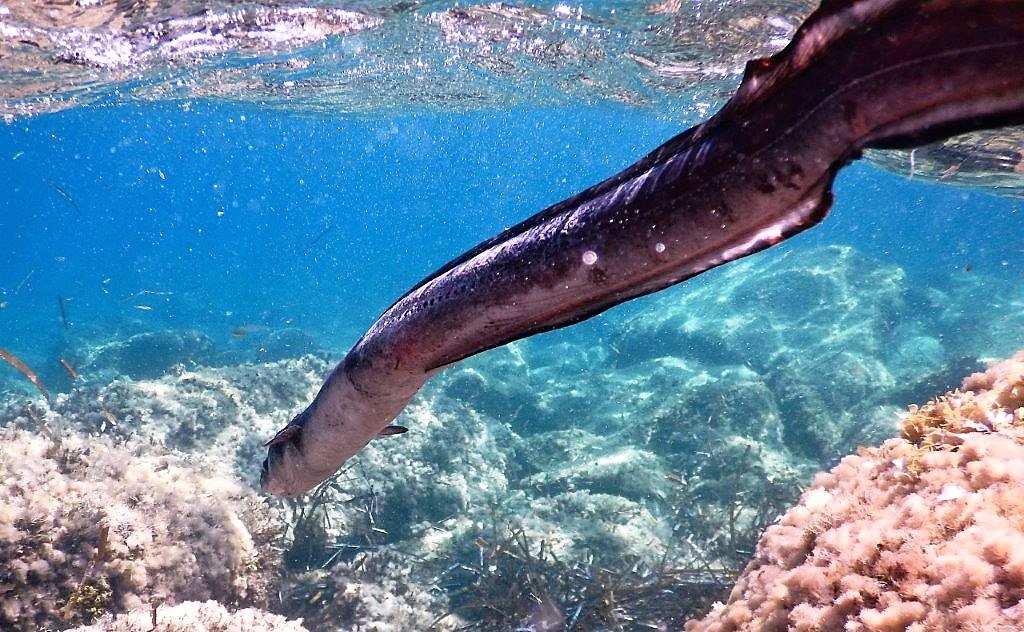
Conger eel (Conger conger)

News Flash 645

Weekly Snapshot of Public Health Challenges


Webinar registration: Rethinking Corporate Accountability in Global Health: Beyond Rankings & Voluntary Measures Dec 19, 2025

Wrapping up 2025: A tumultuous year for global public health law & policy

What Public Health Won and Lost in 2025

ODI Global in conversation with Francesca Albanese

2025: MPP’s challenging but rewarding year

Donors In A Post-Aid World December 2025 update

DNDi 2025 Year in Review

G-FINDER data portal: tracking funding for global health R&D

World leaders adopt a historic global declaration on noncommunicable diseases and mental health

Governments must take concrete actions to ensure equitable access to medical tools for noncommunicable diseases and mental health conditions

Universal Health Coverage Day 2025

Global health architecture reform must be anchored in UHC

From Law to Lives Saved: How the Maternal Newborn and Child Health Bill Can Deliver Universal Health Coverage

On Omelas, cynicism, and the hard work of reimagining Global Health

A Reflection on Lions: The New Future of Development Cooperation Coalition

How can middle-income countries successfully transition away from international health aid?

Can aid centre communities without decentring states?

EU Clinches Landmark Pharma Reform, but Industry Cites Threat to Competitiveness

The Law That Saved America’s Vaccines—And That Secretary Kennedy Is Trying To Destroy

WHO expert group’s new analysis reaffirms there is no link between vaccines and autism

UNAIDS 2025 World AIDS Day report: Overcoming disruption, transforming the AIDS response

AMR data

FDA Approves First New Gonorrhoea Treatment in Decades Amid Rising Antibiotic Resistance

Preventing Anxiety and Depression in Pregnancy: A Landmark Trial from Pakistan

Liberia Faces FGM Crisis as Lawmakers Clash Over Ban

HRR797. ACHIEVING DATA JUSTICE REQUIRES MORE THAN REDUCING THE HARM OF THE CURRENT DATA FLOW AND DATA USE SYSTEM

Calls grow for fully integrated One Health surveillance

Climate crisis driving new disease threats in Africa

‘Extreme melting’ episodes are accelerating ice loss in the Arctic

Reflection on UNPO’s First Participation at UNFCCC COP30

When Frontline Communities Lead: Lessons From Five Years of Just Climate Action


News Flash 644: Weekly Snapshot of Public Health Challenges

News Flash Links, as part of the research project PEAH (Policies for Equitable Access to Health), aim to focus on the latest challenges by trade and governments rules to equitable access to health in resource-limited settings

Wide-eyed flounder (Bothus podas)

News Flash 644

Weekly Snapshot of Public Health Challenges


Global health architecture reform must be anchored in UHC

World malaria report 2025

Malaria’s Changing Face: A Conversation with Professor Moss on the 2025 WHO Report

CDC Committee Delays Hepatitis B Vaccine for Newborns in Critical Guidelines Shift

$1.9 Billion in Pledges to Polio Eradication by Gates and Other Donors Narrows Funding Gap

Gavi Cuts Staff and Support to WHO and UNICEF – Gives More Freedom to Countries to Decide Vaccine Priorities

New data on antimicrobials sales and use in animals in the EU

Farming pressures fuel Africa’s drug resistance crisis

Cautious Signs of Progress on Lead Exposure in Bangladesh

Call For Submissions: Second Annual Research Conference on Global Lead Exposure

The Wall Protecting Public Health from Political Interference Has Fallen

In Public Health, Non-Governmental Actors Are Rising To Meet The Moment

Five takeaways from the UN’s aid plans for 2026

The UN aid coordination agency cuts its funding appeal after Western support plunges

On the International Human Rights Day, we demand a transformation of the UN that strengthens accountability and serves peoples not budgets

Access to essential medicines for noncommunicable diseases during conflicts: The case cardiovascular diseases, diabetes and epilepsy in Northern Syria

A call to respect medical neutrality and protect healthcare in every conflict

HRR796. IT IS PERFECTLY POSSIBLE TO PROVIDE SOCIAL SECURITY TO ALL. WHY IS IT NOT DONE? AFTER ALL, SOCIAL SECURITY IS A HUMAN RIGHT

How the EU actually worked to undermine Global South debt reforms

The Patchwork Workforce: Locum Doctors in Portugal

Once more unto the REACH – Europe’s winding road away from animal testing

Sweden’s mining industry is threatening the Indigenous Sami people’s way of life

Most countries make progress towards universal health coverage, but major challenges remain, WHO–World Bank report finds

Rural women, care and agrochemicals: A Call for Action 

How can better data curb Africa’s crop loss crisis?

Synthetic chemicals in food system creating health burden of $2.2tn a year, report finds

Sri Lanka & the Global Climate Emergency: The Lessons of Cyclone Ditwah

DNDi statement on COP30: Advancing health in the climate agenda

Still Possible to Divert from Disastrous Climate Path to Sustainable, Healthy Planet, says UNEP

How Community Radio Is Powering Tanzania’s Climate Resilience


News Flash 643: Weekly Snapshot of Public Health Challenges

News Flash Links, as part of the research project PEAH (Policies for Equitable Access to Health), aim to focus on the latest challenges by trade and governments rules to equitable access to health in resource-limited settings

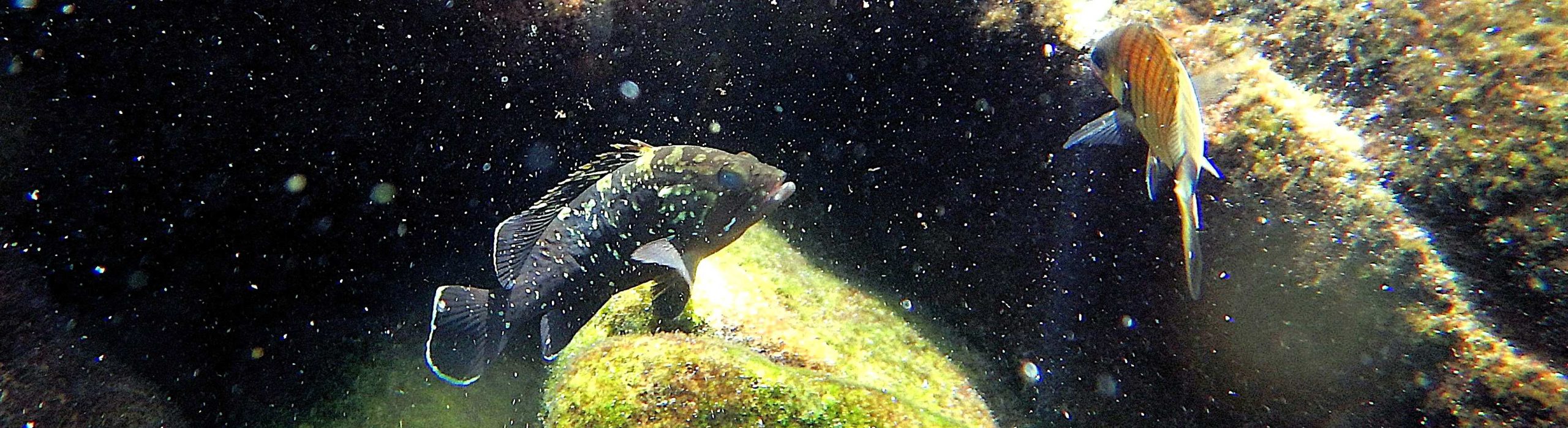
Dusky grouper (Epinephelus marginatus)

News Flash 643

Weekly Snapshot of Public Health Challenges


The Global Polycrisis: Reframing Learning through One Health & Wellbeing for a Sustainable Earth  by George R. Lueddeke 

Why plant health matters for One Health systems 

Webinar registration: Development Banks, Biodiversity, and Food Security: Complementary, or Contradictory?

The Untapped Power of Health Taxes in Sub-Saharan Africa

Opportunities to improve public health in China

AI’s impact could worsen gaps between world’s rich and poor, a UN report says

Africa is Stuck Between Global Pathogen-Sharing Talks and Conflicting US Bilateral Agreements

HIV prevention services hit hardest by funding cuts, UNAIDS warns

WHO Calls on Africa to Protect HIV Gains Amid Funding Cuts

New prevention tools and investment in services essential in the fight against AIDS

Health Beat #36 | Aids at 44: Will HIV-negative people take anti-HIV jabs?

Hepatitis C: a continuing public health challenge in China

International seminar explores the development of treatments for dengue for populations not covered by vaccines

Brazil Approves World’s First Single-Dose Dengue Vaccine

Measles is Surging as Vaccination Coverage Dips Below 95%

A Call to Action to Train Antimicrobial Stewardship Leaders to Combat AMR Globally, Especially in Resource-Limited Settings Like Sierra Leone

How insulin pens are changing lives in South Sudan’s remote villages

Sources of insulin, oral medicines, and medical devices for diabetes for low-and middle income countries

WHO issues global guideline on the use of GLP-1 medicines in treating obesity

Beyond Obesity Pills: Ethical Imperatives for a World of Excess, Hunger, and Ecological Breakdown  by Juan Garay

HRR795. THE FOOD SYSTEM THAT HAS TRAPPED US: WAKE UP AND YELL LOUDLY!

UNPO Advisory Board Member at UN Minority Forum Highlights the “Superpower” of Minority Perspectives

New Diplomatic Effort Underway to Reduce the Costs of Menstrual Products

Bringing medical care to Egyptian and Sudanese people in Aswan

Yemen’s Worsening Food Security Crisis: Economic Collapse, Continued Insecurity, and Humanitarian Challenges

Kenyan court declares law banning seed sharing unconstitutional

Reuse and return schemes could help eliminate plastic pollution in 15 years, says report

The Climate Briefing: What happened at COP30?

COP30 Editor’s take: Why climate policy needs to move beyond consensus

Coastal regions and climate change: how better risk assessment can help protect infrastructure and livelihoods


Beyond Obesity Pills: Ethical Imperatives for a World of Excess, Hunger, and Ecological Breakdown

IN A NUTSHELL
Author's Note 
The WHO’s recent decision to consider anti-obesity drugs as essential medicines occurs in a world marked by profound contradictions: persistent global undernutrition, widespread overconsumption, accelerating ecological degradation, and unprecedented corporate concentration in the agri-food and pharmaceutical sectors. Industrial food systems generate vast ecological harm and animal suffering while driving both obesity and hunger. 
This article analyzes the ethical, ecological, and equity implications of medicalizing obesity, drawing on global health ethics, political ecology, and the author’s earlier work on sustainable health equity, as well as the principles articulated in the Sustainable Health Equity Movement (SHEM) webinars. It argues that pharmaceuticalizing a structurally produced problem risks perpetuating an economy of excess—of calories, material throughput, wealth accumulation, and ecological destruction—while deflecting attention from the structural transformations needed to achieve equitable and sustainable global health
By Juan Garay

Co-Chair of the Sustainable Health Equity Movement (SHEM)

Professor/Researcher of Health Equity, Ethics and Metrics (Spain, Mexico, Cuba, Brazil)

Founder of Valyter Ecovillage (valyter.es)

By the same Author on PEAH: see HERE

Beyond Obesity Pills

Ethical Imperatives for a World of Excess, Hunger, and Ecological Breakdown


Introduction

Today, the world confronts a fundamental ethical paradox: nearly one billion people lack sufficient nutrition, while another billion experience conditions of excess, especially obesity linked to ultra-processed and animal-dense diets (FAO, 2023; WHO, 2024). These phenomena are not isolated but interconnected outcomes of global systems that prioritize economic accumulation over health, justice, and ecological balance.

The author’s earlier work on sustainable health equity emphasized that inequities emerge from structural determinants—economic concentration, ecological overshoot, precarious living conditions, and food systems designed around profit rather than well-being. The Sustainable Health Equity Movement (SHEM) further elaborates these principles, arguing that health equity can only be achieved when economic, social, and ecological inequities are addressed together, as interdependent dimensions of one crisis.

It is in this context that the WHO’s decision to incorporate anti-obesity drugs into essential medicines lists must be critically examined.

Structural Roots of Global Nutritional Inequity

Hunger amid systemic abundance

Global hunger persists primarily because of inequitable distribution, political marginalization, conflict, and poverty, not because of inadequate food production (Sen, 1981; FAO, 2023). SHEM highlights that inequity is systemic: institutions, markets, and power structures create conditions in which hunger is reproduced generation after generation.

Overconsumption as a structural outcome

In many countries, obesity is fueled by:

industrial overproduction of cheap calories

aggressive marketing of ultra-processed foods

subsidies for livestock and monocultures

socioeconomic stressors and precarity

weakened regulatory institutions

These dynamics form what Stuckler and Nestle (2012) call the corporate determinants of health, in which harmful consumption patterns are shaped—and normalized—by powerful economic interests.

Ecological destruction and animal suffering

Industrial animal agriculture contributes to:

high greenhouse gas emissions

deforestation and biodiversity loss

water contamination

antibiotic resistance

the suffering of billions of sentient beings

SHEM emphasizes that ecological degradation and health inequity are inseparable: the communities most harmed by environmental damage are typically those with the least political and economic power.

Medicalization of Obesity

Addressing symptoms while ignoring causes

Pharmaceutical treatment of obesity, though beneficial for individuals, risks reinforcing a paradigm that focuses on downstream biomedical interventions rather than upstream determinants. The author’s earlier work on sustainable health equity argues that health cannot be sustainably improved if structural drivers remain unaddressed.

Expansion of pharmaceutical dependence

Anti-obesity drugs have become a rapidly expanding global market, propelled by:

industry lobbying

medicalization of structurally produced conditions

narratives that emphasize individual responsibility

This dynamic, as some critics argue, risks entrenching long-term dependence on costly pharmacological interventions while diverting attention from prevention and systemic reform.

Ethical concerns about essential medicine designation

Key risks include:

deepening inequities when expensive treatments remain inaccessible

normalizing unhealthy dietary patterns

reinforcing economic structures that benefit from systemic overconsumption

deprioritizing ecological and social determinants of health

Ethics of Sustainable Health Equity

Interdependence of health, ecology, and economy

SHEM proposes that equitable health outcomes require equity in economic distribution and ecological impact, because health cannot be sustained in contexts of concentrated wealth and ecological overshoot.

Planetary boundaries and moral responsibility

Human health relies fundamentally on ecological stability. The crossing of planetary boundaries undermines long-term determinants of health, including food security, water access, and climate resilience (Whitmee et al., 2015; IPCC, 2021).

Redistribution as ethical and ecological necessity

Hunger and obesity represent two faces of the same structural maldistribution of:

food

economic resources

ecological capacity

SHEM emphasizes that sustainability requires reducing excess—not only in dietary intake but also in economic accumulation, resource extraction, and environmental degradation.

Pathways Beyond Pharmaceutical Dependency

Transition to plant-rich and agroecological food systems

Plant-based and agroecological systems:

improve health

reduce chronic disease

lower environmental pressure

eliminate most animal suffering

enhance food sovereignty (Willett et al., 2019)

Strengthening public-interest food governance

Effective interventions include:

regulating harmful food environments

restricting ultra-processed food marketing

fiscal measures that discourage unhealthy consumption

supporting regenerative and community-based agriculture

Reducing corporate concentration

Excessive corporate power in agriculture, food production, and pharmaceuticals undermines equity, democracy, and ecological sustainability (Clapp, 2021)

Integrating sustainable equity metrics into health governance

Inspired by the author’s earlier work and the SHEM framework, essential medicines policies should incorporate:

ecological impacts

distributive justice

structural determinants of demand

long-term sustainability of interventions

This approach helps avoid embedding unjust structures into global health policy.

Conclusion

The rise of anti-obesity medication as an essential global health intervention reflects a world shaped by structural excess and structural deprivation. While pharmacological tools may provide relief for some, they risk reinforcing the economic models and ecological trajectories that produce both hunger and obesity.

Achieving sustainable and just global health requires transforming—and not merely medicating—the conditions of excess consumption, inequality, ecological degradation, and corporate concentration. Sustainable health equity demands rebalancing human nutrition within ecological limits, reducing avoidable suffering (human and non-human), and ensuring that all people have access to nutritious, ethically produced food.

Only by addressing these systemic drivers can global health move toward a future grounded in justice, sustainability, and compassion.

References

Apovian, C. M., et al. (2023). Pharmacotherapy for obesity—new insights and challenges. New England Journal of Medicine.

Clapp, J. (2021). Food. Polity Press.

FAO. (2013). Tackling climate change through livestock.

FAO. (2023). The State of Food Security and Nutrition in the World.

IPBES. (2019). Global Assessment Report on Biodiversity and Ecosystem Services.

IPCC. (2021). Sixth Assessment Report.

Monteiro, C. et al. (2018). Ultra-processed foods and global health. Public Health Nutrition.

Mozaffarian, D., et al. (2023). Transforming the food system for health and sustainability. BMJ.

Poore, J., & Nemecek, T. (2018). Reducing food’s environmental impacts. Science.

Raworth, K. (2017). Doughnut Economics.

Safran Foer, J. (2009). Eating Animals.

SHEM – Sustainable Health Equity Movement (2020–2024).

Webinar series, International Collaborative on Sustainable Health Equity.

Documents and presentations available through participating institutions and partner seminars.

Sen, A. (1981). Poverty and Famines.

Singer, P. (2009). Animal Liberation.

Stuckler, D., & Nestle, M. (2012). Big Food and global health. PLoS Medicine.

Swinburn, B. et al. (2019). The global syndemic. Lancet Commission.

Whitmee, S., et al. (2015). Health in the Anthropocene. The Lancet.

Willett, W. et al. (2019). EAT-Lancet Report.

The Global Polycrisis: Reframing Learning through One Health & Wellbeing for a Sustainable Earth

IN A NUTSHELL
Author's Note 
...Humanity stands at a crossroads where the choices we make—and the values that guide them—will determine whether future generations inherit a flourishing planet or a diminished one. The One Health & Wellbeing concept, the Earth Charter Principles, and ecocentrically reframed UN SDGs together offer a coherent, ethical, and scientifically grounded pathway for realigning human societies with the Earth’s life-support systems. As the 1 HOPE–TDR initiative demonstrates, transforming learning across all societal levels is not simply an educational aspiration but a civilisational imperative. By embracing interconnectedness, shared 'meaning-making' and responsibility, alongside  a renewed ethic of care for all life, humanity can begin to build a just, sustainable, and peaceful world—one in which we finally learn to live in harmony with the planet that sustains us...

George Lueddeke

By George R. Lueddeke, PhD
Global Lead, International One Health for One Planet Education & Transdisciplinary Research Initiative (1 HOPE–TDR)
United Kingdom

The Global Polycrisis

Reframing Learning through One Health & Wellbeing for a Sustainable Earth


A World at Breaking Point

Humanity is living through a period of profound and accelerating transformation, much of it driven by extractive, growth-driven economic models and opportunistic power structures that disregard the limits of the Earth’s life-support systems. Climate instability, biodiversity collapse, geopolitical tensions and democratic erosion, water scarcity, pollution, zoonotic spillover, widening inequalities, and rapid technological disruption are converging into a “perfect storm” of unprecedented scale. These forces are no longer isolated trends—they are mutually reinforcing symptoms of a deeper imbalance between human societies and the natural world.

At the heart of this imbalance lies an educational crisis. Our learning systems still reflect a worldview built on human supremacy, compartmentalised knowledge, and economic growth as the overriding societal priority. This worldview—grounded in human exceptionalism and uncritical technological optimism—has become dangerously misaligned with the planet’s ecological boundaries. Societies today operate without a coherent moral compass in an era defined by existential risk, continuing to function within a mindset shaped by humancentrism (“it’s all about us”), fragmentation, and persistent short-termism—echoes of the pre-Copernican belief that the Earth was the centre of the universe.

Modern education systems—particularly universities—have not yet fully grasped the gravity of this historical moment. A widening gap has emerged between the complexity of cascading global challenges and society’s capacity to understand and respond to them. Increasingly, as institutions are being pushed “to replace education with indoctrination,” decision-makers recognise that transforming learning across all societal levels is essential to securing a more just, inclusive, sustainable, and peaceful future for both current and future generations.

Learning at a Crossroad: Transforming Our Worldview

Yet higher education continues to operate within an outdated paradigm that privileges disciplinary silos, credentialism, institutional competition, and market-driven logic. These traditions undermine the ecological literacy, ethical insight, and transdisciplinary collaboration essential for navigating civilisation-scale crises. If education does not evolve, societies will struggle to evolve with it. Put simply, the world cannot be “saved from itself” unless the systems that shape human understanding and decision-making are transformed.

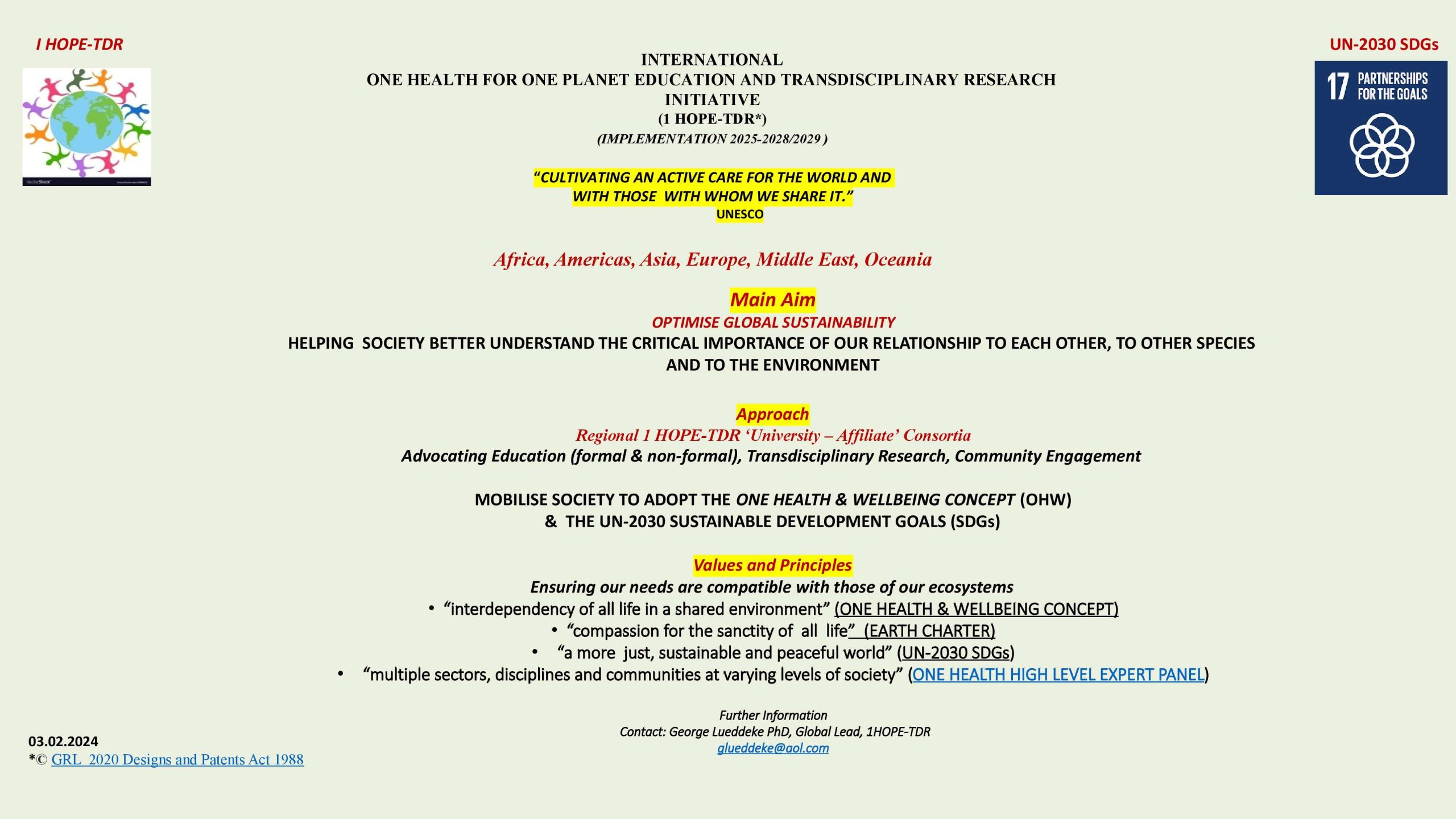
It is in this context that this article examines the emergence and purpose of the International One Health for One Planet Education & Transdisciplinary Research Initiative (1 HOPE–TDR). Developed to bridge the widening gap between global risks and societal capacity, 1 HOPE–TDR provides a values-based, ecocentric, regionally coordinated framework for rethinking how societies learn, govern, and collaborate during an era of planetary upheaval (Fig. 1). Through the integration of One Health & Wellbeing, Earth Charter ethics, and an ecocentric reframing of the UN Sustainable Development Goals, the initiative offers foundations for a transformative shift in global learning—and ultimately, in humanity’s relationship with the Earth.

Figure 1. 1 HOPE–TDR Overview

© 2020 George R. Lueddeke
Adapted from Survival: One Health, One Planet, One Future (2020)

Evolution of an Integrated Knowledge Ecology

A vital step in this transformation is the creation of an integrated knowledge ecology—an understanding of the “interconnectedness of all things” that embraces diverse zones of knowledge extending far beyond academia. These include natural, political, economic, cultural, social, and ethical domains that shape human–Earth relations.

As Emeritus Professor Ronald Barnett (UCL Institute of Education) reminds us, universities and higher education generally carry ‘responsibility not only in sustaining any such ecology’ but also, more importantly, to strengthen it. By attending to all ecological zones, universities and all other education / research system providers  can realise their full potential as institutions with an active concern for the whole Earth — even the universe — and ensure that they remain “constantly adaptable to new circumstances as the world moves forward.

Rethinking the Human–Earth Relationship

It is within this expanded context that 1 HOPE–TDR has taken shape. Recognising that systems-level challenges require systems-level solutions, the initiative brings together the life, natural, physical, and social sciences (including ethics), the humanities, and global policy frameworks to catalyse a shift toward ecocentric, integrated learning and leadership.

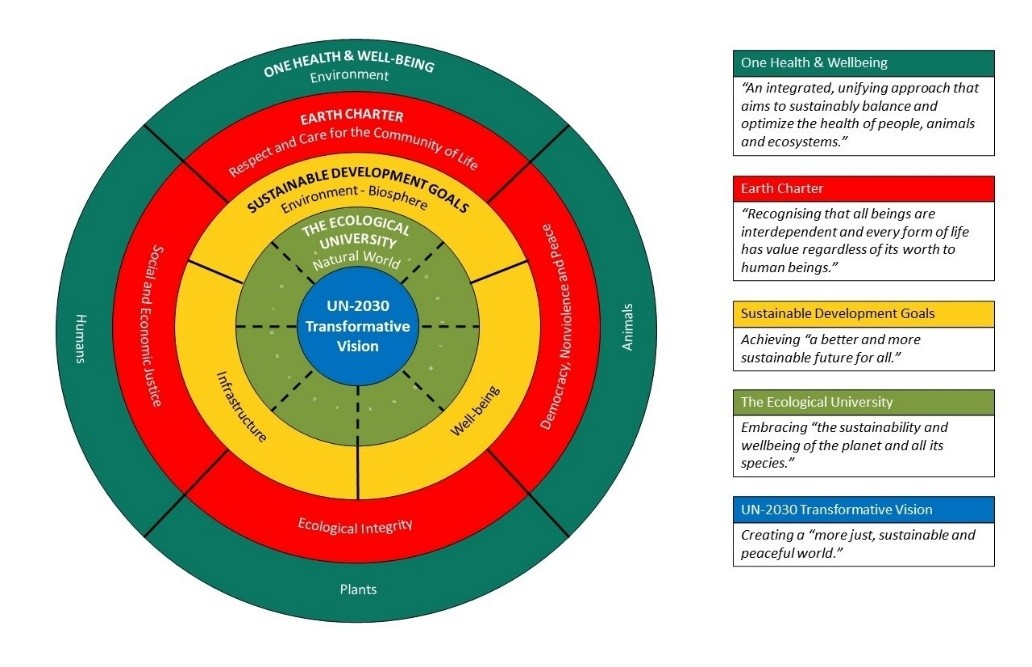
As shown in Figure 2, the initiative is built on Barnett’s ecological zones framework and is supported by three mutually reinforcing pillars:

  1. The One Health & Wellbeing (OHWB) concept
  2. The Earth Charter principles
  3. A reframed ecocentric reorientation of the UN Sustainable Development Goals

Figure 2. 1 HOPE–TDR Conceptual Building Blocks

The One Health & Wellbeing Concept

The OHWB concept offers a scientific and holistic understanding of how human health is inseparable from the wellbeing of non-human animals, plants, ecosystems, and planetary processes. It exposes the illusion that human prosperity can be achieved independently of nature. OHWB demonstrates that:

  • the climate emergency is fundamentally a health and wellbeing emergency (all life).
  • biodiversity loss threatens food systems, water quality, and economic stability.
  • ecosystem degradation accelerates the emergence of infectious diseases.

Beyond its scientific grounding, OHWB invites a new ecological consciousness—one that recognises interdependence as the organising logic of life on Earth and underscores the urgent need for a new global all-life narrative.

The Earth Charter — Turning Conscience into Action

The Earth Charter complements this scientific foundation with a moral and ethical framework for building a just, sustainable, and peaceful world. Its four pillars—respect for the community of life, ecological integrity, social and economic justice, and peace—offer a much-needed ethical compass for a fractured world. They remind us that sustainability is fundamentally an ethical project requiring responsibility, compassion across species, and cultures grounded in reciprocity and care.

Reframing the UN Sustainable Development Goals Ecocentrically

Although the SDGs remain largely humancentric in structure, they provide a crucial platform for shifting toward an ecocentric worldview that recognises the interdependence of people, other species, and the Earth’s systems. None of the goals can be realised unless the planet’s life-support systems are stabilised.

Ecocentrism does not diminish human development; rather, it recognises that development is impossible if ecosystems collapse. Reframing the SDGs in this way aligns them with:

  • the scientific reality of planetary boundaries, and
  • the ethical commitments of the Earth Charter.

Together, OHWB, the Earth Charter, and ecocentrically-reframed SDGs form the triad that underpins 1 HOPE–TDR—providing the philosophical, ethical, and operational foundations for rethinking learning systems worldwide.

The One Health & Wellbeing Mandate for Systemic Transformation

By embedding these three core building blocks across policy, education, governance, decision-making, and practice, societies can begin to realign human activity with the wellbeing of the Earth and all interconnected life-support systems.

Drawing on foundational works such Survival: One Health, One Planet, One Future  including the Ten Propositions for Global Sustainability (Box), and Universities in the Early Decades of the Third Millennium: Saving the World from Itself? ,the integrated conceptual framework offers a coherent pathway for navigating converging existential risks. These elements strengthen the global sustainability narrative by connecting ethical responsibility, systems thinking, and transdisciplinary research with a shared commitment to safeguarding both present and future generations.

The future is not predetermined. It is shaped by the values we teach, the knowledge we cultivate, and the courage with which we act. If humanity is to “save the world from itself,” learning must lead the way.

Box: Ten Propositions for Global Sustainability

WHAT IF?

  1. We recognised the Earth as a living community whose health and wellbeing underpin humanity’s future.
  2. We shifted from a humancentric to an ecocentric worldview, aligning human development with the planet’s life-support systems.
  3. Education at all levels prioritised ecological literacy, ethics, and systems thinking as the foundations for sustainable societies.
  4. Universities became ecological, civic, and globally responsible institutions — serving future generations as well as present communities.
  5. Governments adopted integrated One Health & Wellbeing approaches across all departments, policies, and ministries.
  6. Economies were reoriented toward regeneration, circularity, and long-term planetary wellbeing rather than short-term profit.
  7. Youth and future generations held a central role in shaping governance, innovation, and societal priorities.
  8. Science and Indigenous Knowledge informed one another to guide decisions that respected Earth’s limits and cultural diversity.
  9. Global collaboration replaced competition — connecting nations, disciplines, civil society, and business in service to a sustainable Earth.
  10. We adopted a shared ethic of care — towards each other, other species, and the planet — anchored in the OWB and Earth Charter values and principles.

(© 2020 *Adapted from Lueddeke, G. R. (2020). Survival: One Health, One Planet, One Future.)

Building a Global Architecture for Learning Transformation

Informed by years of foundational development and driven by the imperative to optimise global sustainability, 1 HOPE–TDR advances several essential shifts:

  • from human-centred health to the wellbeing of all species and ecosystems;
  • from individualism to learning with, from, and for one another;
  • from fragmented knowledge to integrative, transdisciplinary learning;
  • from passive knowledge transmission to collaborative knowledge creation;
  • from institution-centred models to deeper community engagement;
  • from vested interests and power dynamics to altruism, compassion, and truth.

Anchored in these principles, 1 HOPE–TDR is establishing continental and regional steering committees and sub-regional coordinating groups to lead major regionally owned grant proposals under a shared theme:
One Health & Wellbeing for the Earth: Learning for Sustainability.

These committees engage multidisciplinary and multisector stakeholders, with strong emphasis on youth and marginalised communities. Dedicated secretariats—currently the University of Education, Winneba (Africa); the Institute of Hygiene and Tropical Medicine, NOVA University Lisbon (Europe); and the Institute for Advanced Studies, Federal University of Rio de Janeiro (Latin America and the Caribbean [LAC])—provide coherence and regional leadership. Plans are underway to extend initiatives to India, Southeast Asia, Oceania, and the Middle East.

Why Learning Must Be Reframed for a Sustainable Future

This wave of coordinated regional developments may represent one of the more significant global shifts now emerging in sustainability efforts. Increasingly, leaders recognise that learning is the master key—the mechanism through which worldviews evolve, values transform, institutions adapt, and societies discover new pathways forward. Learning is not confined to classrooms; it occurs in communities, governments, civil society, workplaces, homes, and rapidly expanding digital environments.

Concluding Comments

Humanity stands at a crossroads where the choices we make—and the values that guide them—will determine whether future generations inherit a flourishing planet or a diminished one. The One Health & Wellbeing concept, the Earth Charter Principles, and ecocentrically reframed UN SDGs together offer a coherent, ethical, and scientifically grounded pathway for realigning human societies with the Earth’s life-support systems. As the 1 HOPE–TDR initiative demonstrates, transforming learning across all societal levels is not simply an educational aspiration but a civilisational imperative. By embracing interconnectedness, shared ‘meaning-making’ and responsibility, alongside  a renewed ethic of care for all life, humanity can begin to build a just, sustainable, and peaceful world—one in which we finally learn to live in harmony with the planet that sustains us.


About the Author

George Lueddeke, PhD is Global Lead of the 1 HOPE–TDR initiative, advancing ecocentric-focused One Health & Wellbeing education and transdisciplinary research - rising above discipline silos. A recognised education developer, adviser, and author  across higher and medical education, population health, sustainability, and learning transformation, he writes and speaks widely on global risks and systemic solutions. He champions a just, sustainable, and peaceful future for all life on the planet. (Brief Bio)