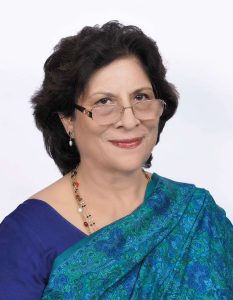
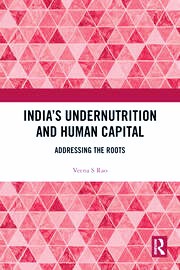
IN A NUTSHELL Editor's noteA highly accomplished professional with extensive experience in addressing undernutrition and micronutrient deficiency in India, Ms. Veena S Rao has served in the Indian Administrative Service (IAS) from Karnataka Cadre, and retired in 2009 as Secretary to the Govt of India, Ministry for the Development of the North East Region. She has worked both in the Govt of Karnataka and Govt of India, and also has international experience, particularly with UN Agencies, World Bank and Asian Development Bank. After retirement She was Advisor, Karnataka Comprehensive Nutrition Mission, an initiative spearheaded by her with the Government of Karnataka to address undernutrition and micro nutrient deficiency in Karnataka, following the inter-generational, inter-sectoral strategy, and addressing the direct causes of undernutrition and micronutrient deficiency in India, namely, information deficit and need for behaviour change, dietary deficit, inter-sectoral convergence through simultaneous operation of ongoing nutrition/health related interventions, particularly relating to immunization, safe drinking water and sanitation, and vigorous, real time monitoring; and the market deficit. She is presently Director, Auro Centre for Public Nutrition, Public Health and Public Policy, Bangalore, a vertical set up by her in Sri Aurobindo Society, Puducherry. In this connection, PEAH had the pleasure to interview Ms. Veena S Rao relevant to her recently released book India’s Undernutrition and Human Capital: Addressing the Roots
By Daniele Dionisio
PEAH – Policies for Equitable Access to Health
INTERVIEW
Auro Centre for Public Nutrition, Public Health and Public Policy (ACPN)
Bangalore, India
By Ms. Veena S Rao already published on PEAH: see HERE
–PEAH: Nice to meet you Ms. Rao. Your professional career makes you an acknowledged expert on conceptualizing Policy and Programming for Health and Nutrition, whereby Programme Implementation, Programme Management and Monitoring, and IEC (Information, Education, and Communication) and Behaviour Change for Health and Nutrition play a fundamental role. What’s your say while linking these to the foundation of your book?
–Rao: Thank you for your very complimentary words. I have always held that the root causes of chronic poor health/nutritional status of a large section of our people are extremely complex and inter-sectoral – ranging from dietary deficit which is accepted as a given in poor households; information deficit regarding balanced diets within family budgets which has led to unhealthy dietary behaviours hardened over generations; superstition regarding complementary feeding for infants and weight gain during pregnancy; lack of knowledge regarding the importance of safe drinking water and proper sanitation and how they protect against infection and improve the health and nutritional status of all age groups in the family, and very importantly, female literacy. I think I have made all these linkages in my book.
–PEAH: World Bank Blogs on February 18, 2020 featured a successful pilot project led by you and completed with exceptionally positive results and improvement in the health and nutritional status of the target groups. Can you let us in on it, just to add context to the book’s contents?
–Rao: Well, in a nutshell I can say that I put into practise whatever I preached! With support from the Karnataka State Government and the World Bank, we finalized an Intersectoral/Intergenerational Strategy which we implemented in all villages in two of the poorest Blocks (Development Units of a District) of Karnataka, Chincholli Block, Kalaburgi District (136 villages)and Devadurga Block in Raichur District (173 villages) targeting the two poorest quintiles of the Blocks covering around 12,560 infants below 3 years, 16,503 adolescent girls 11-18 years, 1624 pregnant women and 3750 lactating mothers when we strated. This was an open expirement wherein beneficiaries within the target groups could leave and return, and new beneficiaries could join. Interventions can be sumarized as 1) Addressing the Information Deficit within the family and community through a continuous but phased multimedia Awareness Generation/Behavior Change Campaign covering basic aspects of child, adolescent and maternal care; dietary diversification within family budgets, in keeping with locally available agricultural and horticultural produce and cultural practices; hygiene and sanitation. 2) Bridging the Dietary Deficit by providing appropriate fortified supplementary nutrition to the 3 target groups which was produced by local Women Self Help Groups; creating demand among communities for ongoing government programmes, particularly health and sanitation programmes, and lastly Real Time Monitoring which gave us real time information of health/nutritional improvements of target groups within families or of any bottlenecks or course correction which were needed. The pilot projects addressed the root causes and brought about very quick improvement in the health and nutritional status of the target groups, reduced incidence of low birth weight babies. Details have been provided in Chapter 7 of the book, “A Strategy that Worked: Karnataka Comprehensive Nutrition Mission.”
–PEAH: You currently serve as Director, Auro Centre for Public Nutrition, Public Health and Public Policy. Relevantly, what as regards your aims and inside strategy in unison with the book scope?
–Rao: The objectives of Auro Centre for Public Nutrition, Public Health and Public Policy (ACPN) are to strengthen our human capital and demographic dividend through impactful inter-sectoral strategies, interventions and convergence at grassroots; to promote research and develop activities for providing information and knowledge to students, professionals, community organizations, panchayats (village elected bodies) and women self-help groups regarding a) The continuum of nutrition, health, education, skills, across the life cycle and b) The inter-sectoral, inter-generational aspects of human development, covering public nutrition, public health, education, skills, learning and livelihoods, and their impact on human capital, reduction of poverty and on economic progress of individuals, communities and the country.
Indeed, the contents of the book cover all these aspects in a wide but simple structure tailored to addressing the grassroots, where the action must really happen.
–PEAH: As in the official brochure, your book explores the undernutrition situation in India and its repercussions on the country’s human capital, from a public policy practitioner’s approach. It critically examines government policy since independence to the present time and foregrounds the issues that have led to the persistence of poor nutritional and health status among a large section of India’s population. In this vein, chapters span across and cover critical issues including, among others, the deep rootes of India’s undernutrition and dietary deficiences and how do improve India’s nutritional and health status within a generation. Can you tell us more as regards the last theme?
–Rao: To begin with, the linkages between health and nutrition to strong human capital and economic growth should seriously enter the public policy domain, so that there is high level public discussion on the subject. Yes, India’s nutritional and public health indicators can be improved faster within a generation if the root causes, what I call the Triple Deficit, are addressed – the Dietary Deficit, the Information Deficit and the Market Deficit. And structurally, these can be best addressed by a minimal inter-sectoral and intergenerational convergence of ongoing government programmes relating to health, nutrition, childcare, education, water and sanitation programmes at family level, and a working system of real time monitoring to ensure that these programmes are reaching every targeted family. Government must focus on the most vulnerable families, provide an additional hand at the village level for this work, leverage the corporate sector and all national and international stakeholders to achieve results.
–PEAH: The volume traces the complex history of public nutrition and public policy in India, and presents a sound multi-sectoral, intergenerational strategy which has been successfully piloted, and can be scaled up across chronic undernutrition pockets of India. Can you elaborate on these points?
–Rao: The multi-sectoral, intergenerational strategy aimed to address the root causes by:
– Adopting the intergenerational, life cycle approach by addressing the nutritional needs of infants, children, adolescent girls and pregnant and nursing mothers.
– Bridging the calorie–protein–micronutrient deficit among the intergenerational target groups by providing appropriate energy-dense fortified supplementation for consumption.
– Accelerating, integrating and tightly monitoring multi-sectoral ongoing programmes that have an impact on malnutrition, such as Immunization and Vitamin A Supplementation, Anaemia control, Water and Sanitation, etc., and achieving convergence between the ongoing programmes so that they operate simultaneously and filling programmatic gaps.
– Increasing programme coverage by demand creation by involvement of the community, NGOs, SHGs and VPs.
– Launching a sustained general public awareness campaign, through the multimedia and interpersonal communication mode to reach the general public, especially at the grassroots, regarding proper nutritional practices within existing family budgets and proper child and maternal care and create demand for government programmes.
– Making available low-cost energy foods for the general population through Public-Private Partnerships.
This strategy has proved successfull and has been validated in the Karnataka Multisectoral Nutrition Pilot Projects, and can be scaled up to cover chronic undernutrition pockets of India
–PEAH: Who is the book for?
–Rao: This book is definitely meant for students of Public Health and Nutritional Sciences, Professionals in any sector of Development, both governmental and non-government, NGOs and Field Workers.
I also believe that policy makers should take a good look at this book, particularly since we are depending so heavily on our human capital and demographic dividend – the largest workforce in the world aged 15-59 years – for our future economic growth and becoming a developed nation. And I also see that increasingly, the whole question of Human Development is taking a bit of a back seat in national debate – much greater emphasis is on AI and other frontier technologies, which are no doubt very important, but I do believe that human development should receive equal priority from government if we want to become a developed country.
The last para of my book says it all
“A global power with developed infrastructure and underdeveloped human capital would suffer from acute social contradictions and bipolarity, both nationally and internationally. Strengthening our human capital across all age groups, which constitute our present, immediate and future demographic dividend, and enabling it to achieve its complete physical and cognitive potential, can only result in better health, learning ability and education among children and adolescents, in acquiring higher skills and increased capacity for physical work, and securing better employment, greater upward mobility and higher incomes. This immediately translates to lower unemployment rates and higher GDP for the country, but a GDP based on greater financial and intelligence quotient (IQ) inclusion, and lower dependence on government for healthcare, food security and nutrition, education and employment. The government must overcome its own policy and programme deficit, show its seriousness and start addressing this issue urgently through new ideas and innovation on the ground, as we approach our US$5 trillion economy and the advent of artificial intelligence.”
–PEAH: Aiming to fill the nutritional gaps you are dealing with, which partners do you currently count on?
–Rao: A very difficult question. Presently, I can only count on government. It appears to me that most non-government and corporate agencies are bound by the mandates of their funding agencies which focus on certain isolated aspects of undernutrition and poor health – for example, school mid day meals programmes, fortification, anaemia, or support ongoing government programmes in Districts. In the recent past, I am not aware of any agency funding a programme which covers and addresses minimal intersectoral aspects of poor health and undernutrition simultaneously, which alone can create impact. So, perhaps, we need to convince them and change their mind set as well.
–PEAH: Thank you Ms. Rao for the excellent work linking advocacy to scientific and humanitarian commitment.
–Rao: Thank you. My pleasure.