When People Move, Healthcare Stops: What Libya Reveals About Care Built Around Places Rather Than Patients

IN A NUTSHELL
Author's note
This article looks at continuity of care for refugees and migrants in Libya, particularly across detention centres, disembarkation points, humanitarian services and the public health system. The central argument is that access to healthcare is only part of the story; what often breaks down is the connection between one episode of care and the next

By Meftah Lahwel
MD, Master in Sustainability in Health

 When People Move, Healthcare Stops

What Libya Reveals About Care Built Around Places Rather Than Patients


By the same Author on PEAH: HERE and HERE


A patient leaves a detention centre in Libya with a prescription and a referral, but no clear idea where the next consultation will happen. A doctor has seen him. Treatment may have started. Yet the next provider may not know what happened before, the medicine may not be available, and the patient may not know which facility will receive him or who is now responsible for the follow-up.

The illness continues. The care may not.

That simple gap between one consultation and the next is one of the less visible problems in healthcare for refugees and migrants in Libya. We are accustomed to asking whether a service was available: Was a doctor present? Was the patient examined? Was medicine provided? Was a referral made? These questions matter, but they describe encounters. They do not necessarily tell us whether care continued.

Migrants, refugees and asylum seekers are not one population. Their reasons for moving, legal situations, vulnerabilities and entitlements differ, and internally displaced Libyans face another set of circumstances. These distinctions should not be blurred. But from the perspective of continuity of care, movement creates a common practical problem: a patient can cross from one place, provider or institution to another while the health condition remains exactly the same.

In Libya, that movement often takes place across a health landscape made up of public facilities, humanitarian services, specialised national programmes and informal networks. None of these components is irrelevant. The problem is that they do not always connect around the patient.

At detention centres and disembarkation points, much of the documented direct healthcare for migrants and refugees has been delivered by international organisations and their partners. IOM’s current Libya response, for example, includes primary healthcare and referrals to secondary and tertiary care at detention centres, disembarkation points and migrant-dense locations. National health structures play a different role: they remain central to the wider public system and to disease surveillance and specialised programmes. Tuberculosis is one of the clearest examples, with diagnosis and treatment embedded in the national TB pathway while international actors support screening, referral and programme capacity.

This division of work has been necessary. It has filled gaps and, in many cases, allowed care to happen where it otherwise might not. But it also exposes the continuity problem. A patient may be seen at a disembarkation point, treated inside a detention centre, referred to a public facility and later need follow-up somewhere else. At each stage, a different actor may be doing exactly what its mandate requires. The patient’s illness, however, does not divide itself according to mandates.

The illness does not recognise the boundary between one mandate and another. The system does.

That is where access and continuity begin to separate. A referral may be correctly issued and still never be completed. A treatment plan may be clinically appropriate and still become impossible to maintain when the patient moves. Medical information may remain with the first provider while the next clinician has to reconstruct the history from memory, a photograph of a prescription or a laboratory paper carried in a bag. Transport, documentation, language, cost and medicine availability can turn a straightforward referral into another point at which care is lost.

For a person who needs one consultation, this fragmentation may be inconvenient. For someone with tuberculosis, diabetes, hypertension, a mental health condition, a complicated pregnancy or another condition requiring follow-up, it can change the course of the illness. Treatment is not only what happens while the patient is in front of the doctor. It is also what happens after the patient leaves.

This matters even more as the direction of policy moves, reasonably, away from permanent parallel humanitarian healthcare and towards greater use of Libya’s national health system. Lately, humanitarian actors advise refugees and asylum seekers to access public primary healthcare centres and hospitals rather than medical assistance through partners or private clinics. That is the right long-term direction. Humanitarian organisations cannot, and should not, become a second national health service.

But integration is not the same as continuity.

The public system people are being asked to use is itself under pressure. WHO has documented shortages of essential medicines and medical supplies and major limitations in facility functionality; in an assessment from December 2024, 84 per cent of assessed facilities were only partially functioning. UNHCR’s own public guidance also reflects practical barriers: identification is generally expected, and secondary and tertiary care usually involves fees. So the patient may leave a humanitarian service and enter a national system that is itself trying to manage shortages, costs and uneven service availability.

The result is an uncomfortable space between two reasonable positions. Humanitarian organisations cannot provide everything forever, and refugees and migrants should, where possible, be included in the national system. Yet neither statement answers the question that matters most at the moment of transition: where does this particular patient go next, and who makes sure the care actually continues?

In practice, that responsibility often shifts quietly onto the patient. People navigating fragmented healthcare become custodians of their own medical histories. They remember medicine names, or sometimes only what a tablet looked like. They keep photographs of prescriptions on their phones, carry laboratory reports with them and repeat the same history to each new clinician. They ask friends, relatives and community members which facility might receive them, where a medicine can be found or whether someone knows someone who can help with a referral.

These informal networks are important. Sometimes they are the reason care continues at all. But we should be careful about calling every act of improvisation resilience. When the patient has to transfer the information, locate the next provider, negotiate the referral and search for the medicine, the patient is doing part of the health system’s work.

That also makes continuity an equity issue. A person with money may buy a missing medicine privately. Someone who speaks Arabic may navigate a facility more easily. Someone with documentation may encounter fewer administrative obstacles. Someone with strong social connections may find a way through a referral pathway that appears closed to somebody else. Another person may simply stop treatment. The same fragmented system therefore produces very different outcomes depending on how much the patient can personally compensate for its gaps.

This is why the discussion has to move beyond access. It also has to move beyond the numbers with which humanitarian and health programmes usually describe success. Consultations, referrals, medicines distributed, facilities supported and people reached are all necessary measures. They tell us what was delivered. But they mostly measure activity, not continuity.

A referral issued is not the same as a referral completed. A prescription written is not the same as treatment maintained. A patient seen today is not necessarily a patient cared for tomorrow.

Libya makes this distinction unusually visible because public services, humanitarian programmes, detention centres, disembarkation points, urban communities and different forms of human mobility all meet within the same health landscape. It is possible for many actors to be present and for the patient still to experience a gap. Several available services do not automatically make one functioning system.

The answer is not to build another separate health architecture for migrants or refugees. Dedicated humanitarian services may remain indispensable in certain settings, particularly at detention centres and disembarkation points. But the long-term task is to make care survive the transition from one provider to another.

That requires less grand language and more practical connection: a medical summary that can move with the patient; a referral the receiving facility understands; communication between the provider sending the patient and the provider expected to receive them; a way of knowing whether an important referral was actually completed; continuity of essential medicines when somebody changes location; and primary healthcare that can reconnect a person with treatment already started elsewhere.

Digital health can help with some of this, but technology cannot solve a problem of responsibility. An electronic record has limited value if the next facility cannot access it, if the medicine is unavailable, if the referral is not recognised or if everyone assumes follow-up belongs to somebody else. Continuity begins when one part of the system accepts responsibility for connecting the patient with the next.

Libya has spent years responding to health needs through public services, humanitarian interventions, emergency arrangements, local initiatives and informal solutions. Much of that work has been necessary, and much of it has saved lives. The next question should not only be whether another service can be added. It should be whether the services already there can begin to behave more like a system.

Patients do not experience healthcare through organisational charts, mandates or funding agreements. They experience it as a sequence: a consultation, a prescription, a referral, a journey to another facility and the hope that somebody there will know what needs to happen next. When that connection fails, the system may still record a successful consultation while the patient experiences an interruption.

The patient should not have to carry the system. The system should carry the care.

Libya cannot remove mobility from its health reality. Humanitarian organisations cannot remain everywhere a patient may eventually go, and a strained public health system cannot simply absorb every additional need because another actor has completed its part. But continuity does not require an impossible promise that one provider will follow every person everywhere. It requires something more basic: that movement should not automatically erase what happened before.

A change in location should not unnecessarily become a break in healthcare. The health condition continues. The patient continues. Healthcare should too.


News Flash 680: Weekly Snapshot of Public Health Challenges

News Flash Links, as part of the research project PEAH (Policies for Equitable Access to Health), aim to focus on the latest challenges by trade and governments rules to equitable access to health in resource-limited settings

Needlefish (Belone belone)

News Flash 680

Weekly Snapshot of Public Health Challenges


From National Power to Sustainable Equity: a critical reading of Donald Trump’s 2026 UN address and a proposal for the refoundation of the United Nations  by Juan Garay

Exclusive: UN’s sprawling development system faces ‘existential threat’

What is UNGA, and why does it matter for global development?

What to watch at UNGA

The Pathology of Health Equity: The Foundation of Equitable Governance  by Fahriba Shahraki Sanavi 

Trailblazers with Garry: a conversation with Priti Patnaik

Who gets surgery under prolonged occupation and in war? The unequal path to surgery in Palestine 

Course registration: IFIC Online Certificate in Integrated Care Autumn 2026

Webinar registration: IFIC Forum Discussion on Learning  Oct 7, 2026

Central African Republic eliminates maternal and neonatal tetanus

Therapeutics for the 2026 Bundibugyo Ebola disease outbreak: Access gaps and recommendations

MSF expands response to Ebola disease with new treatment centres as outbreak spreads across provinces

As Global Pandemic Approach Flounders, Experts Offer Blueprint to Protect All Citizens

Delinkage: New proposal offers a promising way forward on access, benefit sharing during pandemics

Q&A Feature on Combination Vaccines

Chad’s routine immunization gains offer lessons for fragile settings

More than 1,000 dead in Bangladesh measles outbreak

Measles vaccine push urged in Americas after World Cup

Variation and gaps in online pharmacy regulation: a comparative review of regulations across 12 countries

US Medicare Pricing Policies Could Drive Global Costs and Hinder Access Worldwide

Healthcare in Africa ‘under growing strain’ after US withdrawal from aid programs, report warns

Gates Foundation and Google to Bring AI resources to 200 Million Farmers Across the Global South

HRR835. YOU CANNOT PROTECT NATURE WITHOUT UNDERSTANDING THE ECONOMY THAT DESTROYS IT. (Alessandra Prampolini)

OpenAI, Anthropic CEOs call for global AI regulation at UN

Webinar registration: If we value patient and carer perspectives, why aren’t organisations taking them to heart? Oct 8, 2026

4th Annual Seminar on Racism and Health 08-09 October 2026

The best social prescription is a healthy living environment

Africa Has the Technology to Achieve Food Security—Now It Needs Coordinated Deployment

Worsening El Nino threatens Asia with drought, potentially raising food prices globally

After US Embassy Monitors Went Offline, Air Pollution Spiked


A Critical Reading of Donald Trump’s 2026 UN Address and a Proposal for the Refoundation of the United Nations: From National Power to Sustainable Equity

IN A NUTSHELL
Author's note
Donald Trump's address to the 81st United Nations General Assembly on 22 September 2026 offers a clear expression of a model of international relations centred on national power, military strength, economic competition, energy production and national advantage.

This article examines that model from the perspective of Sustainable Health Equity. It considers Trump's treatment of war and peace, Iran, Gaza, Venezuela, Cuba, migration, fossil fuels, climate change, international law and the United Nations itself. It also examines several factual claims in the speech that have been challenged by independent fact-checking.

The analysis is placed within a broader body of work developed through the Sustainable Health Equity Movement and published in PEAH, including the concept of Wellbeing in Sustainable Equity (WISE), the estimation of a major global health inequity burden, the projected climate-related mortality of more than 220 million excess deaths during the remainder of the twenty-first century, and the estimated global "dignity gap" of approximately US$7 trillion.

The article argues that these are not separate crises. They are expressions of a global order in which economic, military and political power remains concentrated while the costs of deprivation, ecological damage and conflict are distributed very unequally.

The article therefore proposes a refoundation of the United Nations around sustainable equity: ensuring that every person can achieve a dignified and healthy life while humanity remains within the ecological limits of the Earth


By Juan Garay  *

Former Head of European Union Cooperation in Cuba (2017–2023)

Professor of Health Equity (Cuba, Mexico, Brazil, Spain)

Co-Chair of the Sustainable Health Equity Movement (SHEM)

By the same Author on PEAH: see HERE

A Critical Reading of Donald Trump’s 2026 UN Address and a Proposal for the Refoundation of the United Nations

From National Power to Sustainable Equity


Introduction

The United Nations was created in 1945 after a world devastated by war. Its Charter sought to establish a system in which sovereign states could cooperate to prevent conflict and promote human rights, development and international peace.

More than eighty years later, the basic architecture of that system remains largely unchanged, while the problems facing humanity have become increasingly global and interconnected.

Climate change, biodiversity loss, pandemics, nuclear weapons, mass displacement, global financial concentration and unequal access to knowledge and essential resources cannot be addressed effectively by states acting only in competition with one another.

Trump’s 2026 address is therefore significant beyond the individual statements it contains. It expresses a particular understanding of how the world should be organised: strong nations protecting their interests through economic, military and technological power.

This raises a larger question:

Can a world facing common existential risks continue to be organised primarily around competition between powerful states?

From the perspective of Sustainable Health Equity, this requires reconsidering what we mean by security, prosperity and development.

Power as the organising principle

Trump repeatedly connects national strength with economic production, military capacity, energy resources and geopolitical influence.

There is nothing new about states defending their interests. The problem arises when national advantage is treated as if it can be pursued independently of the interests of other peoples and of the ecological systems on which all societies depend.

A military can protect territory, but cannot prevent a pandemic.

A larger economy does not necessarily reduce health inequality.

More fossil-fuel production may increase energy supply while increasing climate and pollution risks.

Control of natural resources can strengthen national power while intensifying competition for those resources.

The atmosphere, oceans, biodiversity and many essential resources do not respect national borders.

The security of one population is increasingly connected to the security of all others.

War presented as peace

One of the most striking features of Trump’s speech is the presentation of military action and US power as instruments for achieving peace.

Trump describes several conflicts as having been “settled” and presents American military capacity as a source of deterrence and stability.

But ending active fighting is not necessarily the same as establishing peace.

A ceasefire may stop immediate violence without resolving the causes of conflict, protecting civilian populations, establishing accountability or creating the political and social conditions for lasting peace.

This distinction matters particularly in relation to Gaza and Iran.

Trump presents Iran as a major terrorist threat and warns of extreme military consequences if an agreement is not reached.

A consistent application of international humanitarian law requires the same questions to be asked of every actor: who uses force, against whom, under what legal authority, with what distinction between civilians and combatants, and with what consequences?

International standards lose credibility when the vocabulary of terrorism is applied selectively.

Gaza and the erosion of a moral order

The destruction of Gaza raises a wider question about the credibility of the post-war international order.

The International Court of Justice ordered provisional measures in the South Africa v. Israel case under the Genocide Convention. These measures do not constitute a final judgment on whether genocide has occurred, but they demonstrate the seriousness of the legal allegations and the Court’s concern about the risk of irreparable harm.

The PEAH analysis “Gaza and the End of a Moral Order” argues that Gaza represents more than another regional conflict. It is a test of whether the international system can reconcile its declared principles with its actual behaviour. It describes the growing gap between human-rights language and political action and argues that the crisis exposes the exhaustion of a global order whose legitimacy depends on standards that are not consistently applied.

The question is therefore not whether Hamas’s attacks on civilians should be condemned. They should.

Nor is it whether Israeli civilians have a right to security. They do.

The question is whether the same principles of civilian protection, international law and accountability apply equally to powerful and less powerful actors.

The United States’ longstanding military and political support for Israel therefore forms part of the context that cannot simply be omitted from an assessment of the international order.

The issue is not collective blame. It is universal accountability.

The climate-health burden: an unequal planetary war

The ecological dimension gives this debate an even larger scale.

A 2018 PEAH analysis, “Health and Climate Change: a Third World War with No Guns,” modelled the potential health consequences of continued warming and estimated approximately 216 million excess deaths from temperature increase during the twenty-first century, with the great majority expected in tropical and subtropical populations that have contributed relatively little to cumulative emissions.

Later SHEM work has developed this estimate further, referring to more than 220 million projected excess deaths during the remainder of the twenty-first century, predominantly affecting low-polluting countries, communities and age groups.

These figures are model-based estimates, not observed deaths or certain predictions. Their importance lies in the distribution of the projected burden.

The countries and populations expected to suffer most are not necessarily those responsible for the largest share of historical emissions.

Climate change therefore creates a profound intergenerational and international equity problem.

The PEAH analysis proposed a Universal Ethical Threshold of approximately 1.7 tonnes of CO₂ per person per year in its modelling framework, as an indicative ethical allocation of the remaining carbon space.

Whatever precise threshold is ultimately adopted, the ethical principle is clear: ecological space cannot be treated as an unlimited resource belonging disproportionately to those who reached high consumption first.

Prosperity and the fossil-fuel economy

Trump’s speech repeatedly associates prosperity with energy abundance and increased production.

This reflects a conventional economic model in which prosperity is closely associated with production, consumption, investment and energy use.

But economic activity takes place within a finite ecological system.

The 2025 UNEP Emissions Gap Report estimates that current policies remain consistent with warming of approximately 2.8°C this century, while full implementation of current national climate pledges would still imply approximately 2.3–2.5°C.

The WHO has repeatedly warned that climate change is already affecting health through heat, food insecurity, infectious disease, water insecurity and other pathways.

The central question therefore cannot simply be:

How much can the global economy produce?

It must also be:

How much can humanity produce while maintaining the ecological conditions required for life?

And:

Who receives the benefits and who bears the costs?

Venezuela and resources as the spoils of power

The Venezuela section of Trump’s speech is particularly revealing because natural resources are closely associated with geopolitical victory.

Trump refers to Venezuela’s oil resources and uses the expression “to the victor belong the spoils”.

This language is difficult to reconcile with the idea that natural resources ultimately belong to peoples and future generations rather than to whoever possesses the greatest military or economic power.

There is also a factual problem with his claim that the United States and Venezuela together possess more than 60% of the world’s oil. Independent fact-checking found that their combined share of proven reserves is approximately 22%, not 60%.

The larger issue is whether access to natural resources should be understood as a prize of geopolitical power.

If so, the international system itself creates incentives for competition and conflict over resources.

Cuba: coercion, ideology and the human cost

Trump’s treatment of Cuba is framed largely through the failure of communism.

There are legitimate grounds for criticism of the Cuban political system, including restrictions on political freedoms and political pluralism. But this does not remove the need to examine the consequences of prolonged economic coercion.

The most recent PEAH study, “Cuba Under Economic Siege,” examines the combined effects of the US economic, commercial and financial restrictions, intensified in 2026, particularly through constraints affecting fuel and third-party economic operators. It estimates approximately 14,000 excess deaths in 2024 relative to selected demographic and historical references, while explicitly stressing that these are analytical estimates rather than official counts of avoidable deaths.

The article asks whether the progressive deprivation of essential conditions for life could constitute a “genocide without weapons”, but this is presented as a public-health and ethical question, not as a legal determination of genocide.

The distinction is important.

Cuba has internal political and economic responsibilities for its population’s wellbeing. At the same time, external economic restrictions can have real consequences for access to fuel, medicines, food, water, transport and health services.

A serious analysis needs to consider both.

Migration and the reduction of human beings to security categories

Trump’s treatment of migration reduces a complex global phenomenon largely to questions of borders, illegal entry, crime and sovereignty.

States clearly have the right to regulate entry into their territory.

But migration is also driven by war, poverty, political persecution, economic inequality, family reunification, labour markets and environmental disruption.

A sustainable-equity approach therefore asks not only how borders should be controlled, but why so many people are forced to leave their homes.

If the global system produces radically unequal opportunities for health, security and dignity, migration is partly a symptom of that inequality.

The problem of the numbers

The speech makes extensive use of large numerical claims concerning oil, drugs, migration, investment, military action and wars supposedly ended.

Some have been challenged by independent fact-checking.

For example, PolitiFact found Trump’s claim that US operations had eliminated 97% of drugs entering the United States to be unsupported, because seizure figures cannot establish the total amount entering an illicit market. It also found the oil-reserve claim substantially exaggerated.

The methodological lesson is important.

Numbers in public policy require definitions, denominators, time periods, populations and sources.

Sustainable Health Equity therefore requires not simply more data, but better measurement and greater transparency about what data actually show.

From health inequality to sustainable equity

The health dimension provides a useful way to connect the apparently separate crises of poverty, climate change, war and economic concentration.

The WISE paradigm — Wellbeing in Sustainable Equity — proposes that global development should be assessed by the capacity to achieve the best feasible levels of human wellbeing while remaining within economic and ecological limits.

The starting point is simple: the aspiration for a long and healthy life is universal.

The question is whether the economic and ecological resources needed to achieve this can be distributed fairly.

The WISE analysis estimates a persistent burden of approximately 16 million excess deaths each year associated with global health inequity, while identifying an estimated dignity gap of around US$7 trillion—the additional resources required for countries below the proposed dignity threshold to approach the best feasible levels of health.

This is not simply a call for traditional development aid.

It points towards a much larger redistribution of global resources.

The same analysis proposes a threshold beyond which additional income no longer corresponds to further gains in life expectancy while being associated with increasingly unsustainable ecological consumption. It estimates that a large share of global GDP lies above such an “excess” or “hoarding” threshold.

The implication is uncomfortable but important:

Global justice requires both ending deprivation and reducing excessive accumulation.

The US$7 trillion dignity gap therefore needs to be considered alongside the resources currently accumulated or consumed above levels compatible with sustainable equity.

Restoring the broken human deal

The 2024 PEAH paper “Restoring Broken Human Deal” develops this argument further.

It describes the present system as a broken deal both among human beings and between humanity and nature. It links persistent health inequity, ecological destruction, financial concentration, military power and weak global governance to a common failure of international cooperation.

The paper argues that the problem cannot be solved simply by increasing conventional development assistance.

It calls instead for a new societal paradigm based on empathetic local governance, ecosystem-friendly production and consumption of essential needs, and collaborative innovation directed towards global public goods.

This changes the meaning of redistribution.

It is not simply transferring money from rich to poor.

It means restructuring the global economy so that resources currently absorbed by excessive consumption, speculation, military expenditure and ecological destruction can instead support health, knowledge, essential services and the transition to sustainable production.

The missing denominator: planetary limits

Perhaps the largest omission in Trump’s speech is the absence of a meaningful ecological denominator.

Economic and military power are discussed as if they could continue expanding without reference to the Earth’s capacity to absorb emissions, regenerate ecosystems and provide resources.

The planetary-boundaries framework provides one scientific way of approaching this problem.

Humanity has already crossed several proposed Earth-system boundaries.

This changes the meaning of development.

The question can no longer simply be:

How much more can humanity produce?

It must be:

How much can humanity produce and consume while preserving the ecological systems required for life?

And:

How can the remaining ecological space be shared fairly?

These questions form the basis of sustainable equity.

International law and exceptionalism

International institutions are imperfect and should be reformed.

But the alternative cannot be a system in which powerful states accept international rules only when those rules coincide with their interests.

International law depends on universality.

No state should be above accountability because of its military capacity, economic influence or permanent position in an international institution.

The tension is particularly visible in the Security Council, where five states—China, France, Russia, the United Kingdom and the United States—possess permanent seats and veto power.

This was a political arrangement designed in 1945.

It is increasingly difficult to reconcile with the principle of sovereign equality among UN members and with the global nature of contemporary problems.

From United Nations to United Peoples

The UN Charter begins with the words:

“We the peoples…”

Yet the organisation remains primarily structured around sovereign states.

A refounded UN should explore how to give stronger representation to peoples, regions, civil society, future generations and the global commons while retaining states as essential political actors.

The objective would not be world government.

It would be a more democratic system for managing problems that no country can solve alone.

Climate change is one example.

Pandemics are another.

So are nuclear weapons, artificial intelligence, global financial instability, biodiversity loss and access to essential medicines and scientific knowledge.

A proposal for the refoundation of the United Nations

A refounded UN could be built around the following principles.

1. Sustainable equity as a central global objective

Every person should have the conditions necessary for a dignified and healthy life, while humanity remains within planetary boundaries.

2. A global dignity floor

Countries and communities below an agreed dignity threshold should have access to the resources necessary to reach the best feasible levels of health and wellbeing.

The WISE analysis estimates the present global dignity gap at approximately US$7 trillion annually.

3. An excess-resource threshold

Above a level at which additional accumulation no longer contributes significantly to human wellbeing while increasing ecological damage, resources should progressively be redirected towards global public goods.

This is the economic counterpart of the dignity floor.

4. Recognition of global commons

The atmosphere, oceans, biodiversity, major freshwater systems and other essential ecological systems should be treated as shared responsibilities of humanity.

5. Rights of future generations

Future generations should have recognised rights to the ecological conditions necessary for life and health.

6. Universal application of international law

No state should enjoy effective exemption from international law because of its political or military power.

7. Reform of the Security Council

The permanent veto should be substantially reformed, with greater representation and mechanisms allowing the wider UN membership to act when the Council is paralysed.

8. Progressive demilitarisation

Nuclear weapons and other weapons of mass destruction should ultimately be eliminated, while military expenditure is progressively redirected towards human security and global public goods.

9. Health and knowledge as global public goods

Essential medicines, vaccines, scientific knowledge, health technologies and other life-saving resources should not depend primarily on purchasing power.

10. A fair system of human mobility

The causes of forced migration should be addressed alongside the protection of the rights and dignity of migrants and refugees.

11. Ecological transformation

Global economic governance should support rapid transition away from fossil fuels while ensuring that lower-income countries have sufficient resources to achieve dignified development.

12. Democratic global financing

The UN and other global institutions need predictable and sufficiently independent financing rather than excessive dependence on voluntary contributions from powerful states and private interests.

From competition to cooperation

The alternative to a power-centred international order is not the absence of power.

It is the democratisation and redistribution of power.

Nor is it the rejection of economic development.

It is a different understanding of development: improving human health, dignity and capabilities while reducing unnecessary material consumption and protecting the ecological systems on which future generations depend.

This also changes the meaning of security.

Security should include food, health, water, energy, climate, peace and ecological stability—not simply the military capacity of states.

It changes the meaning of prosperity as well.

Prosperity should not be measured only by how much a country produces, consumes or accumulates, but by whether people can live long, healthy and meaningful lives without undermining the ability of others and future generations to do the same.

Conclusion: a call for a new global settlement

Trump’s 2026 UN speech provides a particularly clear expression of one possible future: a world of strong states competing for security, resources, markets, technology and geopolitical influence.

But this is not simply about one president or one country.

The deeper problem is the persistence of an international system in which military power, economic wealth and control of resources determine whose interests prevail.

The evidence and analysis developed through Sustainable Health Equity point towards another possibility.

The projected burden of climate-related mortality falls disproportionately on populations that have contributed least to historical emissions. Global health inequity continues to generate millions of preventable deaths every year. At the same time, the WISE analysis identifies a substantial global dignity gap alongside enormous concentrations of resources above levels compatible with sustainable equity.

Gaza and Cuba provide two contemporary examples of a broader problem: the distance between the universal principles proclaimed by the international system and the way power is actually exercised. The PEAH analyses of Gaza and Cuba argue, from different perspectives, that the consequences of geopolitical power increasingly reach directly into the conditions of life, health and survival.

The response should therefore be larger than opposition to any single government.

It should be a new global settlement.

A refounded United Nations could place sustainable equity at the centre of international cooperation:

a dignified life for every person; ecological limits for everyone; greater redistribution from excess to deprivation; global public goods; universal accountability under international law; peace instead of permanent military competition; and democratic institutions capable of representing humanity as a whole.

This would give new meaning to the opening words of the UN Charter:

We the peoples.

The challenge is no longer to decide which country should dominate the twenty-first century.

It is to build institutions through which humanity can learn to share the twenty-first century—and protect the living Earth on which all of us depend.

References
  1. Garay JE, Chiriboga DE, Kelley N, Garay A, Garcia-Carmino E. Health and Climate Change: a Third World War with No Guns. PEAH, 2018. The analysis modelled approximately 216 million excess deaths from temperature increase during the twenty-first century, predominantly in tropical and subtropical populations.
  2. Garay J. Towards a WISE – Wellbeing in Sustainable Equity – New Paradigm for Humanity. PEAH, 2023. The article develops the WISE paradigm, the dignity threshold, the estimated US$7 trillion global dignity gap and the concept of an excess/hoarding threshold.
  3. Garay J. Restoring Broken Human Deal. PEAH, 2024. The article develops the analysis of global governance failure, health inequity, ecological destruction, economic concentration and the need for a new societal paradigm.
  4. Garay J. Gaza and the End of a Moral Order: Energy, Power, and the Emergence of a Post-Hegemonic World—and the Prospect of a New Global Life Expectancy Decline. PEAH, 2026.
  5. Garay J. Cuba Under Economic Siege: Evidence of the Humanitarian and Health Consequences of United States Coercive Measures and Arguments for an Equity-Based Response. PEAH, 2026.
  6. United Nations. Charter of the United Nations. San Francisco, 1945.
  7. United Nations. Universal Declaration of Human Rights. Paris, 1948.
  8. International Court of Justice. Application of the Convention on the Prevention and Punishment of the Crime of Genocide in the Gaza Strip (South Africa v. Israel). Provisional Measures, 2024.
  9. United Nations Environment Programme. Emissions Gap Report 2025. UNEP, Nairobi, 2025.
  10. World Health Organization. Climate Change and Health. WHO, Geneva.
  11. Richardson K, et al. Earth beyond six of nine planetary boundaries. Science Advances. 2023;9(37):eadh2458.
  12. United Nations Security Council. Voting System and the Right to Veto.
  13. United Nations Security Council. Vetoes since 1946.
  14. PolitiFact. Fact-check: President Donald Trump misleads on Iran war, AI in speech to UN. September 2026.
  15. Associated Press. FACT FOCUS: Trump made multiple false and misleading claims in front of the UN General Assembly. September 2026.


*  MD, internal medicine, MSc Trop Med, MPH, independent researcher and co-founder of the Sustainable Health Equity Movement (SHEM) and Valyter Ecovillage, a community initiative promoting shared living, care for nature and sustainable development. He has worked for more than three decades in public health, health equity and international cooperation. He served as Coordinator of the European Union Cooperation Programme on Global Health and for Mexico (2013–2017) and Cuba (2017–2023). He is  Visiting Professor at the Latin American School of Medicine (ELAM), the Marta Abreu Central University of Las Villas (UCLV) and the Agrarian University of Havana (UNAH) in Cuba; the Autonomous University of Chiapas (UNACH) in Mexico; Fundação Oswaldo Cruz (Fiocruz) in Brazil; the National School of Public Health (ENS) in Spain; and the University of California, Berkeley, USA. His research focuses on Sustainable Health Equity, global health, human development, international cooperation and the governance of knowledge and global public goods for the common good.

The Pathology of Health Equity: The Foundation of Equitable Governance

IN A NUTSHELL
Author's note
…Health equity cannot be achieved simply by increasing resources, expanding services, or improving average health indicators. It depends fundamentally on how health-related resources, opportunities, risks, costs, and benefits are distributed across different groups within society.

The pathology of health equity shifts attention from merely measuring inequalities to identifying the mechanisms that create and reproduce them. Such an approach requires simultaneous consideration of access, quality of care, financing, resource allocation, governance, power, social participation, intersectoral policies, health-system reforms, digital technologies, and multidimensional vulnerability… 

By Fahriba Shahraki Sanavi 1, 2

1.Associate Professor, Health Promotion Research Center, Zahedan University of Medical Sciences, Zahedan, Iran. Orcid No: 0000-0002-6937-0793. Email: faribasanavi@gmail.com

 2.Center for Development and Studies, Academy of Medical Sciences of the Islamic Republic of Iran, Tehran, Iran

The Pathology of Health Equity: The Foundation of Equitable Governance


Introduction

Health equity is a fundamental component of fair and effective health systems. Despite remarkable advances in medical science, health technologies, and access to healthcare services, unjust differences in health outcomes persist across societies and, in some contexts, have even widened. These differences are not merely reflections of variations in individual health status; rather, they reflect how opportunities, resources, power, and responsibilities are distributed across society.

Health equity cannot be reduced to equal access to healthcare services or the provision of identical care to everyone. Equity requires that all individuals, regardless of their social, economic, geographic, cultural, or political circumstances, have a fair opportunity to attain and maintain good health. From this perspective, health policies and programmes should consider not only their overall effects but also how their benefits, costs, and risks are distributed across different population groups.

The fundamental question, therefore, is not simply how successful a health system is, but who benefits from its achievements, who remains excluded, and what mechanisms create or reproduce these differences. This perspective shifts health equity from a broad normative aspiration to a subject of systematic analysis and pathology.

Health Equity: Beyond Equality

Equality and equity in health are closely related but conceptually distinct. Equality refers to the uniform distribution of resources, services, or opportunities, whereas equity takes into account differences in needs, living conditions, and the barriers faced by different population groups.

Consequently, providing identical services to groups with different needs, resources, and social circumstances does not necessarily produce equitable outcomes. Advancing equity may require allocating greater resources to populations experiencing greater deprivation, vulnerability, or structural barriers.

From this perspective, assessing equity requires moving beyond population averages. National or regional averages may indicate an overall improvement in health while substantial gaps between social groups remain. Examining how health-related opportunities, resources, benefits, and costs are distributed across populations is therefore an essential component of equity assessment.

Social and Structural Determinants of Health

Health does not develop in a vacuum. The economic, social, environmental, and political conditions in which people are born, grow, work, and live fundamentally shape their opportunities to achieve good health.

Income, education, employment, housing, food security, the physical environment, social support, and access to resources are among the factors that can produce divergent health trajectories across population groups. Yet these factors themselves are shaped by broader structures of power, policymaking, and decision-making.

Consequently, analyses of health inequalities are incomplete without considering their structural and political determinants. Economic policies, tax systems, labour-market policies, social protection programmes, resource-allocation decisions, and governance structures can directly or indirectly influence the distribution of opportunities for health.

Recent research on the political determinants of health further demonstrates that governance, decision-making processes, power relations, political discourse, and structures of democratic participation are important forces shaping health equity (Duric et al., 2026).

The Pathology of Health Equity

The pathology of health equity can be understood as an approach to identifying, analysing, and explaining the mechanisms through which avoidable and unjust differences in health are created, sustained, or reproduced.

Within this approach, equity is not merely an anticipated outcome of health policies; it becomes an explicit object of systematic assessment. It is necessary to determine which components of the health system or broader social structures generate unjust gaps, where these gaps become amplified, and which population groups bear the greatest burden of disadvantage.

The pathology of health equity can be examined across several major domains.

  1. Equity in Access to Healthcare Services

Equitable access extends beyond the physical availability of services. Geographic distance, direct and indirect costs, waiting times, service capacity, cultural and linguistic barriers, and access to health information can all influence people’s actual ability to use healthcare services.

The presence of a healthcare facility in a particular area does not necessarily guarantee equitable access for its residents. If low-income populations, people living in deprived areas, older adults, or specific social groups are unable to use services because of cost, transportation constraints, or cultural barriers, nominal availability has not translated into meaningful access.

  1. Equity in Quality and Care Experience

Equity concerns not only whether people receive care, but also the quality of the care they receive.

Two groups may have access to the same type of service while experiencing differences in quality of care, communication with healthcare professionals, respect for patient preferences, time devoted to care, involvement in decision-making, and overall care experience.

From this perspective, quality and equity are not separate concepts. High-quality care has meaning from an equity perspective only when it is attainable across population groups. Research on diversity-sensitive care likewise highlights the importance of responding to cultural, social, and individual differences and taking patients’ experiences into account (Lauwers et al., 2024).

  1. Equity in Health Financing

The way healthcare is financed is one of the major pathways through which inequalities can either be created or reduced. Financing arrangements may place a disproportionate economic burden on groups that are already financially vulnerable.

Out-of-pocket payments, co-payments, and other direct payments may restrict the use of essential services among low-income households and increase the risk of financial hardship associated with healthcare expenditure.

Recent systematic reviews indicate that the distribution of healthcare payments across socioeconomic groups can be highly unequal and that financing systems should explicitly consider their distributional consequences (Luyten & Tubeuf, 2025; Shaltynov et al., 2024).

  1. Equity in Primary Care Financing

Primary care occupies a central position in reducing health inequalities because it is often the first point of contact with the health system and can play an important role in prevention, early diagnosis, and the management of chronic conditions.

However, the allocation of resources to primary care does not always correspond to population need. Areas experiencing greater socioeconomic deprivation may have greater health needs while receiving fewer financial and human resources.

Evidence from an umbrella review indicates that primary care funding arrangements can influence health inequalities and that resource-allocation mechanisms should account for differences in population need and deprivation (Holdroyd et al., 2025).

  1. Resource Allocation and Equity

Resource allocation in health systems inevitably involves choices among competing needs under conditions of limited resources. Decisions concerning budgets, workforce, infrastructure, technologies, and services should therefore be assessed not only in terms of efficiency but also in terms of their distributional consequences.

A policy may be highly effective on average while widening health gaps if its benefits are distributed disproportionately. Thus, policy effectiveness does not necessarily imply policy equity.

An equity-oriented analysis requires examining which groups derive the greatest benefits from resource allocation and which groups are less likely to benefit.

  1. Governance and the Distribution of Power

Health equity is closely linked to who holds decision-making power, whose voices are heard, and which groups are less visible in policymaking processes.

Political, economic, and institutional power can shape health priorities, resource allocation, and policy design. Accordingly, an analysis of equity that does not examine power remains incomplete.

Evidence from systematic research on the political determinants of health indicates that governance structures, decision-making processes, and power relations play important roles in defining and shaping health equity (Duric et al., 2026).

Social Participation: From Presence to Influence

Social participation is an important principle of equitable governance; however, the presence of people in decision-making processes does not, in itself, constitute meaningful participation.

Participation can contribute to equity when individuals and communities have not only opportunities to express their views but also genuine capacity to influence decisions and policy priorities.

A distinction should therefore be made between presence, being heard, and having influence. Tokenistic participation, without meaningful transfer of power or influence over decision-making, may even contribute to reproducing existing inequalities.

A systematic review of social participation in health likewise highlights the importance of assessing the quality and degree of influence in interactions between communities and policymakers (Gupta et al., 2023).

Intersectoral Governance and Health in All Policies

Many important determinants of health lie outside the health sector. Education, transport, housing, employment, the environment, agriculture, and social policies can all influence health and its distribution across society.

Responsibility for achieving health equity therefore cannot rest solely with ministries of health or the healthcare system. The Health in All Policies approach seeks to incorporate the health implications of decisions made across sectors into policymaking processes.

However, effective implementation requires mechanisms for intersectoral coordination, accountability, political commitment, and institutional capacity. Evidence suggests that policymaking processes, relationships between organisations, and interactions among political actors can influence the implementation of Health in All Policies (Lilly et al., 2023).

Equity in Health-System Reform

Health-system reforms are often undertaken to improve efficiency, control costs, enhance quality, or expand access. Yet any reform may have different consequences for different population groups.

Equity should therefore be considered from the design stage through implementation and evaluation, rather than treated as a secondary outcome to be examined after a policy has been implemented.

A recent scoping review indicates that systematically incorporating equity into the design and implementation of health-system reforms can help identify and mitigate unequal consequences of reform initiatives (Bouckley et al., 2025).

Assessing the Distributional Consequences of Policies

Health-policy evaluation should not focus exclusively on average or aggregate outcomes. It is essential to determine how a policy affects different social, economic, and geographic groups.

This requires disaggregated analyses according to income, sex, age, place of residence, social position, and other characteristics associated with vulnerability.

Within such a framework, the central question is not simply, “Is the policy effective?” but rather:

For whom is it effective, who benefits from it, who bears its costs, and does its implementation reduce or widen existing health gaps?

Digital Equity and Health Technologies

The expansion of digital technologies, telemedicine, health-information systems, and mobile health applications has created new opportunities to improve access to and the quality of care.

However, technology does not automatically produce equity. Differences in access to the internet and digital devices, digital literacy, financial capacity, technological skills, and infrastructure quality may result in those with the greatest needs benefiting least from digital innovations.

Digital equity should therefore be considered from the earliest stages of technology design. Evidence from assessments of digital-health interventions also indicates that socioeconomic differences in intervention effectiveness remain insufficiently addressed in many studies (Abdelmalak et al., 2024).

Multidimensional Vulnerability and Intersectional Equity

Vulnerability is rarely attributable to a single factor. Individuals may simultaneously experience multiple forms of disadvantage, including poverty, older age, migration, social isolation, or limited access to services.

These factors can interact and reinforce one another, producing disproportionate health consequences. Equity analysis should therefore move beyond single-dimensional approaches and consider interactions among different social and economic factors.

An intersectional approach to health equity can help identify groups located at the intersection of multiple dimensions of vulnerability who may remain invisible within conventional analyses and policymaking processes (Conduah & Ofoe, 2025).

Equity, Diversity, and Quality of Care

The social and cultural diversity of populations requires health systems to recognise and respond to differing needs.

Equitable care requires respect for cultural, social, and individual differences, effective communication with patients, and the creation of conditions in which all people can receive high-quality care without discrimination.

From this perspective, attention to diversity is not a peripheral concern but an integral component of quality of care. A system that provides inappropriate or discriminatory care experiences to particular groups cannot be considered equitable merely because it meets high technical standards (Lauwers et al., 2024).

Equity, Economic Evaluation, and Resource Decision-Making

Health-system decisions are often made under conditions of resource scarcity, and economic evaluation can support the selection of efficient interventions. However, a narrow focus on efficiency may overlook the distributional consequences of such decisions.

An intervention may be highly cost-effective while delivering most of its benefits to groups that are already socially and economically advantaged.

Efficiency and equity should therefore not be treated as entirely separate objectives. Where possible, economic evaluations should also consider the distributional consequences of interventions, and decision-makers should understand which groups benefit from a policy choice and which groups may bear its disadvantages (Muir et al., 2024).

A Proposed Framework for the Pathology of Health Equity

Based on the preceding discussion, the pathology of health equity can be conceptualised as a multidimensional framework through which equity is examined across different levels of the health system and policymaking.

The framework comprises six major domains:

  1. Identifying inequalities: Identifying populations and groups experiencing disadvantage in health outcomes, access, quality, or resources.
  2. Identifying mechanisms that generate inequalities: Examining the social, economic, organisational, political, and structural factors that create or reproduce inequalities.
  3. Analysing the distribution of resources and opportunities: Assessing how health-system resources, services, benefits, and costs are distributed across different population groups.
  4. Analysing power and participation: Identifying actors who influence decision-making and assessing the extent to which different groups have meaningful participation in setting priorities and shaping policies.
  5. Assessing the distributional consequences of policies: Examining how health policies and reforms affect different population groups and whether they reduce or widen health gaps.
  6. Continuous equity monitoring: Establishing mechanisms for ongoing measurement of health gaps and assessment of the health system’s response to them.

This framework can transform equity from a broad normative principle into an operational dimension of analysis, decision-making, and accountability. Within such an approach, equity is not a secondary outcome but a core criterion for evaluating the performance of health systems and public policies.

Conclusion

Health equity cannot be achieved simply by increasing resources, expanding services, or improving average health indicators. It depends fundamentally on how health-related resources, opportunities, risks, costs, and benefits are distributed across different groups within society.

The pathology of health equity shifts attention from merely measuring inequalities to identifying the mechanisms that create and reproduce them. Such an approach requires simultaneous consideration of access, quality of care, financing, resource allocation, governance, power, social participation, intersectoral policies, health-system reforms, digital technologies, and multidimensional vulnerability.

Within this framework, an analysis of health equity without an analysis of power is incomplete, and an effective policy is not necessarily an equitable policy. Likewise, quality and equity should not be regarded as entirely separate objectives, because genuine quality of care is achieved only when all population groups have a fair opportunity to benefit from high-quality services.

From this perspective, efficiency and equity should be considered together in decisions concerning health resources and policies. Evaluation of health-system performance should also move beyond population averages and demonstrate how health gains are distributed across society.

Ultimately, an equitable health system is one in which no population group is systematically denied a fair opportunity to attain and maintain good health because of its social, economic, geographic, cultural, or political position.

References

Abdelmalak, N., Burns, J., Suhlrie, L., Laxy, M., & Stephan, A.-J. (2024). Consideration of inequalities in effectiveness trials of mHealth applications—a systematic assessment of studies from an umbrella review. International Journal for Equity in Health, 23, 181.

Bouckley, T., Peiris, D., Nambiar, D., Mishra, S., Sood, T., Purwar, P., Elshaug, A. G., Landon, B. E., Pearson, S.-A., Schneider, C. H., & Schierhout, G. (2025). Addressing health equity during design and implementation of health system reform initiatives: A scoping review and framework. International Journal for Equity in Health, 24, 68.

Conduah, A. K., & Ofoe, S. H. (2025). Intersecting impacts of ageing, migration, and socioeconomic disparities on health equity: A post-pandemic policy review. International Journal for Equity in Health, 24, 304.

Duric, P., Smith, M., Collins, P., & Chen, R. (2026). Global definitions of political determinants of health: A systematic review. Social Science & Medicine, 400, 119191.

Gupta, P., Rouffy-Ly, B., Rohrer-Herold, K., Koch, K., Rao, N., Poulussen, C., Brearley, L., Abou-Taleb, H., & Rajan, D. (2023). Assessing the interactions of people and policy-makers in social participation for health: An inventory of participatory governance measures from a rapid systematic literature review. International Journal for Equity in Health, 22, 240.

Holdroyd, I., McCann, L., Berger, M., Fisher, R., & Ford, J. (2025). The impact of primary care funding on health inequalities: An umbrella review. Primary Health Care Research & Development, 26, e24.

Lauwers, E. D. L., Vandecasteele, R., McMahon, M., De Maesschalck, S., & Willems, S. (2024). The patient perspective on diversity-sensitive care: A systematic review. International Journal for Equity in Health, 23, 117.

Lilly, K., Kean, B., Hallett, J., Robinson, S., & Selvey, L. A. (2023). Factors of the policy process influencing Health in All Policies in local government: A scoping review. Frontiers in Public Health, 11, 1010335.

Luyten, E., & Tubeuf, S. (2025). Equity in healthcare financing: A review of evidence. Health Policy, 152, 105218.

Mudd, A. L., Bal, M., Verra, S. E., Poelman, M. P., de Wit, J., & Kamphuis, C. B. M. (2024). The current state of complex systems research on socioeconomic inequalities in health and health behavior—a systematic scoping review. International Journal of Behavioral Nutrition and Physical Activity, 21, 13.

Muir, J. M., Radhakrishnan, A., Ozer Stillman, I., & Sarri, G. (2024). Health equity considerations in cost-effectiveness analysis: Insights from an umbrella review. ClinicoEconomics and Outcomes Research, 16, 581–596.

Shaltynov, A., Jamedinova, U., Semenova, Y., Abenova, M., & Myssayev, A. (2024). Inequalities in out-of-pocket health expenditure measured using financing incidence analysis (FIA): A systematic review. Healthcare, 12(10), 1051.

Sowden, S., Nezafat Maldonado, B., Beyer, F., Bell, W., Lambert, M., Thomson, R., Cookson, R., & Bambra, C. (2025). What works to reduce socioeconomic inequalities in hospitalisations and readmissions? Systematic review of the equity impacts of population-level, health service and integrative interventions. BMJ Public Health, 3(2), e002595.


News Flash 679: Weekly Snapshot of Public Health Challenges

News Flash Links, as part of the research project PEAH (Policies for Equitable Access to Health), aim to focus on the latest challenges by trade and governments rules to equitable access to health in resource-limited settings

Mauve stinger (Pelagia noctiluca)

News Flash 679

Weekly Snapshot of Public Health Challenges


Global civil society warns IMF against a return to deeper austerity

Webinar registration: IFIC Scotland Webinar: Role of Compassionate Communities in Integrated Palliative Care Oct 1, 2026

Urgent Sign-On: EU must drop TRIPS-plus demands from Malaysia–EU FTA (Deadline: Friday, 18 September 2026)

ICIC 27 Tallinn: call for abstracts now open

Is the global humanitarian system collapsing?

AI, Health Dashboards and the Future  by Philip J. Gover 

King Charles to host AI executives as threat fears mount

AI, Gender Equality, and Self-Healing

HRR834. SOWING FOOD SOVEREIGNTY IS WHAT WILL ENSURE FOOD SECURITY PERIOD

Interview: Veena S Rao, ACPN Director, India  by Daniele Dionisio 

WHO and Commonwealth Secretariat renew partnership to strengthen health systems and advance universal health coverage

New DNDi report: Implementing Article 9.5 of the WHO Pandemic Agreement – building on current policy and practice for publicly funded R&D

Drug discovery explained: Moonshot: open science to prepare for pandemics?

Interview with Elizabeth Kaplan on changes to the U.S. Preventive Services Task Force and the importance of evidence-based recommendations for preventive services

What can digital PFM deliver for the health sector?

NGO chief sees ‘hypocrisy’ in Afghan women’s rights calls amid aid cuts

When Harm Hides in Hospital: Messaging and the Medicalisation of Female Genital Mutilation

Childbirth abuse is rife. So why don’t we see it?

Too Old and A Woman: Systemic Age and Gender Discrimination Against Women at Work in South Korea

Europe is failing its legal and moral obligation to save lives at sea

Yemen: Renewed fighting puts pressure on the health system and increases people’s humanitarian needs

Bundibugyo Virus Outbreak Shows Signs of Containment in Northeastern DRC – Still Expanding Elsewhere

Ebola outbreak is DRC’s worst. Where is the vaccine?

Global health ethics in international collaborative research during policy transition: what can we learn from the proposed newborn hepatitis B vaccine trial in Guinea-Bissau?

New Cost Estimate Tool to Aid U.S. Measles Outbreak Response

Chile becomes first country in South America validated for eliminating dog-transmitted rabies as a public health problem

Feasibility of paediatric schistosomiasis prevention with praziquantel, Madagascar

Food Shortages and Cholera Deepen Sudan’s Humanitarian Crisis

Will There Be an African Energy Revolution? That Depends on Who Funds What

Investment in Irrigation Systems Is Vital in Preparing for the Next Climate Shock


AI, Health Dashboards and the Future

IN A NUTSHELL
Author's note

This article asks whether an AI-driven health score can turn information about long-term risk into behaviour that actually changes. It begins with an experiment: an AI tool built to estimate life expectancy, and what happened when the apparent precision of its output was tested. The number was removed.

What follows examines feedback and its limits, drawing on the evidence for in-car and roadside driver feedback, personalised risk communication including genetic risk, the NHS heart age test, Geoffrey Rose's distinction between sick individuals and sick populations, the nudge literature after correction for publication bias, and the arrival of consumer-facing continuous monitoring.

The central argument is that measurement is most useful when it is immediate, attached to an achievable action, and embedded in a cycle of feedback, incentive and repetition. The article argues against false precision, and against assuming that information alone changes what people do, while recognising that modest effects can still produce substantial benefit at scale. It concludes that the future of health dashboards lies not in producing ever more authoritative numbers, but in helping people see what they can change, act on it, watch what happens, and keep going

By Philip J. Gover, BA, MA, MPH, FCMI, FRSPH

Cooperation Works

Cambodia

Comments welcome 

For partnership opportunities: philip.gover@cooperation.works

 By the same Author on PEAH: see HERE

AI, Health Dashboards and the Future

I Built An AI Tool To Predict How Long You Will Live, Then Checked Whether The Idea Works


There is a small piece of engineering in most cars that changed how people drive, without ever saying a word to them. It is the little screen that shows how much fuel you are using, right now, as you drive.

Before it existed, everyone already knew that heavy acceleration burns more fuel. It was not a secret. It was on the news whenever fuel prices rose, and in the cost of filling the tank each month. Almost nobody changed their driving habits. Then the number appeared on the dashboard, moving as you drove, and people began to ease off. They had not learned anything new. The cost had simply stopped being an idea and become something they could watch while their foot was on the pedal.

That gap, between knowing a thing and feeling it at the moment you act, is where most good advice dies. I have come to call it the dashboard problem. Health looks like the worst case of it. Very few people lack information. Most adults can recite the list: move more, drink less, sleep properly, check your blood pressure, do not smoke, do not sit still all day. We are not failing a test of knowledge. We are failing at attention.

The feedback in health arrives 20 or 30 years late, which is to say it does not arrive at all. You cannot feel your arteries. There is no pedal to lift, and no gauge on the dashboard for that. The obvious move, and I made it, is to build the gauge.

What I Built

I spent a while building a prompt: a set of instructions you paste into any AI LLM assistant. It asks 23 questions, one at a time, the way a good doctor asks them rather than the way a form asks them. Your age. Whether you smoke. How much you drink. How you sleep. The state of your gums. Whether your father died at 61, and of what. Whether there is anyone you could telephone at three in the morning. At the end, numbers. Your likely age at death, with a range around it, and a table showing how that range if you changed the two or three things most worth changing. Know your number. It moved is a good hook, and I liked it very much. Then I ran it several times with the same answers, and watched the number move by years. That is a story, not a test, and I will not dress it up as evidence.

What it did was send me looking further and looking properly: first at what the tool was doing, then, less comfortably, at whether the whole idea works.

The Number Is Not Real

The obvious complaint is that an AI large language model is not an Actuary. It has no lifetables inside it. When it says “79, with a 95% range of 71 to 86”, It has not calculated anything. It has written a sentence of the shape that such sentences usually take, and filled it with digits that feel about right. Asked directly, it says as much itself. However that could be fixed, by connecting a real published risk model and doing the arithmetic honestly.

Yet the deeper problem still survives the fix. How long any one person lives varies enormously, and no questionnaire reaches most of that variation. Ask all 23 questions, measure every answer perfectly, and the remaining spread is still far too wide to plan against. A truthful range is not a dashboard. The precision that makes the tool exciting is exactly the precision that does not exist.

Of what I know about the human condition, I also thought about what a numerical warning label is likely to do inside the human mind. We imagine it lowers the reader’s confidence. It does not. It sits above or below the number, and the number is what stays. Tell someone their life expectancy estimate is 79, wrap it in six paragraphs of statistical humility, and ask them to come back two weeks later. It’s unlikely that they will remember the humility. They will remember 79. A few will be frightened in a way that helps nobody, and those few will often be the people who answered the question about anxiety and depression honestly. I took the numbers out of the conclusion.

Not softened, not hedged, not padded the language with the words “might” and “suggests”. Removed them, with a written instruction that the tool must refuse to produce one even if the user asks directly, and must explain why.

Does The Dashboard Idea Even Work?

Having taken the roof apart, it seemed fair to look at the foundation. Starting with the car, since I opened the article with it. Sanguinetti and colleagues (2020) pooled 17 studies of in-car fuel economy feedback. The average improvement is 6.6%. That is real and worth having, yet a good deal smaller than the story I have been telling you.

Two details matter here more than the headline. The feedback that worked best combined the instant reading with the running total. And separately, the effect shrank the longer the system was in place, as drivers stopped noticing a screen that was always there.

Now a second dashboard, one you have probably driven past. Those roadside signs that flash your speed back at you as you approach. Flynn and colleagues (2020), pooling 43 studies, found they cut car speeds by about 4 miles per hour. That sounds trivial until you learn what 4 miles per hour buys at 30 to 35 miles per hour: up to 40% fewer deaths when a car strikes a person on foot. Look at the two together and a pattern appears. Both signals are immediate. Both refer to something your body is doing at that exact second. Both are attached to a small, specific action: lift your foot.

Where those conditions hold, feedback works, modestly, and fades as people get used to it. A predicted age of death has none of those properties. You read it once. It refers to something decades away. It is attached to no particular action at no particular moment. As such, my own analogy breaks at precisely the point where my argument needed it to hold.

Then I Checked The Premise

My whole idea rested on an assumption: that showing people their personal risk changes what they do. I had never examined it. The evidence is not kind. French and colleagues (2017) came at this from above. Rather than running another study, they gathered 9 separate reviews of the existing evidence, which between them covered 36 studies, some appearing in more than one review. Their conclusion was that presenting risk information on its own, even when it is highly personal, does not produce strong or lasting changes in behaviour. Not one of those 9 reviews reached a more hopeful verdict.

Hollands and colleagues (2016), writing in the BMJ, looked at perhaps the most personal risk information of all: your own DNA. They found that telling people about their genetic risk had little or no effect on smoking, diet or exercise. It did not even change what they intended to do. The kind of tool I was building has been examined too. Bonner and colleagues (2019) judged the NHS Heart Age Test against the standards used for screening programmes and found it failed nearly all of them. No trial shows it saved lives. Of roughly 2 million users, 78% were told their heart was older than their real age.

A tool that tells three quarters of a country it is ageing badly, with no proven path for what happens next, is not obviously a gift to anyone.

The Bigger Objection

There is an older and harder version of this argument, worth knowing even if you never touch my questionnaire. Rose (1978) published a paper called “Sick individuals and sick populations”. It is one of the most quoted papers in public health, and its argument is simple: there are two ways to prevent disease. You can find the individuals at high risk and work on them. Or you can change the conditions that produce the risk in everyone.

Rose showed that the first approach, the one that feels obvious, achieves less than people expect. Most cases of most diseases come not from the small group at high risk, but from the very large group at moderate risk, simply because that group is so much bigger. Sorting individuals finds markers of who is vulnerable. It does not touch the cause.

The History Supports Him

In 1854, during a cholera outbreak in London, John Snow traced the deaths to a single public water pump on Broad Street, and had the handle removed. Nobody was persuaded of anything. The water simply stopped being available. Even this story is tidier than the truth, since the outbreak was already fading when the handle came off. The principle holds: you do not teach people out of cholera; you take away the pump.

Closer to living memory, Britain spent years campaigning for people to wear seat belts. By the end of all that campaigning, roughly 40% of drivers and front seat passengers were wearing one. In January 1983 it became the law, and wearing rose to around 95% almost immediately. The Department of Transport’s own analysis of police casualty records found that deaths then fell by 25% among drivers and 29% among front seat passengers, with serious injuries down 21% and 30% respectively. Years of information got to a 40% plateau. One change in the rules got the rest.

A third example sits closer to where I live, and it makes the point in a different way. In Cambodia, drowning is the leading cause of death among children. Hile Teuk Kampuchea, an NGO whose name means Swim Cambodia, reports that around 2,000 children drown here every year, which is roughly 6 a day. The organisation could have run a campaign telling parents that water is dangerous. Parents in a country of rivers, ponds and flooded rice fields already know that water is dangerous. Instead it teaches children to swim, trains them in survival skills, and prepares teachers so that water safety sits inside the school day rather than on a poster.

Notice what that is. It is not aimed at the children most at risk, identified in advance by some questionnaire. It is aimed at all of them, and it moves the whole group a little further away from harm.

That is Rose’s population strategy in its plainest form, and it is the difference between telling people about a risk and changing what they are able to do about it. The most sobering evidence is recent, and it comes from Sir Michael Marmot. He chaired the World Health Organisation’s commission on the social determinants of health, and his 2010 review became the reference point for health inequality policy in England. Ten years later he went back to look at what had happened. Marmot and colleagues (2020) found that for the first time in more than 100 years, life expectancy in England had stopped rising. It stalled between 2010 and 2018. For women in the poorest tenth of the country, it did not merely stall. It fell. The report puts this down to child poverty, housing, the loss of local services, and deaths from suicide, drugs and alcohol among working age adults. However few in that account died prematurely of a failure to know of those risks.

Here I have to be careful, having spent this whole article objecting to overreach. A national trend says something about where the leverage sits. It says nothing about what a questionnaire does to the person filling it in. Mixing those two levels is a well-known way to reach a confident wrong answer, and I am not going to pretend Marmot’s figures are evidence about my tool. They are evidence about the size of the thing my questionnaire is not touching. What the record does support is a question about effort. If the large gains come from prices, laws, housing, clean air and clean water, then a personal risk score is not merely imprecise. It is aimed at the wrong level.

It asks an individual to solve, alone and after the fact, something that keeps being produced upstream.

What About Nudge Theory?

A fair objection at this point is that there is a middle ground between informing people and regulating them, and it has a name. Nudging changes the setting rather than the message: put the healthier option at eye level, make the pension the default so people have to actively choose whether to opt out, or reword that key letter so the form actually gets returned. It is one of the most influential ideas in behavioural policy of the last 20 years, and it is, in principle, exactly the sort of thing I have been arguing for.

The difficulty is not that nudging does not work. It does. The difficulty is that its effects are usually much smaller than the enthusiasm surrounding it suggests. Mertens and colleagues (2022) pooled the nudge literature and reported an effect that looked healthy, at 0.43 in the standard units’ researchers use. Maier and colleagues (2022) took the same data and corrected it for publication bias, which is the tendency for studies that find something to get published, while studies that find nothing sit in an unclaimed drawer. Corrected, the effect fell to 0.04, which is close enough to nothing that the authors said so in their title.

Then the real world. Della Vigna and Linos (2022) examined 126 trials run by two large government nudge units in the United States, covering more than 23 million people. Nudges in academic journals showed an average effect of 8.7 percentage points. The same kinds of nudges, run at scale by the people whose job it is, produced 1.4 percentage points. Real, worth having, and roughly six times smaller than the published literature suggests.

I take two things from this. The first is that nudging works, but modestly. That is not a criticism. A 1.4 percentage point improvement applied to 23 million people is a great deal of good, and it is still cheaper than almost anything else on the list. The mistake is expecting a nudge to transform behaviour on its own. The second is that we should be much more honest about what nudging can achieve.

An effect that is genuine, modest, and repeatable is useful. It only becomes disappointing when we compare it with a promise nobody could keep. Small and honest is not the same as useless.

What Is Left

Less than I hoped, and more than I expected. My original questionnaire no longer gives you a number. It gives you a sorted list of the things you could change, largest first, in your own words, and a short set of questions to take to your next GP appointment. That is a weaker instrument than a dashboard, but an honest one.

The part I now think matters most is the 20 minutes spent answering them properly. Sitting down and being asked, one question at a time, when you last had your blood pressure checked, and how your mother died, and whether you have someone to call at three in the morning, is the useful part. The report at the end is closer to a receipt.

What Is Coming, And What To Make Of It

Health dashboards are continuously evolving, and they will not look like mine. The use of the glucose monitor is the clearest example. It was built for people with diabetes, and it does what a good dashboard is supposed to do: it shows you, within minutes, what a particular meal did to you. Immediate, repeated, attached to an action you are taking now.

Access to affordable smart watches, that already estimate sleep stages and heart rhythm will help close the gap. As AI improves, more of this will be stitched together, and the sales pitch will be a single score that describe how you are doing.

Some of that is worth welcoming. A measurement close to the action beats a lecture about a risk you will face decades away, which is the whole argument of this article. Continuous data can catch things early that an annual appointment misses. For people far from a clinic, and for the many countries where seeing a doctor means a journey and a lost day’s pay, a decent, accessible and affordable smart tool in a pocket is not a gimmick.

There is, a place for dashboards. I have perhaps been too hard on the idea itself. The useful dashboard is not the one that simply tells you how healthy you are. It is the one that sits inside a lifestyle and a cycle of action. It shows you something you can change, gives you reason to change it, lets you see what happened when you did, and furthermore gives you a reason and incentives to do it again.

The dashboard is less a display than part of a feedback system: measure, act, see the result, adjust, repeat. The incentive matters too. It does not have to be financial. It might be reaching a milestone, unlocking the next stage, receiving positive reinforcement, meeting a challenge, or simply seeing that something you did produced a better result. The important thing is that the information has somewhere to go.

A dashboard that produces information and stops there is just another form of advice. A dashboard connected to achievable actions, meaningful incentives and repeated feedback can become part of the behaviour itself. This is not only intuition. It is what Sanguinetti and colleagues found in the driving data: the feedback that worked best paired the instant reading with the running total, and comparison standards, game elements and small rewards all pulled in the same direction.

Three Things Are Worth Doubting

The first is precision theatre, which is the failure I have just described in my own work. A number carried to one decimal place, produced by a system with no idea how wrong it might be, will always feel more authoritative than it deserves. Watch for tools that tell you what your reading is without telling you how uncertain it is.

The second is who gets them. If the people who benefit are those who already have money, time, a good phone and a doctor to interpret the output, then the technology widens exactly the gap Marmot spent his career describing. A tool that helps the comfortable and misses the poor makes the population figures worse while every person using it reports feeling better served. The country is told it is getting healthier. Only the better placed actually are.

The third is what happens to the data. A continuous record of your body is the most intimate thing you will ever generate, and it is being generated on someone else’s servers, under terms almost nobody reads, has been consulted on or agreed to. The question of who can see it, and what follows for insurance and employment purposes is not a footnote to the technology. It is the technology. None of that argues against building these things. It argues for building them honestly, and for asking harder questions of the people who design and sell them, including the ones who write articles about how thoughtfully they built theirs.

If You Want The Prompt

I have not pasted it at the bottom of this post, for a reason. Questions about your parents, your sleep and your fears are not something to hand out like a leaflet, and I would rather send it with a note about what it will and will not do. Message me and I will send it over. It is free, it works in any of the main AI assistants, and it takes about 20 minutes.

Three honest warnings before you ask for it. It is not a medical assessment, and I am not a doctor. The entire purpose of the output is to send you to one better prepared than you would have otherwise arrived. You use it at your own risk, and I accept no liability for anything you do, or do not do, as a result of it. Your answers never come to me. The conversation happens between you and whichever AI Assistant you use. I have no access to it, no copy of it, and no way of seeing what anyone types. Nothing is sent to me, collected by me, or stored by me at any point.

What I cannot promise is what your AI LLM Assistant does with it. You will be typing your family medical history into someone else’s chatbot. Whether that is kept, reviewed by a person, or used for training is decided by that company’s policy and your own settings. Check them first. Use a private or temporary chat if you have one. Skip anything you would rather not have written down.

I still believe the dashboard problem is real, and that making slow burning risks visible is worth working on. I no longer believe you get there by inventing a number precise enough to frighten someone. I am now fairly sure that even a true number would not do the work we keep hoping it will do.

What is left is smaller and more useful. Show a person the two or three things genuinely within their reach. Give them a meaningful way to act on those things, see what happens, and have a reason to keep going.

Be honest that the showing is the easy part, and that the doing belongs to them, their doctor, and the conditions they happen to live in. That is a modest offer. It is also, on the evidence, about as much as a set of questions can honestly promise.


References

Bonner C, McKinn S, McCaffery K, et al. Is the NHS ‘Heart Age Test’ too much medicine? British Journal of General Practice 2019;69(688):560-561.

DellaVigna S, Linos E. RCTs to Scale: Comprehensive Evidence from Two Nudge Units. Econometrica 2022;90(1):81-116.

Durbin J, Harvey A. The Effects of Seat Belt Legislation on Road Casualties in Great Britain. Department of Transport, HMSO, 1985. With Scott PP, Willis PA, Road Casualties in Great Britain: the First Year with Seat Belt Legislation, TRRL, 1985. Wearing rates and casualty reductions as summarised in the RoSPA Road Safety Observatory synthesis on seat belts.

Flynn DFB, Breck A, Gillham O, Atkins RG, Fisher DL. Dynamic Speed Feedback Signs Are Effective in Reducing Driver Speeds: A Meta-Analysis. Transportation Research Record 2020;2674(12):481-492.

French DP, Cameron E, Benton JS, Deaton C, Harvie M. Can Communicating Personalised Disease Risk Promote Healthy Behaviour Change? A Systematic Review of Systematic Reviews. Annals of Behavioural Medicine 2017;51(5):718-729.

Hile Teuk Kampuchea (Swim Cambodia). Drowning figures and programme description from the organisation’s own published material. These are the NGO’s figures rather than independently audited statistics.

Hollands GJ, French DP, Griffin SJ, et al. The impact of communicating genetic risks of disease on risk-reducing health behaviour: systematic review with meta-analysis. BMJ 2016;352: i1102.

Maier M, Bartoš F, Stanley TD, Shanks DR, Harris AJL, Wagenmakers E-J. No evidence for nudging after adjusting for publication bias. PNAS 2022;119(31): e2200300119.

Marmot M, Allen J, Boyce T, Goldblatt P, Morrison J. Health Equity in England: The Marmot Review 10 Years On. Institute of Health Equity, 2020.

Mertens S, Herberz M, Hahnel UJJ, Brosch T. The effectiveness of nudging: a meta-analysis of choice architecture interventions across behavioural domains. PNAS 2022;119(1): e2107346118.

Rose G. Sick individuals and sick populations. British Heart Journal 1978; 40:1069-1077. Reprinted in International Journal of Epidemiology 2001;30(3):427-432.

Sanguinetti A, Queen E, Yee C, Akanesuvan K. Average impact and important features of onboard eco-driving feedback: a meta-analysis. Transportation Research Part F 2020; 70:1-14.


Interview: Veena S Rao, ACPN Director, India

IN A NUTSHELL
Editor's note
A highly accomplished professional with extensive experience in addressing undernutrition and micronutrient deficiency in India, Ms. Veena S Rao has served in the Indian Administrative Service (IAS) from Karnataka Cadre, and retired in 2009 as Secretary to the Govt of India, Ministry for the Development of the North East Region.

She has worked both in the Govt of Karnataka and Govt of India, and also has international experience, particularly with UN Agencies, World Bank and Asian Development Bank.

After retirement She was Advisor, Karnataka Comprehensive Nutrition Mission, an initiative spearheaded by her with the Government of Karnataka to address undernutrition and micro nutrient deficiency in Karnataka, following the inter-generational, inter-sectoral strategy, and addressing the direct causes of undernutrition and micronutrient deficiency in India, namely, information deficit and need for behaviour change, dietary deficit, inter-sectoral convergence through simultaneous operation of ongoing nutrition/health related interventions, particularly relating to immunization, safe drinking water and sanitation, and vigorous, real time monitoring; and the market deficit.
She is presently Director, Auro Centre for Public Nutrition, Public Health and Public Policy, Bangalore, a vertical set up by her in Sri Aurobindo Society, Puducherry.

In this connection, PEAH had the pleasure to interview Ms. Veena S Rao relevant to her recently released book India’s Undernutrition and Human Capital: Addressing the Roots

By Daniele Dionisio

PEAH – Policies for Equitable Access to Health

  INTERVIEW

Veena S Rao

Auro Centre for Public Nutrition, Public Health and Public Policy (ACPN)

Bangalore, India

By Ms. Veena S Rao already published on PEAH: see HERE

–PEAH: Nice to meet you Ms. Rao. Your professional career makes you an acknowledged expert on conceptualizing Policy and Programming for Health and Nutrition, whereby Programme Implementation, Programme Management and Monitoring, and IEC (Information, Education, and Communication) and Behaviour Change for Health and Nutrition play a fundamental role. What’s your say while linking these to the foundation of your book? 

–Rao: Thank you for your very complimentary words.  I have always held that the root causes of chronic poor health/nutritional status of a large section of our people are extremely complex and inter-sectoral – ranging from dietary deficit which is accepted as a given in poor households; information deficit regarding balanced diets within family budgets which has led to unhealthy dietary behaviours hardened over generations; superstition regarding complementary feeding for infants and weight gain during pregnancy; lack of knowledge regarding the importance of safe drinking water and proper sanitation and how they protect against infection and improve the health and nutritional status of all age groups in the family, and very importantly, female literacy.  I think I have made all these linkages in my book.

–PEAH: World Bank Blogs on February 18, 2020 featured a successful pilot project led by you and  completed with exceptionally positive results and improvement in the health and nutritional status of the target groups. Can you let us in on it, just to add context to the book’s contents? 

–Rao: Well, in a nutshell I can say that I put into practise whatever I preached! With support from the Karnataka State Government and the World Bank, we finalized an Intersectoral/Intergenerational  Strategy which we implemented in all villages in two of the poorest Blocks (Development Units of a District) of Karnataka, Chincholli Block, Kalaburgi District (136 villages)and Devadurga Block in Raichur District (173 villages)  targeting the two poorest quintiles of the Blocks covering around 12,560 infants below 3 years, 16,503 adolescent girls 11-18 years,  1624 pregnant women and 3750 lactating mothers when we strated. This was an open expirement wherein beneficiaries within the target groups could leave and return, and new beneficiaries could join. Interventions can be sumarized as 1) Addressing the Information Deficit within the family and community through a continuous but phased multimedia Awareness Generation/Behavior Change Campaign covering basic aspects of child, adolescent and maternal care; dietary diversification within family budgets, in keeping with locally available agricultural and horticultural produce and cultural practices; hygiene and sanitation. 2) Bridging the Dietary Deficit by providing appropriate fortified supplementary nutrition to the 3 target groups which was produced by local Women Self Help Groups; creating demand among communities for ongoing government programmes, particularly health and sanitation programmes, and lastly Real Time Monitoring which gave us real time information of health/nutritional improvements of target groups within families or of any bottlenecks or course correction which were needed. The pilot projects addressed the root causes and brought about very quick improvement in the health and nutritional status of the target groups, reduced incidence of low birth weight babies. Details have been provided in Chapter 7 of the book, “A Strategy that Worked: Karnataka Comprehensive Nutrition Mission.”

–PEAH: You currently serve as Director, Auro Centre for Public Nutrition, Public Health and Public Policy. Relevantly, what as regards your aims and inside strategy in unison with the book scope? 

–Rao: The objectives of Auro Centre for Public Nutrition, Public Health and Public Policy (ACPN) are to strengthen our human capital and demographic dividend through impactful inter-sectoral strategies, interventions and convergence at grassroots; to promote research and develop activities for providing information and knowledge to students, professionals, community organizations, panchayats (village elected bodies) and women self-help groups regarding a) The continuum of nutrition, health, education, skills, across the life cycle and b) The inter-sectoral, inter-generational aspects of human development, covering public nutrition, public health, education, skills, learning and livelihoods, and their impact on human capital, reduction of poverty and on economic progress of individuals, communities and the country.

Indeed, the contents of the book cover all these aspects in a wide but simple structure tailored to addressing the grassroots, where the action must really happen.

–PEAH: As in the official brochure, your book explores the undernutrition situation in India and its repercussions on the country’s human capital, from a public policy practitioner’s approach. It critically examines government policy since independence to the present time and foregrounds the issues that have led to the persistence of poor nutritional and health status among a large section of India’s population. In this vein, chapters span across and cover critical issues including, among others, the deep rootes of India’s undernutrition and dietary deficiences and how do improve India’s nutritional and health status within a generation.  Can you tell us more as regards the last theme? 

–Rao: To begin with, the linkages between health and nutrition to strong human capital and economic growth should seriously enter the public policy domain, so that there is high level public discussion on the subject. Yes, India’s nutritional and public health indicators can be improved faster within a generation if the root causes, what I call the Triple Deficit, are addressed – the Dietary Deficit, the Information Deficit and the Market Deficit. And structurally, these can be best addressed by a minimal inter-sectoral and intergenerational convergence of ongoing government programmes relating to health, nutrition, childcare, education, water and sanitation programmes at family level, and a working system of real time monitoring to ensure that these programmes are reaching every targeted family. Government must focus on the most vulnerable families, provide an additional hand at the village level for this work, leverage the corporate sector and all national and international stakeholders to achieve results.

–PEAH: The volume traces the complex history of public nutrition and public policy in India, and presents a sound multi-sectoral, intergenerational strategy which has been successfully piloted, and can be scaled up across chronic undernutrition pockets of India. Can you elaborate on these points? 

–Rao: The multi-sectoral, intergenerational strategy aimed to address the root causes by:

– Adopting the intergenerational, life cycle approach by addressing the nutritional needs of infants, children, adolescent girls and pregnant and nursing mothers.

– Bridging the calorie–protein–micronutrient deficit among the intergenerational target groups by providing appropriate energy-dense fortified supplementation for consumption.

– Accelerating, integrating and tightly monitoring multi-sectoral ongoing programmes that have an impact on malnutrition, such as Immunization and Vitamin A Supplementation, Anaemia control, Water and Sanitation, etc., and achieving convergence between the ongoing programmes so that they operate simultaneously and filling programmatic gaps.

– Increasing programme coverage by demand creation by involvement of the community, NGOs, SHGs and VPs.

– Launching a sustained general public awareness campaign, through the multimedia and interpersonal communication mode to reach the general public, especially at the grassroots, regarding proper nutritional practices within existing family budgets and proper child and maternal care and create demand for government programmes.

– Making available low-cost energy foods for the general population through Public-Private Partnerships.

This strategy has proved successfull and has been validated in the Karnataka Multisectoral Nutrition Pilot Projects, and can be scaled up to cover chronic undernutrition pockets of India

–PEAH: Who is the book for? 

–Rao: This book is definitely meant for students of Public Health and Nutritional Sciences, Professionals in any sector of Development, both governmental and non-government, NGOs and Field Workers.

I also believe that policy makers should take a good look at this book, particularly since we are depending so heavily on our human capital and demographic dividend – the largest workforce in the world aged 15-59 years – for our future economic growth and becoming a developed nation. And I also see that increasingly, the whole question of Human Development is taking a bit of a back seat in national debate – much greater emphasis is on AI and other frontier technologies, which are no doubt very important, but I do believe that human development should receive equal priority from government if we want to become a developed country.

The last para of my book says it all

“A global power with developed infrastructure and underdeveloped human capital would suffer from acute social contradictions and bipolarity, both nationally and internationally. Strengthening our human capital across all age groups, which constitute our present, immediate and future demographic dividend, and enabling it to achieve its complete physical and cognitive potential, can only result in better health, learning ability and education among children and adolescents, in acquiring higher skills and increased capacity for physical work, and securing better employment, greater upward mobility and higher incomes. This immediately translates to lower unemployment rates and higher GDP for the country, but a GDP based on greater financial and intelligence quotient (IQ) inclusion, and lower dependence on government for healthcare, food security and nutrition, education and employment. The government must overcome its own policy and programme deficit, show its seriousness and start addressing this issue urgently through new ideas and innovation on the ground, as we approach our US$5 trillion economy and the advent of artificial intelligence.” 

–PEAH: Aiming to fill the nutritional gaps you are dealing with, which partners do you currently count on? 

–Rao: A very difficult question. Presently, I can only count on government. It appears to me that most non-government and corporate agencies are bound by the mandates of their funding agencies which focus on certain isolated aspects of undernutrition and poor health – for example, school mid day meals programmes, fortification, anaemia, or support ongoing government programmes in Districts. In the recent past, I am not aware of any agency funding a programme which covers and addresses minimal intersectoral aspects of poor health and undernutrition simultaneously, which alone can create impact. So, perhaps, we need to convince them and change their mind set as well.

–PEAH: Thank you Ms. Rao for the excellent work linking advocacy to scientific and humanitarian commitment.

–Rao: Thank you. My pleasure.


News Flash 678: Weekly Snapshot of Public Health Challenges

News Flash Links, as part of the research project PEAH (Policies for Equitable Access to Health), aim to focus on the latest challenges by trade and governments rules to equitable access to health in resource-limited settings

Needlefish (Belone belone)

News Flash 678

Weekly Snapshot of Public Health Challenges


How Much is the EU’s Proposed Development Budget for 2028-2034 Really Increasing?

Public finance conference 2026: health spending under pressure Date 29 Sep – 30 Sep 2026

UN Tax Convention negotiations: State of Play and joint civil society inputs

Webinar registration: The EU & Allies’ Positions in the PABS Negotiations Under Human Rights Scrutiny Sep 10, 2026

Behind the scenes of the pandemic agreement

Medico International: 10/22/2026 – 10/23/2026 | Frankfurt Public Pharma for Europe: 2nd Public Pharma Conference

Antimicrobial stewardship in low- and middle-income countries: Access versus adherence

Webinar registration: Understanding Trust in Integrated Care Through the Lived Experiences of MND Sep 23, 2026

WHO validates Bhutan for eliminating dog-transmitted human rabies

WHO validates Timor-Leste’s elimination of trachoma as a public health problem

Global and regional progress towards reduced burden of oral conditions between 2019 and 2023: a systematic analysis for the Global Burden of Disease Study 2023

The long wait for fistula surgery in Liberia

Ebola response in eastern DR Congo must include food assistance, WFP says

HRR833. FORMAL EQUALITY EXISTS ON PAPER; INEQUALITY EXISTS IN PEOPLE’S LIVES. (Esteban Gonzalez P.)

To bridge the evidence gap in women’s health, look at the real world

AI could pose ‘existential’ risk to humanity, UN rights chief warns

Immigration in Sweden: how the country went from one of Europe’s most welcoming, to one of its most restrictive

UN Votes to Adopt New World Map That Shows Africa’s True Size

Health Advisory Council: Urgent health update: Consequences of war on Gaza, the West Bank/East Jerusalem, and Lebanon – September 5, 2026

Cuba Under Economic Siege: Evidence of the Humanitarian and Health Consequences of United States Coercive Measures and Arguments for an Equity-Based Response  by Juan Garay

Sudan’s healthcare system on brink of collapse after cuts, medical charity warns

Namibia: Drought displaced Angolans face human rights abuses

Special edition: Africa’s massive food systems conference zeroes in on youth

Indonesian Wildfires Cause Air Pollution Levels to Rise to Hazardous Levels in Southeast Asia

Wildfires, heat waves threaten to undermine air quality, UN weather agency says

Global health’s great derangement

Nepal puts climate justice at centre of global pitch for flood aid

Nepal flood disaster exposes cascading threats in Himalayas

You Don’t Know How Connected You Are to Nature

The Global Framework on Chemicals – First International Conference (IC1) 16-20 November 2026, Geneva, Switzerland


Cuba Under Economic Siege: Evidence of the Humanitarian and Health Consequences of United States Coercive Measures and Arguments for an Equity-Based Response

IN A NUTSHELL
Author's note
Can the progressive deprivation of essential conditions for life constitute a “genocide without weapons”? An analysis from the perspective of public health and Sustainable Health Equity

By Juan Garay[1]

SHEM[2] Co-Chair and Professor of Health Equity (Cuba, Mexico, Brazil, Spain)

By the same Author on PEAH: see HERE

Cuba Under Economic Siege

Evidence of the Humanitarian and Health Consequences of United States Coercive Measures and Arguments for an Equity-Based Response


I. Introduction

The purpose of this study is to contribute to a better understanding of recent trends and the current situation in Cuba in the social, political, economic, and health sectors, as well as to identify possible priorities for collaboration and cooperation.

This is the third article by the same author in the last three months addressing the health situation and challenges in Cuba. The previous articles analysed the humanitarian health crisis[3] and the risks of increasing inequity associated with neoliberal reforms of the private economy and their relationship with the selective United States economic siege.

The current analysis must be placed within a particularly complex context. The United States economic, commercial, and financial embargo and sanctions, intensified during 2026 and with increasing effects on third parties and, particularly, on access to fuel, are combined with internal factors that limit the country’s productive, financial, and administrative capacity. Declining domestic production, difficulties in importing essential goods, the energy crisis, the loss of capacity in public services, migration, and rapid population ageing are increasingly affecting living conditions and the capacity of the State to maintain basic services.

The latest available official data, corresponding to 2024, show a significant deterioration in some mortality indicators. The analysis conducted in this study estimates, in comparison with different historical and demographic references, an annual excess mortality of around 14,000 deaths and a loss of more than 100,000 years of life due to premature deaths associated with recent changes in mortality rates. These estimates should be interpreted as analytical calculations rather than official records of avoidable mortality.

Socioeconomic and migration trends, together with the deterioration of certain capacities within the social and health systems, suggest a possible worsening of this trend during 2025 and 2026. The available information on infant mortality, although still incomplete and showing important differences between territories, represents a warning signal. The national infant mortality rate may have increased to approximately 9.9 per 1,000 live births in 2025, compared with an average of around 4.4 per 1,000 during the previous fifteen years. Particularly high increases have also been observed in some municipalities analysed during the mission. These local data require confirmation through consolidated national statistics, but they justify priority monitoring.

The Cuban health system retains important structural strengths: universal coverage, an extensive primary health care network, historically high availability of health professionals, domestic training of human resources, and long experience in public health, prevention, and vaccination. However, these capacities are under increasing pressure. The reduction in the number of professionals, difficulties in importing raw materials, medicines, equipment and spare parts, problems in production and distribution, the energy crisis, and transport difficulties are progressively affecting the effective capacity of the system to provide timely and equitable care.

Access to medicines is one of the main critical areas. The irregular availability of essential medicines has contributed to the expansion of an informal market in which the prices of some treatments represent a very high proportion of the income of public-sector workers and pensioners. This situation may transform chronic diseases that are normally manageable into additional sources of inequity and mortality, particularly among older people and households without stable access to foreign currency or remittances.

The analysis of the burden of health inequity developed in this study, using historical, territorial, and international references, makes it possible to estimate part of the mortality and potential years of life that could be avoided through improvements in social, economic, environmental, and health conditions. The results suggest that recent deterioration affects not only national averages but may also be widening differences between age groups, sexes, and territories.

At the same time, growing economic inequality can be observed between people with access to income in foreign currencies, remittances, or private economic activities and those who depend mainly on public salaries or pensions. The development of micro, small, and medium-sized enterprises has created new opportunities for employment and income, but it has not compensated for the loss of capacity of the public sector to guarantee universal services. In addition, an important proportion of private activity is concentrated in trade and the importation of consumer goods, while national productive capacity for essential goods remains limited.

In this context, it is particularly important to protect effective and equitable access to essential medicines, primary health care, adequate food, water, energy, transport, and other fundamental determinants of health. International cooperation can play an important role if it is directed towards preserving public capacities, strengthening national production and distribution, and reducing inequalities in access.

Based on the analysis conducted, possible priority areas for collaboration include support for primary health care professionals and services, strengthening equitable access to essential medicines, improving storage and distribution systems, supporting academic and health institutions, restoring national pharmaceutical production capacities, and promoting sustainable solutions in energy, water, and food.

II. Health in Cuba before 2020

The demographic, political, economic, and psychosocial complexity of Cuba, together with existing limitations in certain areas of economic and social information, makes it difficult to produce a precise picture of the current situation and, particularly, to develop short- and medium-term scenarios. For this reason, the present analysis combines official Cuban statistics, international sources, and estimates specifically developed for this study.

Until approximately 2015, Cuba showed an unusual combination of relatively high health and wellbeing indicators with levels of ecological resource consumption lower than those of high-income countries. According to the Sustainable Health Equity Atlas developed by J. Garay and the Sustainable Health Equity Movement (SHEM), Cuba was above the global average for certain health and wellbeing indicators while maintaining a relatively low ecological footprint.
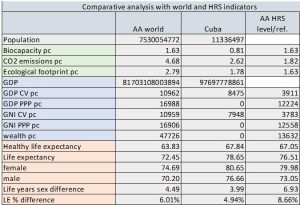
Table 1. Comparative analysis of economic, ecological, and health indicators for Cuba, the global average, and the Sustainable Equity reference

The comparison with the Dominican Republic is particularly illustrative. Both countries share certain historical, geographical, and demographic characteristics, although they have followed different economic and political trajectories. Until approximately 2020, Cuba had a life expectancy nearly five years higher than that of the Dominican Republic, with a difference of more than six years among men. This health advantage was achieved with significantly lower levels of economic resources and ecological consumption than those of high-income countries.
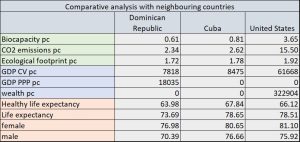
Table 2. Comparative analysis of economic, ecological, and health indicators for Cuba, the United States, and the Dominican Republic

Source: Sustainable Health Equity Atlas, J. Garay, SHEM[4]

The comparison with the United States is also significant. Despite the United States having a per capita biocapacity several times higher and a GDP per capita far above that of Cuba, Cuba’s life expectancy until approximately 2020 was comparable and, in some groups, slightly higher, particularly among men. This difference is one of the factors supporting an analysis of the Cuban experience from the perspective of social efficiency and equity, without ignoring its important economic and political limitations.

Since 2020, however, health indicators have shown significant deterioration. The pandemic caused a substantial increase in mortality and a decline in life expectancy to levels not observed for previous decades. In 2021, life expectancy fell to approximately 73.2 years. This was followed by a partial recovery during 2022 and 2023, but data for 2024 show a further deterioration.

Analysis of data from the Statistical Yearbook of Health indicates that in 2024 life expectancy declined by approximately 1.1 years compared with 2023, according to the calculation used in this study, accompanied by an increase in mortality adjusted for demographic structure. Estimated excess mortality compared with 2023 was around 13,800 deaths.

The absence of consolidated statistics for 2025 and 2026 requires subsequent trends to be interpreted with caution. Nevertheless, the increase in infant mortality reported in 2025 and data obtained in some municipalities during 2026 are warning signals that support the hypothesis of a possible worsening of health conditions. This hypothesis should be tested when complete national statistics become available.

III. Demography

Demographic change is one of the main structural factors shaping the current situation. Cuba increased from approximately seven million inhabitants in 1959 to nearly ten million by the mid-1980s. Since then, population growth has stopped and, since approximately 2019, the population has entered a period of decline.

Current estimates place the resident population at around 9.5 million people, although the effective figure may be lower if people who have recently emigrated but remain administratively registered as residents are taken into account.

Historically, Cuban migration has been directed mainly towards the United States, followed by Spain and Mexico. In recent years, new migration routes towards Latin America, including Brazil, have developed. For part of the low-income population, migration involves the sale of family assets, particularly homes, in order to finance documentation, transport, visas, and initial settlement costs.

Migration has also begun to modify the sex structure of the population. Until approximately 2012, more men than women lived in Cuba, whereas this relationship subsequently reversed and there is now a slight female majority. This phenomenon may be related both to migration, which affects particular age and sex groups differently, and to the greater proportion of women at older ages.

Population ageing is another major challenge. Approximately one quarter of the population is currently aged 60 years or over. The birth rate has declined steadily over previous decades, and fertility is clearly below replacement level, at around 1.3 children per woman.

The combination of low fertility, migration, and increased survival during previous decades is producing rapid population ageing and a decline in the working-age population. This increases the dependency ratio and places additional pressure on pension systems, health care, and long-term care.

IV. Political context

Cuba maintains a political structure centred around the Communist Party of Cuba (PCC), constitutionally recognised as the leading force of society and the State. The PCC provides political direction to the main structures of government, including the Council of State, the Council of Ministers, and the country’s institutional system.

The National Assembly of People’s Power is the main representative and legislative body. Its members are elected through the constitutionally established electoral system, although the composition of national institutions remains closely linked to the political and social structures of the Cuban system. In addition to the PCC, social and mass organisations participate in institutional representation, including organisations representing women, students, farmers, and other social groups.

The process for approving major socioeconomic transformations reflects this hierarchical structure of decision-making. Strategic measures are discussed and approved within political structures before being submitted to the corresponding legislative bodies.

The main traditional media—television, radio, and the press—remain under State control. At the same time, social networks and digital platforms have become an increasingly important source of alternative information, debate, and circulation of opinions, although they are also exposed to misinformation and political polarisation.

In foreign policy, relations with the United States remain particularly tense, although some spaces for dialogue exist. Cuba continues to participate actively in the G77 and maintains political and economic relations with Venezuela, Russia, China, Vietnam, Mexico, Brazil, and other countries. The international situation and the tightening of United States sanctions have progressively altered opportunities for cooperation and trade.

V. The embargo, sanctions, and the international context

Specific consideration should be given to the evolution of the United States economic, commercial, and financial embargo. For decades, a system of bilateral restrictions has been maintained, accompanied by measures with extraterritorial effects, particularly following the Helms-Burton legislation.

During 2026, according to the information analysed during the mission, these restrictions have acquired new dimensions, particularly regarding access to fuel and the behaviour of third-party economic and financial operators. Secondary sanctions and concerns about regulatory risks may generate effects extending beyond the companies formally subject to sanctions.

This phenomenon is particularly relevant for humanitarian cooperation. International organisations, United Nations agencies, and NGOs may face difficulties in transporting or financing certain donations when shipping companies, banks, or suppliers adopt policies of sanctions over-compliance.

The practical consequence is that medicines, food, agricultural equipment, and other goods intended for social programmes may be delayed or temporarily immobilised. These difficulties should be considered in any cooperation strategy intended to operate in Cuba, as they may affect both the cost and logistical feasibility of interventions.

At the same time, greater openness can be observed towards certain commercial flows linked to the Cuban private sector. This process may contribute to economic diversification, but it may also generate new inequalities if access to foreign currency, fuel, and imported goods becomes concentrated among groups with greater economic capacity.

From a public health perspective, the central question should not be limited to determining which actor is responsible for each restriction, but rather to analysing their concrete consequences for the availability of medicines, food, energy, water, transport, and health services, and to establishing cooperation mechanisms that reduce their effects on the most vulnerable populations.

VI. Economy

Limitations of information

The Cuban macroeconomic situation is particularly difficult to quantify. Official statistics do not always allow the full range of transactions carried out in foreign currencies or in informal markets to be reconstructed. This is compounded by multiple exchange rates, restrictions on banking liquidity, and difficulties in recording economic activities carried out outside official channels.

GDP per capita estimates produced by international organisations may be useful for international comparisons, but they do not necessarily reflect the effective purchasing power of the population. The existence of different exchange rates and the significant depreciation of the Cuban peso in informal markets mean that direct conversion of GDP and official salaries can produce very different results depending on the exchange rate used.

A significant proportion of economic transactions currently takes place through informal or semi-formal mechanisms. This particularly affects trade in consumer goods, medicines, foreign currencies, and certain services.

State sector

The State sector continues to play a fundamental role in the provision of social services, particularly health, education, social security, water, sanitation, justice, and other public services.

However, the loss of productive capacity, financial restrictions, infrastructure deterioration, and fuel shortages are reducing the effective capacity of these structures. In some services, informal payments or alternative mechanisms may emerge to compensate for the loss of workers’ purchasing power, with potentially negative consequences for access and equity.

The creation and expansion of micro, small, and medium-sized enterprises has introduced an important transformation. The establishment of an MSME can now take place relatively quickly, and thousands of formally registered private entities already exist.

The private sector offers salaries substantially higher than those available in the public sector and is becoming an increasingly important source of income for part of the population. However, a significant proportion of these activities is concentrated in trade, imports, and services, with still limited capacity to replace the State in the universal provision of social services.

Income and inequality

Public salaries and pensions have lost a substantial part of their purchasing power due to inflation and the depreciation of the Cuban peso. The figures used in this study place the average salary of workers in the budget-funded sector at around 7,000 CUP per month, while the incomes of many private-sector workers are several times higher.

Remittances from abroad are another fundamental component of household economies. Some studies have estimated flows close to US$2 billion annually. However, their distribution is highly unequal and depends mainly on the existence of relatives living abroad.

As a consequence, an economically differentiated society is emerging between those with access to foreign currency, remittances, or private economic activities and those who depend mainly on public salaries or pensions.

This transformation has important health consequences. When public services lose their capacity to provide services free of charge or at subsidised prices, the loss of purchasing power particularly affects households without access to foreign currency, increasing differences in nutrition, medicines, transport, and other determinants of health.

Informal economy

A growing proportion of economic activity takes place through social networks, digital platforms, and informal markets. These mechanisms make it possible to meet needs that cannot be adequately covered through official channels, but they often lack economic, fiscal, health, or consumer protection regulations.

The informal market for medicines is a particularly relevant example from a public health perspective. The availability of certain drugs may depend on travellers, intermediaries, and private networks, often at high prices and without sufficient guarantees regarding storage, authenticity, or quality.

Public assets

The State retains a very substantial proportion of the country’s land and productive and residential assets, as well as almost all State-owned hotel infrastructure. These assets represent considerable potential economic capacity, although their real value and capacity to generate liquid resources are difficult to estimate.

Any strategy for the use of these assets should be assessed not only from a financial perspective but also in terms of its distributive, environmental, and social consequences.

VIII. Ecology and sustainability

Cuba has high biodiversity and a natural heritage of considerable importance. Since the beginning of comparable international series, the country has maintained a relatively low ecological footprint per capita compared with high-income countries.

Cuban biocapacity per capita is approximately 50% below the global average. For long periods, the ecological footprint per capita has remained relatively close to the available biocapacity.
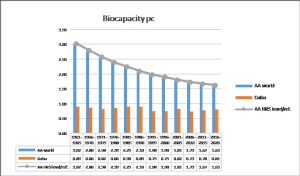
Figure 1. Evolution of per capita biocapacity in Cuba compared with the global average, 1960–2020

The carbon footprint has followed a different trajectory. Per capita emissions increased during certain decades, subsequently declined, and later returned to levels above those considered compatible with certain sustainability criteria.

The estimates used in this study place average emissions during 2015–2020 at approximately 2.5 tonnes of CO₂ per inhabitant, above a sustainability threshold estimated at around 1.8 tonnes.
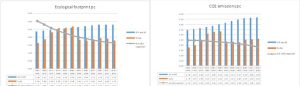
Figures 2 and 3. Evolution of the ecological footprint and carbon footprint per capita in Cuba, 1960–2020, with reference to the ethical threshold of the planetary boundary

These emissions are nevertheless considerably lower than those of the United States and the European Union. The main issue for Cuba is not simply to reduce emissions, but to avoid a future economic recovery based on a model of consumption intensive in fossil fuels and imported goods.

The energy crisis has temporarily reduced some emissions, but the increasing dependence on imported goods may shift an important part of the environmental footprint abroad. The increase in waste from packaging and processed products is also becoming a growing problem in a context of weakening public collection and recycling systems.

IX. Society and living conditions

The energy crisis is currently one of the main determinants of living conditions. Insufficient fuel for thermoelectric power plants, together with breakdowns and deteriorating infrastructure, has produced significant deficits in electricity generation.

Irregular electricity supply directly affects other essential services. Water pumps depend on electricity, meaning that power cuts may result in interruptions to water supply. Internet access and communications are also affected.

Prolonged periods without electricity, water, or communication have cumulative effects on health. They make personal and household hygiene more difficult and affect food preservation, meal preparation, hydration, night-time rest, and the use of fans or other cooling systems during periods of extreme heat.

These problems disproportionately affect older people, households with chronic illnesses, persons with disabilities, and those without the resources to acquire generators, fuel, or private supply systems.

Cost of food and basic goods

Current prices of basic food products represent a very high proportion of public-sector salaries. The family food basket calculated for this study amounts to approximately 85,000 CUP per month.

Basic good / kg-l Price CUP Proportion of two average salaries Equivalent in Spain (€)
FOOD
Sweet potato 200 2.9% 60
Cassava 160 2.3% 48
Taro 400 5.7% 120
Rice 700 10.0% 210
Beans 800 11.4% 240
Lentils 1,000 14.3% 300
Eggs, one dozen 2,010 28.7% 603
Cooking oil 4,000 57.1% 1,200
Chicken (imported from the United States) 1,500 21.4% 450
Minced meat (imported from Brazil) 1,120 16.0% 336
Powdered milk 4,000 57.1% 1,200
Flour 1,000 14.3% 300
Salt 800 11.4% 240
Sugar 1,100 15.7% 330
Coffee 7,000 100.0% 2,100
Seasonal fruit 200 2.9% 60
Onion 1,200 17.1% 360
Garlic, one unit 40 0.6% 12
Bread roll 250 3.6% 75
White Cuban cheese 2,000 28.6% 600
Monthly family basket 85,130 608.1% 12,769.5
HYGIENE
Bar soap 350 5.0% 105
Detergent, 1 kg 1,500 21.4% 450
Toilet paper, one roll 200 2.9% 60
TRANSPORT
Journey of 2–3 km by tricycle 200 2.9% 60
Journey of 2–3 km by car 1,000 14.3% 300
OTHER EXPENSES
Restaurant meal 3,000 42.9% 900
One night in a hotel 21,000 300.0% 6,300
Bicycle 140,000 2,000.0% 42,000
Mobile telephone 91,000 1,300.0% 27,300
Rice cooker 95,000 1,357.1% 28,500
Washing machine 110,000 1,571.4% 33,000
Computer 350,000 5,000.0% 105,000
Electric tricycle 3,500,000 50,000.0% 1,050,000
Car 28,000,000 400,000.0% 8,400,000

Table 3. Prices of basic products in relation to the average State salary and equivalent costs in Spain

When this amount is compared with the average public-sector salary used as a reference, basic food for a family of four requires several monthly salaries. Housing, electricity, water, gas, transport, medicines, hygiene, and other essential goods must be added to these expenses.

The calculation used in this study places the minimum cost of a dignified life at around 210,000 CUP per month, although this figure should be considered an analytical estimate rather than an official poverty threshold.

The discrepancy between the official exchange rate and the effective exchange rate is one of the main factors required to understand this situation. Converting official salaries using the State exchange rate may provide a very different picture from the population’s actual purchasing power.

X. Psychosocial conditions

The material conditions described above also have psychosocial consequences. Economic insecurity, the migration of family members, separation from support networks, difficulties in accessing essential goods, and prolonged interruptions in electricity and water supplies may increase stress and social isolation.

Official information available on mental health is limited. Among the available indicators is the suicide rate, estimated at approximately 13.8 per 100,000 inhabitants, with a marked difference between men and women.

Dementia is also becoming an increasing cause of mortality in the context of rapid population ageing. The growing number of older people living alone or with reduced family networks creates an increasing need for community support services, care, and mental health services.

XI. Health

Life expectancy

Life expectancy is one of the most sensitive indicators for assessing overall changes in living and health conditions.

In 1959, Cuban life expectancy was around 63 years. It subsequently increased steadily, reaching approximately 77.4 years at the beginning of the 2000s.

After a period of stagnation, the pandemic caused an exceptional decline. In 2021, life expectancy fell to approximately 73.2 years. The subsequent recovery was partial, and the 2024 data again show deterioration.
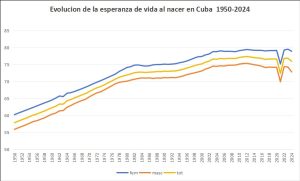
Figure 4. Evolution of average life expectancy at birth and life expectancy disaggregated by sex in Cuba, 1950–2024

According to the analysis conducted using available statistics, life expectancy in 2024 was around 75.4 years, with differences between men and women. These figures indicate a recovery from the 2021 low but do not yet demonstrate a sustained recovery to pre-pandemic levels.

Territorial differences are relatively moderate compared with those in other countries, although relevant variations exist. Guantánamo has one of the highest values, while the Isle of Youth has one of the lowest.

XII. Burden of health inequity

The calculation of mortality rates by age and sex and their comparison with different references makes it possible to estimate the potential burden of mortality associated with avoidable inequalities.

When Cuba in 2024 is compared with the average of the two decades preceding the pandemic, estimated excess mortality is approximately 11,349 deaths, of which around 65% occurred among men.

Compared with mortality rates in 2023, estimated excess mortality reaches approximately 13,783 deaths, with around 62% occurring among men.

Comparison with Guantánamo, used as an internal territorial reference, produces a higher estimate, close to 21,033 deaths. Comparison with an international Sustainable Health Equity reference, represented in this analysis by Sri Lanka, produces a different estimate of approximately 6,600 deaths.

Comparisons with Costa Rica and Spain generate substantially higher potential burdens, exceeding 44,000 and 53,000 deaths, respectively. These figures should not be interpreted as the actual number of deaths that could be prevented through a specific intervention, but rather as counterfactual estimates dependent on the reference used.

Analysis of the relative burden of inequity (RBI) makes it possible to express these differences as a proportion of observed mortality. In relation to the Cuban period 2000–2019, the estimated RBI for 2024 is around 9.6%. Compared with 2023, it rises to approximately 10.4%. The comparison with Guantánamo reaches 16.4%, while international references generate different values according to the social, economic, and environmental characteristics of each country.

Analysis by age shows that inequity is not distributed evenly. Children and certain younger age groups show particularly sensitive burdens when international references with higher survival are used.
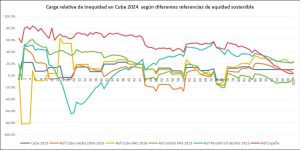
Figure 5. Relative burden of inequity by age and according to different Sustainable Health Equity references

The results suggest that Cuba could benefit from a specific analysis of the factors that allow countries with limited economic resources to maintain better health outcomes. Sri Lanka represents a particularly interesting reference from this perspective, while Guantánamo provides a useful internal reference for identifying potentially replicable territorial practices.

XIII. Years of life lost

Including age in the calculation makes it possible to estimate not only the number of potentially avoidable deaths but also the number of years of life lost.

For 2024, the estimated number of years of life lost associated with the burden of inequity is approximately:

60,000 compared with the Cuban average for 2000–2019.

110,000 compared with Cuba in 2023.

118,000 compared with Guantánamo.

120,000 compared with the Sri Lanka reference.

343,000 compared with Costa Rica.

574,000 compared with Spain.

The differences between these figures demonstrate the importance of carefully selecting the references used. The higher the survival of the population used for comparison, the greater the potential number of years of life lost identified.

This indicator is particularly useful for guiding public policies because it makes it possible to identify where the potential loss of health is concentrated: not only in the number of deaths, but also in deaths occurring at relatively early ages.

XIV. Main patterns of morbidity and mortality

Cardiovascular diseases are the leading cause of death, followed by tumours and respiratory diseases. Cerebrovascular diseases and accidents also account for a significant proportion of mortality.

Infectious diseases have considerably reduced their relative importance compared with previous decades. However, some communicable diseases show worrying trends, including syphilis and certain respiratory infections, hepatitis, and tuberculosis.

From the perspective of years of life lost, tumours are among the main causes, particularly lung, colon, prostate, and breast cancer.

Infant mortality is one of the most sensitive indicators of the current situation. Mortality among children under five may have increased from approximately 6.2 per 1,000 in 2020 to 9.7 per 1,000 in 2024. Two thirds of these deaths occur during the first year of life, and an important proportion are related to perinatal conditions.

Maternal mortality also shows signs of deterioration. In 2024, it was around 33 per 100,000 live births according to the data used in this study, representing an increase compared with the previous year.

Low birth weight has increased from approximately 5% during the two decades preceding the pandemic to around 7–8% in recent years.

Regarding chronic diseases, hypertension, asthma, diabetes, and cerebrovascular disease represent an important burden for the health system, particularly in an increasingly ageing population.

XV. National health system

The Cuban health system maintains a public structure with universal coverage and an extensive primary health care network. This is one of the country’s main assets and should be protected in any cooperation strategy.

Cuba has polyclinics, family medicine practices, hospitals, maternity homes, institutions for older people, and other community-based and specialised services.

The country allocates a high proportion of its public budget to health. However, interpreting health expenditure in US dollars is particularly complex because of the different exchange rates and the difference between nominal values and the real cost of imported goods.

For this reason, rather than relying on a single figure expressed in dollars, it is more useful to analyse the effective capacity of the system to acquire medicines, equipment, fuel, food, and other essential supplies.

Human resources

Until 2020, approximately 400,000 people worked in the Cuban health system. This number may have declined to around 300,000 by 2024.

The number of physicians has also declined substantially, from more than 106,000 in 2020 to approximately 75,000 in 2024. Despite this reduction, Cuba continues to maintain a high physician density by international standards.

The deterioration of salary conditions and economic opportunities in the private sector may be contributing to the movement of professionals from the public health system into other activities or to migration abroad.

The loss of human resources is probably one of the main structural risks to the sustainability of the Cuban health model. Training new professionals takes years and cannot rapidly compensate for the departure of experienced personnel.

Approximately one in six physicians works as a family doctor, integrated into basic health teams and based in the community. The country also has tens of thousands of nursing professionals.

The health system operates through thousands of basic health teams, hundreds of polyclinics and hospitals, and a network of maternal and child, geriatric, and psychopedagogical institutions.

The health information infrastructure, with thousands of units connected to Infomed, represents another important asset for training, scientific communication, and health management.

Activity and coverage of the public health system

In 2024, the National Health System provided more than 100 million consultations, of which approximately 96% were provided through primary health care. Millions of emergency consultations, hundreds of thousands of hospital admissions, and hundreds of thousands of surgical procedures were also recorded.

Vaccination coverage remains one of the main strengths of the system, with coverage close to 98–100% for numerous vaccines included in the national programme.

The national essential medicines list includes around 660 medicines, an important proportion of which are produced domestically. However, economic, energy, productive, and logistical difficulties have significantly reduced their effective availability.

Declining domestic production and imports have resulted in recurrent interruptions in supply. The problem affects not only medicines used in hospitals but also essential treatments for chronic diseases requiring continuity of care.

Informal market for medicines

Insufficient availability of medicines in pharmacies and health facilities has contributed to the expansion of an informal market. Medicines are sometimes brought into the country by travellers and distributed through social networks and personal contacts.

This market may partially compensate for the absence of certain products, but it presents important risks for health and equity. There is not necessarily any guarantee regarding storage conditions, authenticity, expiry dates, or product quality.

Prices observed during the mission show that certain medicines represent an exceptionally high proportion of the incomes of pensioners and public-sector workers.

Medicines Price CUP Proportion of average pension Equivalent in Spain (€)
Paracetamol, 10 tablets 850 24.2% 255
Ibuprofen, 10 tablets 850 24.2% 255
Amoxicillin, 20 tablets 1,700 48.6% 510
Nifedipine, per month 2,250 64.2% 675
Salbutamol, per month 4,000 104.2% 1,200
Enalapril, per month 3,000 85.4% 900
Alprazolam, per month 4,500 128.6% 1,350
Insulin, 300 units/month 12,000 342.8% 3,600

Table 4. Prices of medicines on the informal market, proportion of the average pension, and equivalent values in euros in relation to a salary in Spain

For a person with limited income, common treatments for hypertension, asthma, diabetes, or other chronic diseases may represent a substantial proportion of monthly income. Consequently, purchasing medicines on the informal market may constitute catastrophic health expenditure for some households.

This phenomenon is particularly concerning because it may lead to interruptions in treatment and, consequently, to increased complications, hospitalisations, and avoidable mortality.

XVI. General conclusions

Cuba is experiencing one of the deepest socioeconomic crises of recent decades. The combination of external restrictions, declining productive capacity, inflation, loss of purchasing power, the energy crisis, migration, and population ageing is progressively weakening the capacity of public institutions to guarantee certain basic services.

At the same time, the public system retains important capacities, particularly in health, education, and the training of professionals. The situation should therefore not be interpreted as the disappearance of these capacities, but rather as a process of erosion that may eventually compromise them if resources and productive capacities are not restored.

The development of the private sector represents an important transformation of the Cuban economy. MSMEs have created employment and new sources of income, but so far they have not demonstrated the capacity to replace the redistributive and universal functions historically performed by the State.

The main concern from a public health perspective is that this economic transition may produce increasing segmentation of society between those who have access to foreign currency and those who depend on public salaries or pensions. This inequality may directly translate into differences in food, medicines, transport, energy, housing, and effective access to services.

Recent trends in mortality, life expectancy, infant mortality, low birth weight, and other health indicators constitute warning signals. Data for 2025 and 2026 are still insufficient to establish precisely the magnitude of the deterioration, but they justify strengthening epidemiological and social monitoring.

International cooperation should therefore be directed primarily towards preventing a further loss of essential capacities and protecting the most vulnerable groups.

XVII. Strategic directions for cooperation

The Cuban experience of recent decades raises a broader question: how to preserve achievements in social and health equity in a context of economic restrictions, demographic transition, and ecological crisis.

The response should avoid both an idealisation of the historical Cuban model and an interpretation focused exclusively on its deficiencies. The challenge is to identify which capacities continue to function, which are at risk, and which interventions may contribute to preserving or restoring them.

In this context, four strategic priorities are proposed.

Sustainable energy sovereignty

The first priority should be to move towards greater energy sovereignty based progressively on distributed renewable sources.

Dependence on imported fossil fuels currently represents a systemic vulnerability affecting electricity generation, water supply, hospitals, the preservation of medicines and food, transport, and communications simultaneously.

A strategy based on distributed solar generation, energy storage, and microgrids could initially prioritise health facilities, water systems, rural communities, and other essential services.

The preliminary estimate of approximately 2 kW of solar capacity per inhabitant represents a major investment and would require a specific technical and financial study. Rather than presenting it as an immediate operation, it should be considered as a reference for assessing the scale required for an energy transition.

Part of the country’s public assets, including certain tourism assets, could potentially be assessed as a source of financing for strategic investments, provided that any operation protects the public interest and is evaluated transparently.

Sustainable food sovereignty

The second priority should be the progressive recovery of national capacity to produce healthy and sustainable food.

The increasing dependence on imported food, particularly processed products, creates economic vulnerability, nutritional problems, waste, and logistical dependence at the same time.

The energy transition should be linked to a rural strategy facilitating access to land, water, renewable energy, credit, seeds, and technical assistance for agroecological producers.

Tourism could complement this strategy through rural, ecological, and cultural experiences that generate local income and contribute to financing productive infrastructure.

Fiscal equity and social protection

The third priority should be to strengthen the progressivity of the fiscal system.

In a context of growing inequality between public incomes, remittances, and private economic activities, it is necessary to ensure that people with incomes below a minimum threshold of dignity do not face a fiscal burden that compromises their basic needs.

At the same time, extraordinary incomes and activities with greater capacity to contribute should provide an increasing proportion of resources to finance public goods.

Fiscal policy could also incorporate incentives for activities contributing to the care of people, public health, sustainable food production, renewable energy, the circular economy, and ecosystem protection.

Protection of health, education, and the production of essential medicines

The fourth priority should be to preserve universal and free coverage of essential public services, particularly health and education.

In health, the first objective should be to guarantee the continuity of primary health care and essential treatments for chronic diseases.

The second should be the progressive recovery of national production of essential medicines, including raw materials, formulation, quality control, and distribution systems.

Strengthened national pharmaceutical capacity would not only reduce external dependence but could also allow the development of products of interest to other low- and middle-income countries, transforming certain Cuban capacities into regional or global public goods.

International cooperation could contribute through technology transfer, support for laboratories, joint procurement, quality assurance systems, specialised training, and strengthening supply chains.

XVIII. Final consideration

Cuba is currently facing a critical situation. The combination of external restrictions, internal problems, economic deterioration, population ageing, migration, and the energy crisis is producing a deterioration in living conditions that may compromise some of the social and health achievements accumulated over decades.

At the same time, the country retains important human, institutional, and scientific capacities. The existence of an extensive primary health care network, highly trained professionals, academic institutions, pharmaceutical capacities, and significant historical experience in public health provides a foundation on which action is still possible.

From the perspective of Médecins du Monde, the priority should be to contribute to ensuring that the crisis does not result in an irreversible loss of these capacities and, particularly, in increased inequalities in access to the basic determinants of health.

Cooperation should therefore prioritise interventions with the greatest impact on equity: essential medicines, primary health care, maternal and child health, older people, chronic diseases, mental health, water, energy, and food.

The transition towards greater energy and food sovereignty, accompanied by more progressive taxation and the protection of universal public services, could constitute a strategy capable of simultaneously reducing economic vulnerability, social inequity, and health and environmental risks.

The ultimate objective should not simply be to recover pre-crisis levels, but to build a development model that combines dignity, equity, sovereignty, environmental sustainability, and effective protection of essential public goods.

References
  1. a) Garay, J. (2026). “Cuba’s Health System: From Global Reference in Equity and International Solidarity to Contemporary Crisis.” PEAH – Policies for Equitable Access to Health. Available at: https://www.peah.it/2026/06/16179/
  2. a) Garay, J. (2026). “Cuba: Health Equity, Sustainability and the Limits of a Universal Health System under Prolonged Crisis.” PEAH – Policies for Equitable Access to Health. Available at: https://www.peah.it/2026/06/16179/
  3. b) National Office of Statistics and Information of the Republic of Cuba (ONEI). Statistical Yearbook of Cuba. Latest available editions. Havana: ONEI. Available at: https://www.onei.gob.cu/
  4. c) National Office of Statistics and Information of the Republic of Cuba (ONEI). Studies and publications on population, demography, migration, employment, income, and living conditions. Havana: ONEI. Available at: https://www.onei.gob.cu/
  5. d) Ministry of Public Health of the Republic of Cuba (MINSAP). Statistical Yearbook of Health. Latest available editions. Havana: MINSAP. Available at: https://salud.msp.gob.cu/
  6. e) Pan American Health Organization/World Health Organization (PAHO/WHO). Basic indicators and country profiles: Cuba. Washington, D.C.: PAHO. Available at: https://www.paho.org/es/cuba
  7. f) World Health Organization. Global Health Observatory. Cuba: Health and Health-related Indicators. Geneva: WHO. Available at: https://www.who.int/data/gho
  8. g) United Nations, Department of Economic and Social Affairs, Population Division. World Population Prospects 2024. New York: United Nations. Available at: https://population.un.org/wpp/
  9. h) United Nations Development Programme. Human Development Report 2023/2024: Breaking the Gridlock: Reimagining Cooperation in a Polarized World. New York: UNDP. Available at: https://hdr.undp.org/
  10. i) World Bank. Cuba: data, indicators, and economic and social analysis. Washington, D.C.: World Bank. Available at: https://data.worldbank.org/country/cuba
  11. j) Economic Commission for Latin America and the Caribbean (ECLAC). Economic Survey of Latin America and the Caribbean. Recent editions. Santiago: United Nations. Available at: https://www.cepal.org/
  12. k) Economic Commission for Latin America and the Caribbean (ECLAC). Social Panorama of Latin America and the Caribbean. Recent editions. Santiago: United Nations. Available at: https://www.cepal.org/es/temas/pobreza
  13. l) Food and Agriculture Organization of the United Nations, International Fund for Agricultural Development, United Nations Children’s Fund, World Food Programme, and World Health Organization. The State of Food Security and Nutrition in the World. Recent editions. Rome: United Nations. Available at: https://www.fao.org/publications/sofi/
  14. m) World Health Organization and World Bank. Tracking Universal Health Coverage: Global Monitoring Report. Recent editions. Geneva and Washington, D.C.: WHO and World Bank.
  15. n) Sustainable Health Equity Movement (SHEM). Methodological documents and analyses on sustainable equity, avoidable mortality, and years of life lost. Available at: https://www.sustainablehealthequity.org/
  16. o) Pan American Health Organization. Health in the Americas+: Cuba. Washington, D.C.: PAHO. Available at: https://hia.paho.org/
  17. p) World Health Organization. Access to Medicines and Health Products. Geneva: WHO.
  18. q) World Health Organization. WHO Guideline on Country Pharmaceutical Pricing Policies. Geneva: WHO.
  19. World Health Organization. Medication Without Harm: Global Patient Safety Challenge. Geneva: WHO.
  20. r) World Health Organization. Primary Health Care on the Road to Universal Health Coverage: 2019 Global Monitoring Report. Geneva: WHO.
  21. s) World Health Organization. Operational Framework for Primary Health Care: Transforming Vision into Action. Geneva: WHO and UNICEF.
  22. t) World Health Organization. Social Determinants of Health. Geneva: WHO.
  23. u) World Health Organization. World Report on Ageing and Health. Geneva: WHO, 2015.
  24. v) World Health Organization. Decade of Healthy Ageing 2021–2030. Geneva: WHO.
  25. w) International Organization for Migration. World Migration Report 2024. Geneva: IOM.
  26. x) Médecins du Monde Spain. Institutional documents on humanitarian action, the right to health, equity, and health systems strengthening. Madrid: Médecins du Monde.
  27. y) United Nations. Sustainable Development Goals: Goal 3, Good Health and Well-being. New York: United Nations.
  28. z) World Health Organization. Everybody’s Business: Strengthening Health Systems to Improve Health Outcomes. WHO’s Framework for Action. Geneva: WHO, 2007.
  29. aa) World Health Organization. Monitoring the Building Blocks of Health Systems: A Handbook of Indicators and Their Measurement Strategies. Geneva: WHO, 2010.
Endnotes

[1] https://www.valyter.es/

[2] https://www.sustainablehealthequity.org/

[3] https://www.peah.it/2026/06/16179/

[4] https://www.valyter.es/atlas-de-la-equidad-global
 

News Flash 677: Weekly Snapshot of Public Health Challenges

News Flash Links, as part of the research project PEAH (Policies for Equitable Access to Health), aim to focus on the latest challenges by trade and governments rules to equitable access to health in resource-limited settings

White seabream (Diplodus sargus sargus)

News Flash 677

Weekly Snapshot of Public Health Challenges


Voluntary data submission pilot to advance innovative alternatives to animal testing

Webinar registration: Where Are the PABS Negotiations Heading? Understanding the Africa Group’s Federated Model Sep 7, 2026

Webinar registration: IFIC Forum Discussion on Finance Sep 24, 2026

Webinar registration: From Policy Ambition to System Reality: Improving Access to NCD Medicines in LMICs Sep 25, 2026

Indonesia’s Constitutional Court Restores Safeguards Against Pharmaceutical Patent Evergreening

Amid Ongoing Measles Outbreaks, U.S. Children Remain Vulnerable to Vaccine-Preventable Disease

Respiratory Season Virus Vaccines: Restoring Confidence and Trust

Global initiative launched to improve access to mpox vaccines

Treatment and prevention research on Bundibugyo virus disease must deliver for children, not leave them behind

Feasibility of paediatric schistosomiasis prevention with praziquantel, Madagascar

A Blind Spot in a Humanitarian Catastrophe: Why Yemen’s Jaw Pain Crisis Demands Action by Sami A. Hosain Al-Sakkaf, Ahmed A. Abdulrahman Al-Sakkaf, Akram M. Mohammed Al-Sakkaf

The Road to IHR Reform: How the International Health Regulations were amended to fortify the response to health emergencies

MSF statement: 76th session of the WHO Regional Committee for Africa

HRR832. WE SPEND MORE TIME TRYING TO KEEP TRACK OF INFORMATION THAN USING IT. (Stephen Bezruchka)

Denmark versus UK: which country gets more health for their money?

Measurement of maternal mortality, United Republic of Tanzania

UNICEF Report Underscores Rising Rates of Tech-Facilitated Sexual Abuse Targeting Children

Does aid pay off at home? A new study claims more aid means more exports

UN slashes food aid for occupied West Bank and Gaza amid funding shortfall

The Trump administration cut funds for natural hazards monitoring in Nepal

Nepal’s Flood: Chilling Example of Climate Devastation Facing Developing Countries

Nepal-Tibet flood: this is the cost of not acting in the face of the climate crisis

World Has No Realistic Path to Meet 1.5ºC Warming Target, UN Declares

Occupational heat protection policies

Air pollution across One Health domains

Kenya offers a blueprint for civil society in the ‘America First’ era

Africa Has the Answers to Its Food Security Challenges. What It Needs Is the Architecture to Act on Them

Industrial Aquaculture: better production, better nutrition, better environment, and better life?

Rising Hunger Crisis In Somalia as Millions Go Hungry, WFP Warns

FIAN NEWSLETTER SEPTEMBER 2026 IS OUT! What does the struggle for the right to food look like across different parts of the world?