Oral Public Health and Epidemiology: Foundations for Action in Yemen – A Textbook for Students and Researchers in Fragile and Conflict-Affected Settings

IN A NUTSHELL
Editor's Note 
This comprehensive summary provides valuable, evidence-based insights into the hidden oral health crisis in Yemen and offers practical solutions for fragile and conflict-affected settings. It aligns closely with PEAH's mission to address health inequities and advocate for fair access to care for disadvantaged populations

 Authors: Mahmood Md. Mohsen Al-Sakkaf¹, Sami A. Hosain Al-Sakkaf²’³, Akram M. Mohammed Al-Sakkaf¹’⁴*, Ahmed A. Abdulrahman Al-Sakkaf²

¹Faculty of Medicine and Health Sciences, Aden University;

²Faculty of Dentistry, Hodeidah University, Yemen

³Center of Tropical Medicine and Epidemiology Studies – Hodeidah University (CTMES-HU)

⁴Special Programme for Research and Training in Tropical Diseases (TDR)

 Type of Manuscript: Review Article / Textbook Synopsis

Note: This manuscript describes the content, structure, and evidence base of a forthcoming textbook on oral public health and epidemiology in Yemen. The full textbook is approximately 85,000 words with 20 chapters.

*Corresponding Author:

Dr. Akram M. Mohammed Al-Sakkaf, MBChB, MPH

Email: Akram.m.alsakkaf@gmail.com

Oral Public Health and Epidemiology: Foundations for Action in Yemen – A Textbook for Students and Researchers in Fragile and Conflict-Affected Settings


ABSTRACT

Background: Yemen has experienced a protracted armed conflict since 2015, facing one of the most severe humanitarian crises in recent times. The ongoing conflict has forced over 4 million people from their homes and devastated nearly half of the country’s healthcare facilities, and more than 80% of the population living in poverty. About 79.3% of adults are suffering from periodontitis, and between 50% and 60% of long-term Qat chewers have potentially malignant oral lesions and most of dental caries remain untreated. Moreover, Yemen lacks a national oral health survey or an oral cancer registry, and no fluoridation programme at the population level. Additionally, the dentists-to-population ratio is less than one dentist for every 50,000 people; far below the WHO’s recommendation of one for every 5,000

Objectives: This textbook aims to address these issues by offering a detailed guide to oral public health and epidemiology tailored specifically for Yemen. It takes global frameworks and adjusts them to fit the unique challenges of conflict-affected settings, pulling together all the peer-reviewed research available from Yemen.

Target Audience: undergraduate and postgraduate students studying dentistry, medicine, nursing, and public health; researchers working in fragile environments; and clinicians, policymakers, and humanitarian workers who are either in Yemen or places facing similar challenges.

Structure and Content: The textbook is organized into four parts with 20 chapters and six appendices. The first part covers the core concepts and social determinants of health. The second part focuses on periodontal diseases, caries, oral cancer, and local risk factors. Part three provides guidance on conducting research in conflict zones. Part four part covers health promotion strategies, prevention methods, rebuilding health systems post-conflict. In addition, dedicated chapters on Qat harm reduction, traditional tobacco use, malnutrition concerns, and fluorosis. Practical resources include consent forms available in both Arabic and English.

Conclusion: This textbook fills a crucial gap by providing an evidence-based resource tailored for oral public health in Yemen. It stands as an essential reference not just for students and researchers but also for clinicians and policymakers not only in Yemen but also in other fragile settings around the world.

Keywords: Qat chewing; periodontitis; dental caries; oral cancer; Shammah; Al-Tambal; fluorosis; conflict setting; fragile state; internally displaced persons; task‑shifting; universal health coverage; harm reduction; prevention and  health promotion; social determinants of health.


INTRODUCTION

Yemen has been in a protracted armed conflict since 2015, and it has resulted in one of the most severe humanitarian crises faced in this century. According to a 2023 report from the United Nations Development Programme (UNDP), over 4 million individuals have been forced to flee their homes, and nearly half of the health facilities are either barely functioning or completely destroyed. On top of that, over 80% of the population lives below the poverty line [1].

Oral diseases are quietly spreading like a hidden epidemic. A recent study conducted in Sana’a in 2026 found that 79.3% of adults are suffering from periodontitis [2]. Other research indicates that around 50-60% of long-term Qat chewers end up developing potentially malignant oral lesions [3-5]. Dental caries is largely untreated, particularly in children and according to the Global Burden of Disease (GBD) study, approximately 3.7 billion people globally are suffering from dental caries and untreated dental caries is actually the most common health problem [6].

The situation is exacerbated by Yemen’s fragile health system; no national oral health survey since 1990, there is no registry for oral cancer, and no programmes for water or salt fluoridation. In rural areas, the dentists-to-population ratio is concerning; there is often less than one dentist for every 50,000 residents. Low-income countries typically have around 0.55 dentists for every 10,000 people, which breaks down to about one dentist for every 18,000 persons. The World Health Organization (WHO) actually recommends having a dentist for every 5,000 people [7-9]. This shortage really hits hard in these rural communities [7], makes it so much harder for people to get the dental care they really need.

When the authors went looking for a textbook on oral public health and epidemiology that fits Yemen’s unique challenges, they found a significant gap. Most international textbooks operate under the assumption that there is stable governance and some basic infrastructure conditions that definitely do not apply to Yemen right now. They lack advice on how to carry out an oral health survey in a displacement camp or how to adapt WHO criteria when you do not even have a dental chair available. This textbook aims to bridge this gap and is designed as a comprehensive guide on oral public health and epidemiology specifically for Yemen. It takes those global frameworks and adapts them to fit the unique challenges that come with being in a conflict zone. Furthermore, it brings together all the important peer-reviewed research that are available from Yemen, making it highly relevant for anyone interested in this field.

METHODS-BOOK STRUCTURE

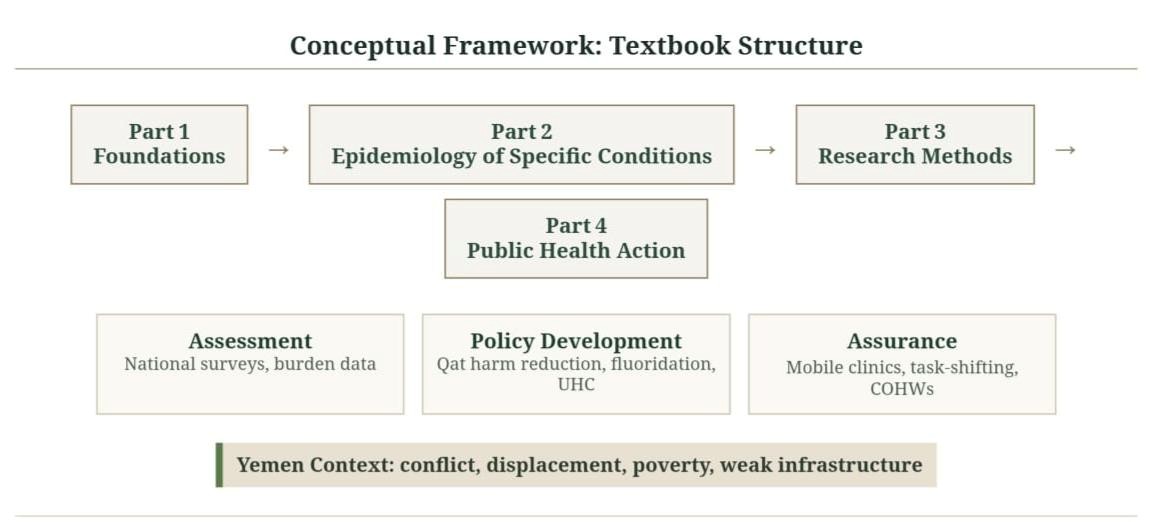
The textbook is divided into four main parts with a total of 20 chapters and six appendices. It is designed with a solid foundation in public health education while also being tailored to fit the unique context of Yemen. Figure 1 shows how the textbook is structured into four connected parts. It starts with the foundations in Part One, then moves through epidemiology and risk factors in Part Two. Next up is Part Three, which dives into research methods, and it all wraps up with public health action in Part Four. This framework is backed by three core public health functions: assessment, policy development, and assurance [10] taking into account the specific challenges faced in Yemen, including conflict, Qat use, tobacco issues, malnutrition, and fluorosis. This framework is inspired by the Dahlgren-Whitehead rainbow model [11] adjusted to address the unique challenges faced by areas like Yemen, where conflict and instability are part of everyday life.

Figure 1: Conceptual Framework of the Textbook Structure. Four integrated parts flow from foundations to public health action, supported by the three core functions of public health and the Yemen‑specific context
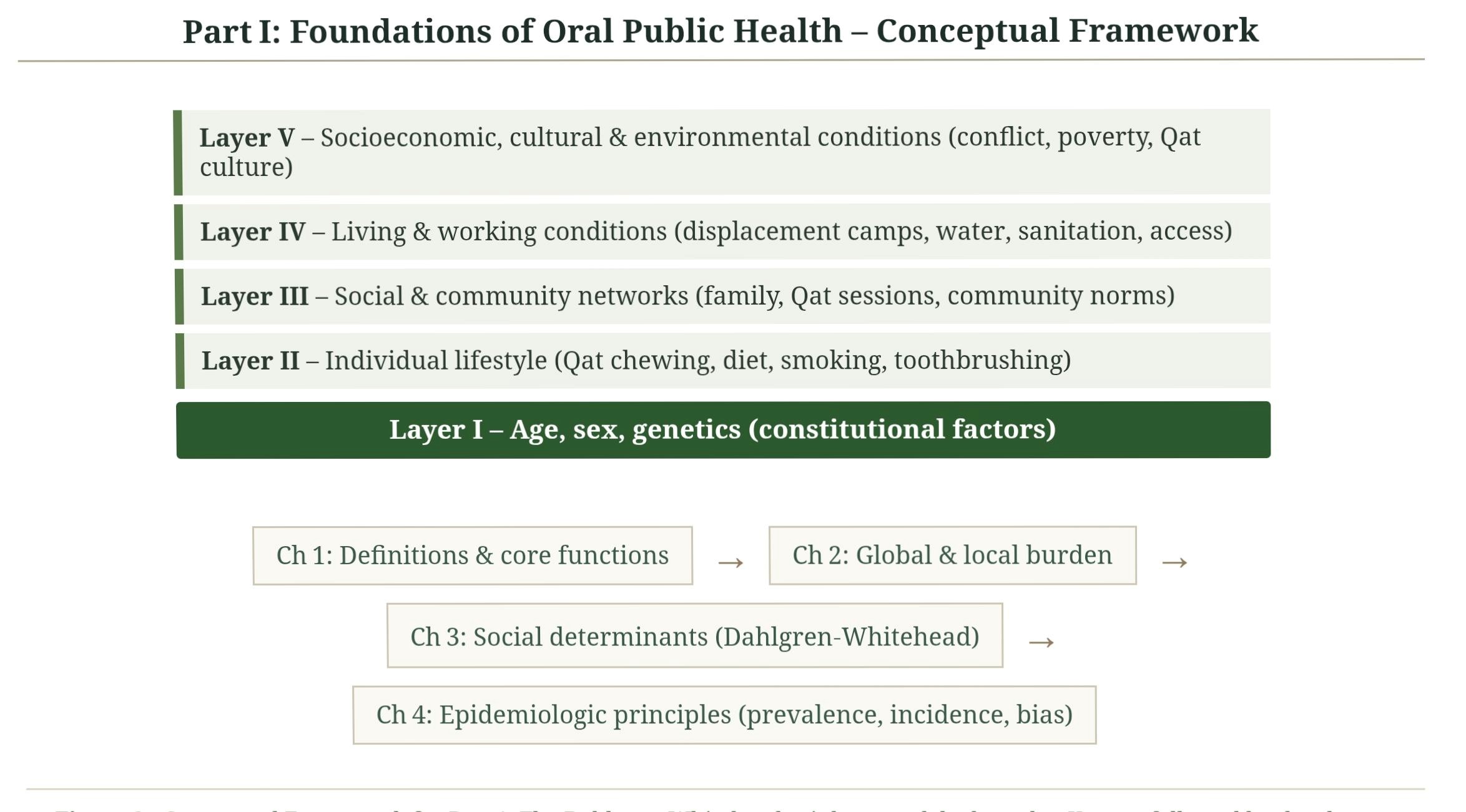
  • Part One: Foundations of Oral Public Health (Chapters 1-4) – Figure 2 (Conceptual Framework)

This part sets the stage for understanding oral public health, especially in vulnerable settings. In Chapter 1, begin by breaking down what oral public health actually is and how it stands apart from clinical dentistry. The three core functions of public health: assessment, policy development, and assurance were defined by the Institute of Medicine’s insights from way back in (1988) [10]. Chapter 2, looks at the global burden of oral diseases, throwing in some eye-opening stats from Yemen, heavily leaning on findings from the GBD Study [6]. Chapter 3, discusses how conflict, displacement, poverty, and Qat culture impact on oral health issues in Yemen using the Dahlgren-Whitehead rainbow model [11] to help illustrate these connections. Chapter 4 wraps up with some essential epidemiologic principles like prevalence and incidence and using real data from Yemen to bring those concepts to life [12,13].

Figure 2: Part One Conceptual Framework. Foundations of Oral Public Health. Four Chapters follow from core definitions to epidemiologic methods. Adapting the Dahlgren-Whitehead rainbow model to Yemeni context
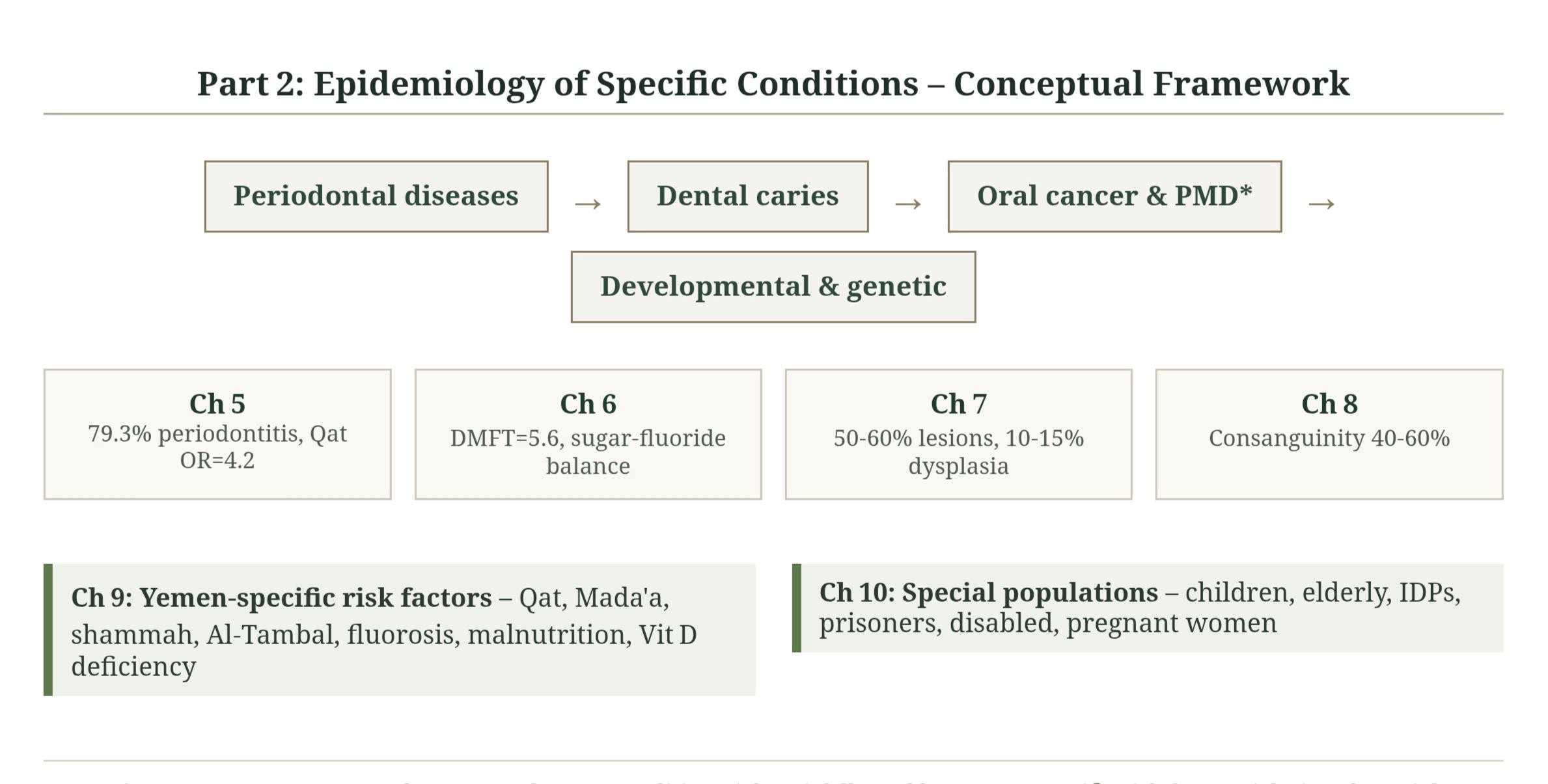
  • Part Two: Epidemiology of Specific Conditions (Chapters 5-10) – Figure 3 (Conceptual Framework)

In this part, applies epidemiologic concepts and methods and diving into some specific oral diseases that are particularly relevant to Yemen. Chapter 5 zooms in on periodontal diseases, drawing on insights found from recent Sana’a study [2] and current classification systems [14]. Chapter 6, addresses dental caries, from the sugar-fluoride balance to the tricky issue of getting access to restorative care [6,14-18]. Chapter 7 focuses on oral cancer and potentially malignant lesions using evidence from local studies [3,4,19,20] and research from around the world [21-23]. Chapter 8 takes a look at developmental and genetic oral conditions while shining a light on consanguineous marriage a practice that is common in about 40-60% of Yemeni marriages [24]. Chapter 9 discusses some unique risk factors in Yemen including Qat use [25], Mada’a waterpipe [25,27], smokeless tobacco products i.e., Shammah [5,28] and Al-Tambal (betel quid) [21] along with burning issues like malnutrition and vitamin D deficiency [29] and endemic fluorosis [30]. Chapter 10 looks into oral health among special populations including children, the elderly, and those who have been internally displaced [31,32].

Figure 3: Part  Two Conceptual Framework. Epidemiology of Specific Oral Public Health Conditions. Ch 5-8 Core conditions, followed by Yemen‑specific risk factors (Ch 9) and special populations (Ch 10). *PMD = Potentially Malignant Disorders
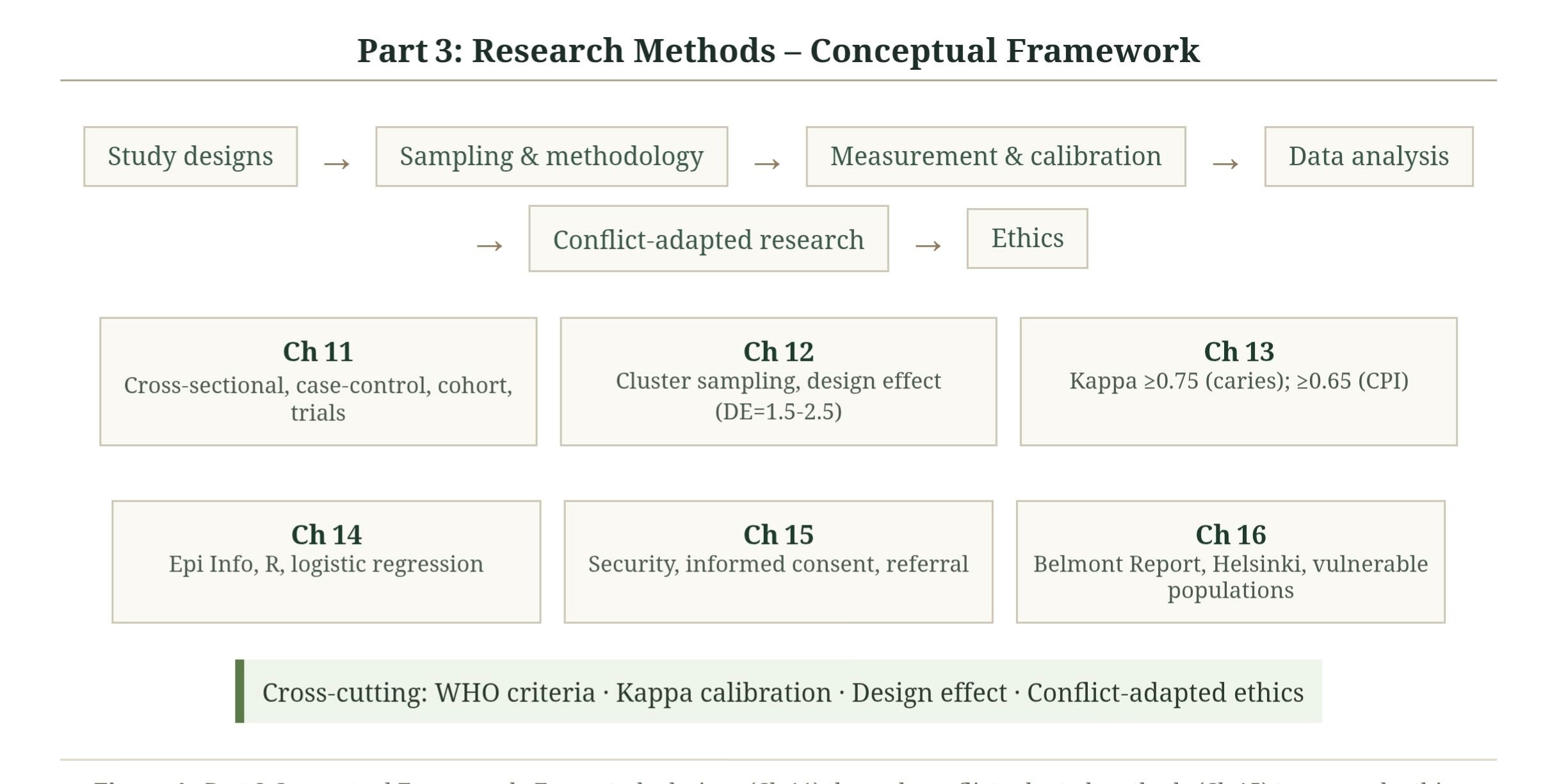
  • Part Three: Research Methods in Oral Epidemiology (Chapters 11-16) – Figure 4 (Conceptual Framework)

This part dives into practical tools for conducting oral health research in fragile and conflict zones. Chapter 11 discusses various study designs that fit the situation in Yemen [33,13]. Chapter 12 addresses sampling methods and survey techniques, drawing from Levy & Lemeshow and the WHO [34,9]. Chapter 13, a thorough discussion of measurement based on WHO guidelines, including how to calculate and understand the kappa statistic thanks to Landis & Koch and the WHO again [34,9]. Moving on to Chapter 14, data management and analysis, along with some software options discussed, with insights from the CDC and R Core Team [35,36]. Chapter 15 discusses challenges may be faced by researchers in conflict areas from getting ethical approvals when review boards are non-functional to figuring out informed consent for individuals with low literacy citing Ford et al. and the WHO [37, 38]. Chapter 16 zooms in on ethical issues specific to oral health research in fragile states, referencing both the Belmont Report and the Declaration of Helsinki [39,40].

Figure 4: Part Three Conceptual Framework. Research Methods in Oral Epidemiology from study designs (Ch 11) through conflict‑adapted methods (Ch 15) to research ethics (Ch ’6)
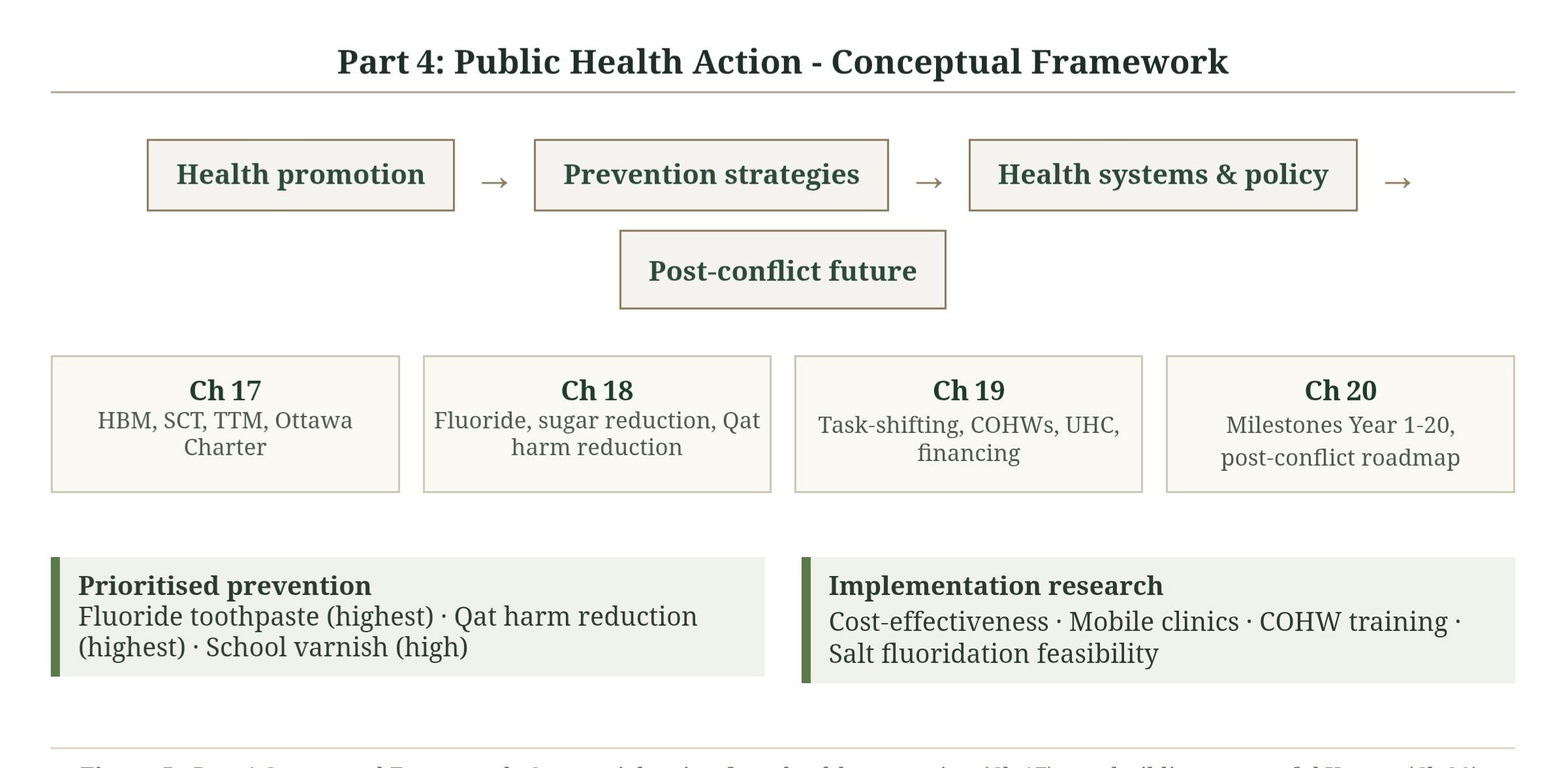
  • Part Four: Public Health Action (Chapters 17-20) – Figure 5 (Conceptual Framework)

This part focuses on how we can take what we have learned from epidemiological studies and put it into action for public health. Chapter 17, dive into health promotion and education strategies, integrating behavior change theories such as the Health Belief Model from Becker [41] Social Cognitive Theory by Bandura [42]. In addition, Ottawa Charter for Health Promotion and the Transtheoretical Model [43,44]. Chapter 18 explores evidence-based prevention strategies. Discussions about fluoride interventions [45,46] and sugar reduction initiatives [18] not to mention Qat harm reduction and school-based programmes. Chapter 19, discusses how health systems can better support oral health in Yemen. This includes integrating oral health into primary care and other methods aimed at reaching universal health coverage [46,47]. Finally, in Chapter 20, presents a vision for rebuilding oral health in a peaceful Yemen; drawing inspiration from lessons learned in other post-conflict countries [48,49,50] and the WHO Global Oral Health Action Plan [51].

Figure 5: Part Four Conceptual Framework. Public Health Sequential Action from health promotion (Ch 17) to rebuilding a peaceful Yemen (Ch 20)
  • Appendices

Six appendices were provided include practical tools such as an adapted WHO-based oral health assessment form for field use in Yemen; sample consent forms in both Arabic and English; an examiner calibration protocol; statistical tables; a sample dataset for student activities; plus a detailed glossary. There’s also back matter with answers to review questions and an index that’s fully cross-referenced for easy navigation. 

RESULTS / KEY FINDINGS FROM THE YEMENI EVIDENCE BASE

Some key epidemiological findings from Yemen integrated throughout the textbook which help grasp the burden, distribution, and risk factors of oral diseases in conflict and fragile state.

  • Periodontal Disease Burden and Risk Factors

A recent cross-sectional study in Sana’a by Alhajj and colleagues in 2026 [2] assessed the oral health of 450 adults between 18 and 65 years old, using the WHO Community Periodontal Index (CPI) and found that around 79.3% of urban Yemeni adults were found to have periodontitis, with almost a third at severe stage-pocket depths of ≥6 mm, ranking Yemen among the countries with the highest periodontal disease prevalence globally. This is not just about genetics or luck: several behavioral risk factors were identified i.e., 68.8% of men and 12.7% of women reported daily or near daily Qat chewing. Smoking was also prevalent, with 24.2% of participants were current smokers and only about 22.2% brushed their teeth twice a day. When they further analyzed the numbers using multivariable logistic regression, five main risk factors emerged for periodontitis. Daily Qat chewing was the strongest (adjusted OR = 4.2; 95% CI: 2.8-6.3; p < 0.001), followed by being over 45 years old (OR = 3.5; 95% CI: 2.2-5.6; p < 0.001), having diabetes mellitus (OR = 2.8; 95% CI: 1.6-4.9; p = 0.003), brushing teeth less than once a day (OR = 2.3; 95% CI: 1.5-3.6; p = 0.001), and current smoking (OR = 2.1; 95% CI: 1.4-3.2; p = 0.002) [2].

When it comes to prevention, these findings are significant for public health. Basically, when calculating the population attributable fraction (PAF) in order to understand how many cases of periodontitis could be prevented if everyone just stopped chewing Qat. Using the formula PAF = Pe(OR-1)/[Pe(OR-1)+1] where Pe = 0.402 is the rate of daily Qat chewing at around 40.2%, the PAF = 56.3%; meaning that more than half of periodontitis cases (56.3%) could be potentially prevented. This shows how important it is to focus on harm reduction strategies for Qat use; a clear call for action.

  • Qat-Associated Oral Lesions and Their Malignant Potential

In this regard, the textbook synthesises multiple studies that explore oral lesions linked to Qat chewing in Yemen, helping readers grasp just how serious this habit can be.

Al-Sharabi and colleagues in 2013 conducted a landmark study comparing 500 Qat chewers to non-chewers in Sana’a and found that white lesions appeared at the chewing site for about 58% of Qat chewers compared to just 4% among non-chewers; biopsy revealed that while most were benign hyperkeratosis, about 12% showed dysplastic changes which may progress to cancer [3]. Another study among long-term Qat chewers confirmed a dose‑response relationship the longer duration of Qat chewing, the higher their risk becomes for serious health issues and malignant potential [4].

A systematic review by Hassan and colleagues took a broader look at six studies from both Yemen and Somalia and reported that around half 52% (95% CI: 44‑60%) of Qat chewers had oral lesions, with dysplasia appearing in about one out of every nine lesions analyzed 11% (95% CI: 6‑16%) [19].

A histopathologic study by Ali examined biopsies from chronic Qat users and comparing tissues from both sides of their mouths “chewing vs non-chewing” and demonstrated marked localised damage caused by Qat use: thickened layers (acanthosis) on the chewing side were seen in nearly all samples 88% versus 0% on the non‑chewing side. Notably when combined with smoking, risks skyrocketed with epithelial dysplasia was present in about 41% of smokers who also chewed Qat compared to 9% among those who did not smoke at all [20]. This insight is pivotal for clinical practice and is emphasized throughout the textbook.

  • Shammah: A Group 1 Carcinogen in Widespread Use

Next up is Shammah a powdered smokeless tobacco product classified as a Group 1 carcinogen by the International Agency for Research on Cancer (IARC) [22]; which means there is a solid evidence that is causes cancer in humans (carcinogenicity).

In a recent systematic review (2025) by Museedi and colleagues, synthesising 40 studies from the Middle East and reported some alarming findings that using Shammah was associated with an odds ratio of 3.9 (95% CI 2.5-6.2) when it comes to the risk of oral cancer, which definitely indicates a significant increase in risk. On the other hand, Qat chewing had a pooled odds ratio of 2.7 (95% CI 1.9-3.8) pointing out that it is risky too, just not to the same extent as Shammah [5].

A study by Scheifele and colleagues involving 200 Shammah users across Yemen revealed that 31% had mucosal burns, primarily located on the tongue or floor of the mouth – high‑risk sites for oral cancer. They also found oral leukoplakia present in about a quarter of users along with two documented cases of oral squamous cell carcinoma [28]. What is really alarming is that only about one-fifth (19%) of Shammah users knew it could cause cancer; a major gap in public health education addressed later on in the textbook’s health promotion sections [28].

Factors like age, non-formal or primary education, previous Shammah use, and frequency of use per day were played significant roles too and independently associated with the presence of such lesions [28]. The textbook helps readers make sense of these relationships by discussing dose-response relationships to illustrate risk gradients like how using Shammah for more than five minutes significantly raises risk level compared to shorter use times.

On a more positive note, several protective factors emerged too. Rinsing after applying Shammah seemed to lower risk substantially while knowing its carcinogenicity made a difference too showing potential pathways for harm reduction strategies moving forward [28]

  • The Dual Burden of Fluoride: Fluorosis and Caries

The textbook also examines the paradoxical fluoride situation in Yemen. The fluoride levels found in groundwater across various regions far exceed what is deemed safe by WHO 1.5 mg/L where in some areas i.e., Sana’a, Taiz, Ad Dhale’e, Ibb, and Dhamar hit the levels “reaching up to thirty-two mg/L” [9]. In a large survey involving over seventeen thousand schoolchildren conducted by Al-Akwa and colleagues found that around two-thirds of children had dental caries [30]. Beyond the general paediatric population, orphaned children face additional challenges when it comes to their dental health, and it is often tougher for them than for other children. A study from 2025 looked at 644 orphans aged 6 to 10 in Ibb and Al-Hodeidah and found that around 7.8% had already lost their early primary molars. It is pretty eye-opening to see how the region impacts their dental issues, showing just how vulnerable these children truly are [18].

An inverse relationship (negative correlation) was observed between fluoride levels and caries experience with the lowest caries scores at the optimum fluoride level of 0.61‑2 ppm while the highest scores at the two extremes (0.0‑0.4 ppm and >2 ppm), demonstrating the characteristic U‑shaped relationship between fluoride exposure and dental caries [30]. To break down fluoride toxicity, the textbook outlines how fluorosis progresses as exposure increases from mild mottling at lower levels to severe deformities as concentrations climb higher than ten mg/L [9].

  • Workforce and Access to Care

The textbook addresses workforce issues within Yemen’s oral health sector which are quite pressing right now. A recent study highlighted gaps among general dental practitioners regarding techniques such as stainless steel crowns and Hall technique, findings that over eighty percent of dentists felt they needed additional training [52]. Younger dentists under thirty seemed more open to using advanced methods which hints at shifts happening within clinical practices over time but quite a few learned these techniques informally through platforms like YouTube rather than through formal education systems. The disparities observed between northern/middle versus southern regions regarding technology usage (p < 0.001), reflecting the fragmented nature of health services in Yemen [52]. These findings guide discussions around important strategies like task-shifting or mobile clinics as ways to tackle workforce shortages effectively across Yemen’s health landscape.

DISCUSSION

This textbook represents a significant advance; being the first to address oral public health and epidemiology in Yemen. It brings together what’s known about the situation in Yemen, points out some significant gaps in research, and provides practical solutions for dealing with health issues in conflict zones.

Some of the findings from the current available studies are downright shocking: such as, 79.3% of people have periodontitis associated with Qat chewing, nearly half to 60% of those who chew it long-term end up with oral lesions, and around 10-15% showing signs of dysplasia, and the significant high odds ratio for developing oral leukoplakia among Shammah users OR=12.99. More than two-thirds of school children in highland areas are battling endemic fluorosis. These numbers really bring home just how serious the oral health crisis is in Yemen and show how urgent it is to take action. Oral health problems in Yemen are pretty similar to what we have seen in other conflict-affected areas in the Middle East. For instance, a study from Gaza in 2025, showed that nearly 30% of dental patients had oral lesions, and more than 19% were found to have potentially malignant disorders. It just goes to show how widespread these oral health challenges are among populations living through the chaos of war in the region [53].

Contribution of the Textbook

This textbook breaks new ground in the field of oral public health, especially when it comes to fragile and conflict-affected places like Yemen.

For starters, it is the first comprehensive guide tailored specifically for Yemen. Many international textbooks just assume there is stable governance and functioning health services, which is far from the reality in Yemen right now. This textbook adapts the current well-established international frameworks i.e,. the WHO Oral Health Survey Manual [9] to fit the context-specific challenges faced by a country in crisis. As Dahlgren and Whitehead pointed out, effective public health needs to tackle multiple layers of factors, and this textbook does just that, ranging from individual behavior change to advocating for national policies [11].

It also dives deep into specific risk factors that are particularly relevant to Yemen but often missed from standard literature. For instance, it discusses the traditional Mada’a waterpipe, which can deliver nicotine equivalent to approximately 70 cigarettes in a single session [25]. And when people mix that with Qat chewing, it significantly increases the chances of developing epithelial dysplasia [5,28]. The book does not shy away from smokeless tobacco products like Shammah either, which have been linked to a high risk of oral lesions [5,19,28]. Furthermore, it highlights the odd situation where both endemic dental and skeletal fluorosis alongside rampant dental caries in different areas definitely a phenomenon rarely addressed in standard health textbooks.

Moreover, this textbook provides practical guidance on conducting research in conflict zones, which is pretty hard to come by elsewhere. It lays out protocols for getting ethical approval even when institutional review boards are non-functional [37], safety planning for research teams, and how to get informed consent from individuals with limited literacy levels. It also suggests ways to create referral pathways for participants needing treatment and how to share findings with various audiences effectively. As the WHO has pointed out, doing research in fragile settings requires some substantial adaptations that are not covered in standard research guides [38].

Given that Yemen has fewer than one dentist per 50,000 people in rural areas [7,8,9], this textbook dives into some practical solutions, like task-shifting and training up community oral health workers, these strategies are important for getting care to more peoples. The authors take inspiration from successful models in other low-income countries and adapt them to fit Yemen’s specific needs.

Target Audience and Utility

This textbook is designed for a diverse audience. Undergrads studying dentistry, medicine, nursing, or public health will find foundational concepts paired with Yemeni case studies and review questions. Postgraduate researchers can dig into advanced methods and gaps in research with detailed answer keys provided. Clinicians and general practitioners will benefit from the emphasis on social determinants of health and hands-on strategies such as dealing with Qat-related lesions and reduction strategies which can be directly applied in their daily practice. Plus, health policymakers and humanitarian workers will find solid guidance on strengthening health systems, financing strategies, task-shifting approaches, universal health coverage principles, and even tips on ethical resource allocation.

Further, the authors rely on legitimate peer-reviewed studies and acknowledging the gaps either if there is no enough Yemeni data, like national surveys or cancer registries, they highlight those areas where more research is desperately needed.

Limitations

There are a few key limitations to keep in mind when looking at the scope and generalizability of this textbook and how applicable it really is.

First, the information we have on oral health in Yemen is pretty limited. It has been ages (since 1990, to be precise) since there has been a national survey on oral health. Second, no national oral cancer registry-limited data on the actual numbers to accurate understanding of the oral cancer situation in Yemen. Third, when it is comes to traditional Yemeni habits and risky behaviors like the Mada’a waterpipe, Shammah, and Al-Tambal (betel quid), little epidemiological research has been done. No prospective longitudinal studies to track how these products impact health over time and no randomized controlled trials to see if any harm reduction methods actually work. Fourth, the textbook suggests some solid solutions for improving the health system, like adding fluoride to salt, taxing sugary stuff, and shifting-tasks among healthcare workers. But here is the thing: these suggestions depend on a level of governance and stability that is not happening in Yemen right now. Thus, putting these ideas into action will not be straightforward and need to take it step by step, starting with some pilot programmes, and of course significant international support will be crucial to make any real progress. Fifth, the textbook can definitely might have its own biases, especially when it comes to publication and geography. Sixth, the practical advice in the textbook for doing research in conflict zones has not really been officially validated. A lot of the adjustments made to the WHO methods like using fewer sampling clusters, trading dental lights for headlamps, and simplifying consent forms are based more on what the authors have seen in the field and what experts suggest rather than solid proof. Also, while the focus is on Yemen, those adjustments might not necessarily fit well in other unstable regions without a bit of extra customization to fit local culture, politics, and health concerns. However, as mentioned earlier, the oral health problems in Yemen could really be a snapshot of what’s happening in other conflict-affected areas throughout the Middle East [53].

Finally, it is clear that even though the authors tried to stay objective, their own opinions and priorities definitely peek through in the textbook. They really focus on oral health and public health research, and that shapes what gets included. However, other stakeholders perspectives like Qat farmers, traditional tobacco users, patients fighting oral cancer, or even humanitarian aid workers was not systematically explored during the writing process. Bringing in those different perspectives would make future editions much better.

Implications for Policy and Practice

Even with these limitations, the textbook suggests a few important points for oral health policy in Yemen.

Prevention: We really need to step up Population-wide fluoride programmes urgently. Pushing for salt fluoridation sounds like a solid long-term plan, but right now, getting fluoride varnish into schools should be of top priority. Qat harm reduction, when we talk about qat use, let’s focus on promoting safer practices like chewing on different sides, rinsing, doing self-checks, and making sure people get screened annually without condemning anyone for their choices. For people’s in areas with high fluoride levels (Taiz, Ibb, Dhamar, and Ad Dhale’e), finding alternative water sources and setting up home filtration systems is crucial to tackle fluorosis issues.

On the workforce side: shifting some tasks to COHWs (who just basic training) and Dental Nurses (who train for two years) is highly important. If we aim for one COHW for every 10,000 people, we are looking at needing around 3,000 of them across the country. That’s totally achievable within five years if we can get some international support.

Health system: It is essential to create a national oral health policy that dedicates at least 1% of the health budget to this area. Oral health must be integrated into primary care and Universal Health Coverage. Furthermore, basic services package that covers education, fluoride varnish application, atraumatic restorative treatment (ART), extractions, and dentures would cost around $2-3 per person each year.

As for research priorities include national surveys, set up an oral cancer registry, collect pediatric data, conduct economic analyses, and run longitudinal studies on traditional risk factors. Plus, intervention trials will play a key role in shaping our national research agenda. Partnerships with international organizations are essential for boosting our research capacity as well.

CONCLUSION

Oral Public Health and Epidemiology: Foundations for Action in Yemen” addresses a significant gap in the available literature. It is a comprehensive, evidence-based guide designed for oral public health education and professionals in Yemen, tailoring global public health concepts to meet the distinct challenges that arise in a country affected by conflict and in fragile states. The textbook synthesises a wealth of peer-reviewed studies from Yemen. For instance, some recent research shows that approximately 79.3% of people have periodontitis, which is strongly linked to Qat chewing [2]. Additionally, there are alarming rates of oral lesions linked to Qat use, 50-60% of users are affected, with 10-15% showing dysplasia [3,4]. Shammah users have an odds ratio of 12.99 for developing leukoplakia, whereas only 19% know it can lead to cancer [5,28]. Finally, the widespread issue of fluorosis among schoolchildren, where dental caries has a prevalence rate of 67.6% [30].

In summary, this textbook extends beyond data; it offers practical advice that has been tested in the field. There are strategies for research in conflict zones, models for task-shifting, designs for mobile dental clinics, and culturally sensitive ways to reduce harm from Qat. It is set up for open-access publication, making it a reference for dental and public health students, researchers, clinicians, and policymakers not just in Yemen but also in other fragile areas around the globe. The authors welcome feedback and contributions for future editions since the understanding of oral health is always evolving especially in fragile settings like Yemen.

Funding:  None

Conflicts of Interest:

The authors declare that they have no conflicts of interest.

Acknowledgments:

The authors acknowledge the support of the University of Aden, the University of Hodeidah. They are grateful to the WHO and IARC for providing such valuable resources. And, of course sincere gratitude to the patients and community members across Yemen who shared their stories with us. Their openness means so much.


REFERENCES

[1] United Nations Development Programme. Yemen: Socioeconomic assessment 2023. New York: UNDP; 2023. https://www.undp.org/yemen/publications/yemen-socioeconomic-assessment-2023

[2] Alhajj WA, AlHaj NJ, Basmail FS, Saleh RA. Prevalence of periodontal diseases and correlations with risk factors among a sample of Yemeni people: cross-sectional study. Braz Dent Sci. 2026;29:e4747. https://doi.org/10.4322/bds.2026.e4747

[3] Al-Sharabi AK, Shuga-Aldin H, Ghandour I, Al-Hebshi NN. Qat chewing as an independent risk factor for periodontitis: a cross-sectional study. Int J Dent. 2013;2013:317640. https://doi.org/10.1155/2013/317640

[4] Kassab A, Al Moustafa AE. Role of Qat Chewing and Mate Consumption in Human Oral Carcinogenesis. In: Al Moustafa AE, ed. Development of Oral Cancer. Cham: Springer; 2017:155-168. https://doi.org/10.1007/978-3-319-48054-1_9

[5] Museedi O, et al. Cultural Practices and Oral Cancer Risk in the Middle East: A Systematic Review. 2025. PMID: 40760977.  https://pubmed.ncbi.nlm.nih.gov/40760977/

[6] GBD 2019 Oral Disorders Collaborators. Global, regional, and national burden of oral disorders from 1990 to 2019. J Dent Res. 2021;100(13):1445-1455. https://doi.org/10.1177/00220345211047068

[7] World Health Organization. Global strategy on human resources for health: workforce 2030. Geneva: WHO; 2016. https://www.who.int/publications/i/item/9789241511131

[8] Gallagher JE, Carr E, Brocklehurst P. Health workforce for oral health inequity: Opportunity for action. PLoS One. 2024;19(6):e0292549. https://doi.org/10.1371/journal.pone.0292549

[9] World Health Organization. Oral health surveys: basic methods. 5th ed. Geneva: WHO; 2013. https://www.who.int/publications/i/item/9789241548649

[10] Institute of Medicine (US) Committee for the Study of the Future of Public Health. The future of public health. Washington, DC: National Academies Press; 1988. https://doi.org/10.17226/1091

[11] Dahlgren G, Whitehead M. The Dahlgren-Whitehead model of health determinants: 30 years on. Copenhagen: WHO Regional Office for Europe; 2021. https://www.who.int/europe/publications/i/item/9789289058735

[12] Last JM. A dictionary of epidemiology. 4th ed. Oxford: Oxford University Press; 2001. https://doi.org/10.1093/acref/9780195314496.001.0001

[13] Rothman KJ, Greenland S, Lash TL. Modern epidemiology. 3rd ed. Philadelphia: Lippincott Williams & Wilkins; 2008. https://www.wolterskluwer.com/en/solutions/ovid/modern-epidemiology-885

[14] Caton JG, Armitage G, Berglundh T, et al. A new classification scheme for periodontal and peri-implant diseases and conditions. J Periodontol. 2018;89(Suppl 1):S1-S8. https://doi.org/10.1002/JPER.18-0157

[15] Fejerskov O, Nyvad B, Kidd E, editors. Dental caries: the disease and its clinical management. 3rd ed. Oxford: Wiley-Blackwell; 2015. https://doi.org/10.1002/9781118935826

[16] Selwitz RH, Ismail AI, Pitts NB. Dental caries. Lancet. 2007;369(9555):51-59. https://doi.org/10.1016/S0140-6736(07)60031-2

[17] World Health Organization. Guideline: sugars intake for adults and children. Geneva: WHO; 2017. https://www.who.int/publications/i/item/9789241549028

[18] Alshamrani KK, AlDhelai TA, Ibrahim RM, Almuallim AM, Alhumaidi AM, Baggash TA, Al Moaleem MM, Shiryan N, Al Makramani B, Qasem AM. Early Primary Molar Loss and Associated Factors among Institutionalized Orphans in Yemen. The Open Dentistry Journal. 2025 Jun 27;19(1).https://opendentistryjournal.com/VOLUME/19/ELOCATOR/e18742106387163/FULLTEXT/

[19] Hassan NA, et al. Qat chewing and oral potentially malignant disorders: A systematic review. J Oral Pathol Med. 2019;48(8):668-675. https://doi.org/10.1111/jop.12923

[20] Ali AA. Histopathologic changes in oral mucosa of Yemenis addicted to water-pipe and cigarette smoking in addition to takhzeen al-qat. Oral Surg Oral Med Oral Pathol Oral Radiol Endod. 2007;103(3):e55-e59. https://doi.org/10.1016/j.tripleo.2006.07.011

[21] International Agency for Research on Cancer. IARC monographs on the evaluation of carcinogenic risks to humans: khat. Lyon: IARC; 1985. https://publications.iarc.fr/Book-And-Report-Series/Iarc-Monographs-On-The-Identification-Of-Carcinogenic-Hazards-To-Humans/Khat-1985

[22] International Agency for Research on Cancer. Betel-quid and areca-nut chewing and some areca-nut-derived nitrosamines. IARC Monographs on the Evaluation of Carcinogenic Risks to Humans, Vol. 85. Lyon: IARC; 2004. https://publications.iarc.fr/100

[23] Sung H, Ferlay J, Siegel RL, et al. Global Cancer Statistics 2020: GLOBOCAN estimates of incidence and mortality worldwide for 36 cancers in 185 countries. CA Cancer J Clin. 2021;71(3):209-249. https://doi.org/10.3322/caac.21660

[24] Mossey PA, Modell B. Epidemiology of oral clefts 2012. Cleft Palate Craniofac J. 2012;49(6):1-13. https://doi.org/10.1597/11-052

[25] Balint EE, Falkay G, Balint GA. Khat – a controversial plant. Wien Klin Wochenschr. 2009;121(19-20):604-614. https://doi.org/10.1007/s00508-009-1259-7

[26] World Health Organization. Waterpipe tobacco smoking: health effects, research needs and recommended actions for regulators. Geneva: WHO; 2015. https://www.who.int/tobacco/publications/prod_regulation/waterpipe-tobacco-smoking/en/

[27] El-Zaatari ZM, Chami HA, Zaatari GS. Health effects of waterpipe (hookah) smoking: A systematic review. JAMA Intern Med. 2015;175(4):535-545. https://doi.org/10.1001/jamainternmed.2014.8356

[28] Scheifele C, Nassar A, Reichart PA. Prevalence of oral cancer and potentially malignant lesions among shammah users in Yemen. Oral Oncol. 2007;43(1):42-50. https://doi.org/10.1016/j.oraloncology.2005.12.013

[29] Al-Maweri SA, Halboub E, Al-Sufyani G, et al. Is vitamin D deficiency a risk factor for recurrent aphthous stomatitis? A systematic review and meta-analysis. Oral Dis. 2020;26(6):1116-1123.  https://doi.org/10.1111/odi.13294

[30] Al-Akwa AA, et al. Dental caries prevalence and its association with fluoride level in drinking water in Sana’a, Yemen. Eur J Dent. 2018;12(1):15-20.  https://doi.org/10.4103/ejd.ejd_27_17

[31] United Nations High Commissioner for Refugees. Oral health in humanitarian settings: a needs assessment. Geneva: UNHCR; 2022. https://www.unhcr.org/media/oral-health-humanitarian-settings-needs-assessment

[32] World Health Organization. Oral health in ageing populations. Geneva: WHO; 2015. https://www.who.int/publications/i/item/WHO-NMH-PND-15.1

[33] Hennekens CH, Buring JE. Epidemiology in medicine. Boston: Little, Brown and Company; 1987.  https://www.lww.com/product/9780316356367

[34] Levy PS, Lemeshow S. Sampling of populations: methods and applications. 4th ed. Hoboken: Wiley; 2013. https://doi.org/10.1002/9781118627394

[35] Landis JR, Koch GG. The measurement of observer agreement for categorical data. Biometrics. 1977;33(1):159-174. https://doi.org/10.2307/2529310

[36] Centers for Disease Control and Prevention. Epi Info user guide. Atlanta: CDC; 2022. https://www.cdc.gov/epiinfo/index.html

[37] R Core Team. R: a language and environment for statistical computing. Vienna: R Foundation for Statistical Computing; 2023. https://www.R-project.org/

[38] Ford N, et al. Ethics of research in conflict settings. PLoS Med. 2009;6(2):e1000023. https://doi.org/10.1371/journal.pmed.1000023

[39] World Health Organization. Research in fragile and conflict-affected settings. Geneva: WHO; 2017.  https://www.who.int/publications/i/item/9789241513227

[40] National Commission for the Protection of Human Subjects of Biomedical and Behavioral Research. The Belmont Report. Washington, DC; 1979.  https://www.hhs.gov/ohrp/regulations-and-policy/belmont-report/index.html

[41] World Medical Association. Declaration of Helsinki: ethical principles for medical research involving human subjects. JAMA. 2013;310(20):2191-2194.  https://doi.org/10.1001/jama.2013.281053

[42] Becker MH. The health belief model and personal health behavior. Health Educ Monogr. 1974;2(4):324-473.  https://doi.org/10.1177/109019817400200407

[43] Bandura A. Social foundations of thought and action: a social cognitive theory. Englewood Cliffs: Prentice-Hall; 1986. https://www.pearson.com/en-us/subject-catalog/p/Bandura-Social-Foundations-of-Thought-and-Action/P200000001106

[44] Prochaska JO, DiClemente CC. Stages and processes of self-change of smoking. J Consult Clin Psychol. 1983;51(3):390-395. https://doi.org/10.1037/0022-006X.51.3.390

[45] World Health Organization. Ottawa Charter for Health Promotion. Geneva: WHO; 1986.  https://www.who.int/teams/health-promotion/enhanced-wellbeing/ottawa-charter

[46] Marinho VC, Worthington HV, Walsh T, Clarkson JE. Fluoride varnishes for preventing dental caries in children and adolescents. Cochrane Database Syst Rev. 2024;(7):CD002279.  https://doi.org/10.1002/14651858.CD002279.pub3

[47] World Health Organization. Universal health coverage: Oral health. Fact sheet. Geneva: WHO; 2021.  https://www.who.int/news-room/fact-sheets/detail/oral-health

[48] World Health Organization. Framework for action on interprofessional education and collaborative practice. Geneva: WHO; 2010.  https://www.who.int/publications/i/item/9789241501460

[49] Binagwaho A, et al. Rwanda’s health system: a post-conflict success story. Lancet. 2014;384(9940):294-305.  https://doi.org/10.1016/S0140-6736(14)60426-2

[50] Tulchinsky TH, Varavikova EA. The new public health. 3rd ed. San Diego: Academic Press; 2014.  https://doi.org/10.1016/C2012-0-01077-5

[51] World Health Organization. Global oral health action plan 2023-2030. Geneva: WHO; 2023. https://www.who.int/publications/i/item/9789240075326

[52] Al-Rai S, Alyousefy M, Al-Twaili Z, et al. Knowledge, practice, and challenges in the use of stainless steel crowns and the Hall technique among Yemeni general dental practitioners: a cross-sectional study. Front Oral Health. 2025;6:1527355.  https://doi.org/10.3389/froh.2025.1527355

[53] Oral lesions and related risk factors in Palestine-Gaza. Philos Ethics Humanit Med. 2025;20:42. https://doi.org/10.1186/s13010-025-00204-z


About the Authors and Their Contributions

All four authors contributed equally in developing the textbook, right from the initial idea, concept and scope, to the target audience definition. On top of that, investigation through systematic collection of peer-reviewed studies from Yemen, WHO reports, and various international literature to back up the work.

Dr. Mahmood Md. Mohsen Al-Sakkaf, MSc, PhD – Genetic epidemiologist at the University of Aden with over 40 years of public health research experience in Yemen. ORCID: https://orcid.org/0009-0001-0921-2208. Conceptualisation, methodology, drafting (Chapters 3-4, 11-13), project administration, corresponding author.

Dr. Sami A. Hosain Al-Sakkaf, MSc, PhD – Oral health specialist and orthodontist at the University of Hodeidah, member of CTMES-HU. ORCID: https://orcid.org/0009-0005-0022-7242. Methodology, drafting (Chapters 1-2, 5-10), clinical insights.

Dr. Akram M. Mohammed Al-Sakkaf, MBChB, MPH – Public health physician, implementation researcher, and WHO-TDR fellow; University of Aden. ORCID: https://orcid.org/0000-0003-4709-4596 . Methodology, drafting (Chapters 17-20), figures, co-administration

Dr. Ahmed A. Abdulrahman Al-Sakkaf, BDS – Dentist and clinical researcher, University of Hodeidah. ORCID: https://orcid.org/0009-0009-9914-6635 . Appendices, case studies, figures.

All authors reviewed and approved the final manuscript

Sustainable Health Equity: A Scientific Framework for Strengthening Human Development Drawing on Cuba’s Experience and Contemporary Challenges

IN A NUTSHELL
Author's Note 
This article reflects the evolution of a line of research developed over recent years within the framework of the Sustainable Health Equity Movement (SHEM).

The conceptual proposal presented here has been deeply inspired by the Cuban experience and by more than three decades of professional, academic and international cooperation with Cuban institutions, universities, researchers, health professionals and local communities.

The author firmly believes that Cuba's long-standing commitment to universal health care, education, solidarity and social justice represents a valuable contribution to global thinking on human development. At the same time, the current challenges faced by the country provide an opportunity to further strengthen these principles through innovation, local development, scientific cooperation and new approaches to sustainable public policy evaluation.

This work is therefore offered in a spirit of respect, dialogue and shared learning. It does not advocate a particular political or economic model. Rather, it seeks to contribute to the scientific discussion on how societies can better transform available resources—both territorial and globally shared—into health, human capabilities, social equity and sustainable well-being for present and future generations

By Juan Garay  *

Former Head of European Union Cooperation in Cuba (2017–2023)

Visiting Professor of Sustainable Equity in Cuban universities including ELAM, UCLV and UNAH

Co-Chair of the Sustainable Health Equity Movement (SHEM)

By the same Author on PEAH: see HERE

Sustainable Health Equity

A Scientific Framework for Strengthening Human Development Drawing on Cuba’s Experience and Contemporary Challenges

With profound respect and gratitude for their enduring commitment to health, education, solidarity and social justice.

May this work contribute, however modestly, to strengthening those principles in the face of today's challenges, while fostering dialogue, shared learning and cooperation among all those working towards a healthier, fairer and more sustainable future.
I.       Abstract

Background

The twenty-first century faces the unprecedented challenge of advancing human well-being while simultaneously promoting social equity and environmental sustainability. Although economic growth, human development and health equity have traditionally been assessed through separate frameworks, there remains a need for integrated approaches capable of evaluating how effectively societies transform available resources into sustainable improvements in people’s lives. Cuba’s long-standing commitment to universal health care, education and social justice, together with the challenges it currently faces, provides a particularly valuable context for exploring such approaches.

Objective

To present the conceptual foundations of Sustainable Health Equity (SHE) and introduce the Sustainable Health Equity Tools (SHET), an open methodological toolbox designed to assess the capacity of societies to transform territorial resources and shared global public goods into health, human capabilities and sustainable well-being, illustrating its relevance through the Cuban experience.

Methods

The proposed framework integrates the capabilities approach, the social determinants of health, sustainable development, ecological economics and the concept of global public goods into a unified analytical perspective. It introduces the Sustainable Health Equity Space (SHES) as a reference model combining indicators of health outcomes, resource availability, equity and sustainability. SHET is designed for application at international, national and local levels, enabling the identification of good practices, inefficiencies and opportunities for evidence-informed policy improvement.

Results

Sustainable Health Equity provides a multidimensional framework for understanding development beyond economic performance alone. By focusing on societies’ capacity to transform available resources into healthy, equitable and sustainable lives, SHET supports comparative analyses across countries and within territories, facilitating public policy evaluation, local development and international cooperation. The Cuban experience illustrates both the enduring value of investment in universal social policies and the importance of continuously strengthening innovation, territorial development and sustainable governance in response to evolving global challenges.

Conclusions

Sustainable Health Equity offers a scientific framework that integrates health, equity, sustainability and human development within a unified perspective. Through the Sustainable Health Equity Tools (SHET), it provides practical instruments to support evidence-informed decision-making, participatory governance and continuous institutional learning. While inspired in part by Cuba’s experience, the framework is intended for broad international application and invites further empirical validation, interdisciplinary collaboration and the progressive development of new analytical tools that contribute to the common good.

Keywords: Sustainable Health Equity; Human Development; Health Equity; Sustainable Development; Social Determinants of Health; Human Capabilities; Public Policy; Global Public Goods; Artificial Intelligence; International Cooperation; Cuba.

II.    Introduction

Humanity is entering an era in which health, social equity, environmental sustainability and technological change are becoming increasingly interconnected. Climate change, biodiversity loss, demographic transitions, widening inequalities, geopolitical tensions and the rapid expansion of artificial intelligence are reshaping the conditions under which societies pursue human development. These challenges call for analytical frameworks capable of integrating multiple dimensions of well-being and guiding public policies towards long-term resilience and the common good (1–8).

Over recent decades, important advances have been made in understanding development beyond economic growth alone. The capabilities approach has highlighted the importance of expanding people’s substantive freedoms (1,2), while the social determinants of health framework has demonstrated that health outcomes largely depend on the social, economic and environmental conditions in which people are born, grow, live, work and age (3). Similarly, the Sustainable Development Goals (SDGs) have emphasized the interdependence of human development, environmental sustainability and social justice (4). Nevertheless, these perspectives have generally evolved through separate conceptual and methodological traditions, and there remains a need for approaches that integrate them into a common operational framework.

This article proposes Sustainable Health Equity (SHE) as an integrative scientific framework for understanding how societies transform available resources into healthy, equitable and sustainable lives. Rather than focusing exclusively on economic production or income distribution, SHE evaluates the capacity of societies to convert both territorial resources and shared global public goods into human capabilities, population health and sustainable well-being across generations.

To operationalize this framework, the paper introduces the Sustainable Health Equity Tools (SHET), an open methodological toolbox designed to support evidence-informed policy analysis at international, national and local levels. Within this toolbox, the Sustainable Health Equity Space (SHES) provides a multidimensional analytical model for comparing health outcomes with the resources available to achieve them, allowing the identification of reference experiences, structural inefficiencies, resource deficits and situations of unsustainable resource concentration.

Although conceived as a universally applicable framework, the present paper draws extensively on the Cuban experience. For more than six decades, Cuba has demonstrated that sustained investment in universal health care, education and social protection can achieve remarkable social outcomes despite severe economic constraints. At the same time, the country currently faces complex demographic, economic and geopolitical challenges that require continued innovation, territorial development and institutional learning. These circumstances make Cuba an especially relevant context for exploring approaches that seek to strengthen social justice while improving efficiency, sustainability and resilience.

Rather than evaluating a particular political or economic model, this article seeks to contribute to a broader scientific discussion on the principles that enable societies to translate available resources into human well-being. In this sense, Cuba is presented neither as an exception nor as a model to be replicated, but as a valuable source of experience from which internationally relevant lessons may be drawn.

The objectives of this paper are therefore threefold: (i) to present the conceptual foundations of Sustainable Health Equity; (ii) to introduce the Sustainable Health Equity Tools (SHET) and the Sustainable Health Equity Space (SHES) as practical instruments for policy analysis; and (iii) to illustrate their potential contribution through the Cuban experience while exploring their broader relevance for international cooperation, sustainable development and the governance of global public goods.

III. Conceptual Framework: Sustainable Health Equity

The concept of equity has traditionally been understood as the absence of unfair and avoidable differences in health, opportunities or access to essential services (1–3). While this perspective has profoundly influenced public health and social policy over recent decades, contemporary global challenges call for a broader understanding of equity that also incorporates sustainability, resilience and intergenerational responsibility.

This paper proposes Sustainable Health Equity (SHE) as a new conceptual framework for understanding equity in the twenty-first century. Rather than considering equity solely as the fair distribution of outcomes or opportunities, SHE defines equity as the capacity of societies to transform available territorial resources and shared global public goods into healthy, replicable and sustainable lives for present and future generations.

This definition introduces several complementary dimensions.

First, equity depends on the availability of resources, including natural assets, human capacities, institutional quality, scientific knowledge, financial resources and global public goods.

Second, equity depends on the efficiency and quality of transformation processes, through which societies convert these resources into health, education, capabilities, environmental sustainability and social well-being.

Third, equity requires that these achievements remain replicable and sustainable, ensuring that present gains do not compromise opportunities for other populations or future generations.

Consequently, Sustainable Health Equity is not defined by the absolute quantity of resources available, nor solely by the distribution of those resources, but by the capacity to achieve the highest attainable and sustainable levels of human well-being with fairness, solidarity and ecological responsibility.

This perspective also shifts attention from competition for scarce resources towards collaboration in generating and protecting shared global public goods, including scientific knowledge, climate stability, biodiversity, peace, digital commons and ethical governance of artificial intelligence. These collective assets increasingly determine the capacity of all societies to achieve equitable and sustainable development.

Within this framework, economic growth is understood not as an end in itself but as one possible means of expanding human capabilities and improving sustainable well-being. Likewise, technological innovation acquires value insofar as it contributes to reducing inequities, strengthening human dignity and protecting planetary systems.

The Cuban experience illustrates many of these principles. Decades of sustained investment in universal education, health care and social protection demonstrate the capacity of public policies to generate high levels of human development under conditions of limited material resources. At the same time, current demographic, economic and environmental challenges highlight the importance of continuously strengthening local innovation, institutional adaptability and sustainable governance while preserving the country’s enduring commitment to social justice and solidarity.

Sustainable Health Equity therefore provides both a normative vision and an operational foundation for evaluating how societies translate available resources into durable improvements in human well-being.

IV. Sustainable Health Equity Tools (SHET): An Operational Framework for Policy Analysis

The conceptual framework of Sustainable Health Equity (SHE) is operationalized through the Sustainable Health Equity Tools (SHET), an open methodological toolbox designed to support evidence-informed decision-making, policy evaluation and continuous institutional learning across different geographical and administrative levels.

Rather than proposing a single composite index, SHET provides a flexible set of analytical tools that enable societies to evaluate how effectively available resources are transformed into sustainable human well-being. This approach recognises that development pathways differ across countries and territories, while maintaining a common conceptual basis for comparison and shared learning.

The methodological framework is founded on three complementary analytical dimensions.

Resource Availability refers to the territorial and globally shared assets available to support human development. These include natural resources, financial capacity, infrastructure, scientific and technological knowledge, institutional quality, social capital, ecosystem services and access to global public goods such as climate stability, peace, international cooperation and digital knowledge.

Transformation Capacity describes the effectiveness with which societies convert these resources into population health, education, human capabilities, social cohesion, environmental sustainability and quality of life. This dimension incorporates the efficiency, equity, resilience and governance of public policies and institutions.

Sustainable Outcomes evaluate whether the resulting levels of well-being are not only high, but also socially equitable, environmentally sustainable and replicable over time without compromising opportunities for future generations or other populations.

Together, these dimensions provide a comprehensive framework for analysing the relationship between available resources and achieved well-being, moving beyond conventional measures based solely on economic production or expenditure.

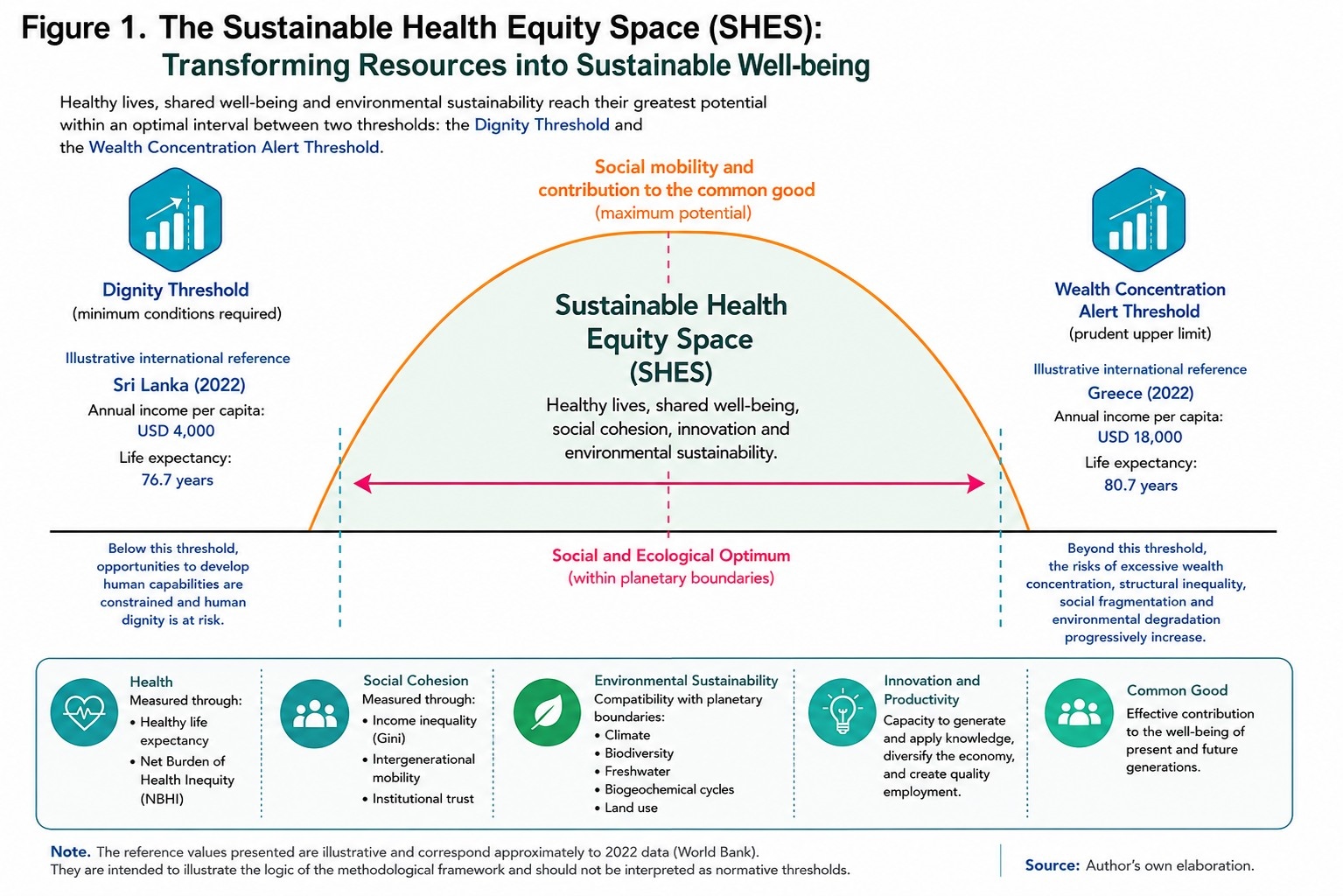
Within SHET, the central analytical instrument is the Sustainable Health Equity Space (SHES) (Figure 1). SHES graphically represents the relationship between available resources and achieved levels of sustainable well-being, allowing territories to be classified according to their relative performance.

Rather than ranking territories in a linear manner, SHES identifies different development situations that require different policy responses. Territories located within the Sustainable Health Equity Zone demonstrate an effective and sustainable transformation of available resources into human well-being. Other territories may present resource deficits, indicating insufficient resources to achieve expected outcomes; transformation inefficiencies, where available resources are not translated into corresponding improvements in well-being; or resource accumulation, where high levels of resource availability coexist with outcomes that are either inefficient or ecologically unsustainable.

This analytical perspective shifts policy attention from simply increasing resource availability towards improving the quality, equity and sustainability of transformation processes. It also facilitates the identification of reference experiences from which other territories may learn, fostering collaboration rather than competition.

The SHET toolbox is designed to operate across multiple scales. Internationally, it enables comparisons among countries facing different development trajectories. Nationally, it supports analyses of regional and sectoral inequalities. Locally, it assists municipalities and communities in identifying strengths, constraints and opportunities for improving sustainable well-being according to their own contexts.

Importantly, SHET is conceived as an open and evolving methodological framework. As new scientific evidence, technologies and social priorities emerge, additional indicators and analytical modules can be incorporated while preserving the conceptual coherence of Sustainable Health Equity. In this sense, SHET is intended not as a static measurement system but as a living scientific platform supporting continuous learning, participatory governance and adaptive public policy.

Figure 1 synthesises the conceptual architecture of Sustainable Health Equity. It illustrates the optimal space within which societies transform territorial resources and shared global public goods into healthy, dignified, replicable and sustainable lives, while respecting both minimum dignity requirements and ecological and social limits associated with excessive resource concentration.
V.    Applying Sustainable Health Equity to Cuba’s Contemporary Challenges

Cuba occupies a distinctive position in the global landscape of human development. For more than six decades, the country has maintained a strong commitment to universal health care, education and social protection, achieving levels of health and human development that compare favourably with those of many countries with substantially greater economic resources. These achievements have been widely documented and continue to provide valuable lessons for global health and social policy.

At the same time, Cuba currently faces a complex combination of demographic, economic, environmental and geopolitical challenges that increasingly influence the sustainability of these achievements. Population ageing, migration, economic constraints, climate-related risks, technological transformation and changing patterns of international cooperation require continuous adaptation while preserving the constitutional principles of equity, solidarity and universal social rights.

Within this context, Sustainable Health Equity (SHE) offers a complementary analytical perspective. Rather than evaluating political or economic systems, it seeks to understand how available resources can be more effectively transformed into sustainable well-being while safeguarding the ethical foundations that have historically characterised Cuban social development.

The Sustainable Health Equity Tools (SHET) provide practical instruments for analysing these processes across different territorial scales. At the national level, SHET can support the assessment of how resources, public policies and institutional capacities contribute to health, human development and environmental sustainability. At provincial and municipal levels, the framework enables a more detailed understanding of local diversity, recognising that territories with similar resource endowments may achieve markedly different outcomes depending on governance, social participation, innovation and institutional effectiveness.

Particularly relevant is the application of the Sustainable Health Equity Space (SHES) to municipal analysis. By comparing resource availability with indicators of sustainable well-being, municipalities can be grouped according to their relative performance.

Some municipalities may constitute Sustainable Health Equity reference areas, achieving excellent health and social outcomes despite modest resource availability through effective local governance, strong community participation and the sustainable management of natural and social assets. These experiences may provide valuable lessons for other territories.

Other municipalities may exhibit transformation gaps, where relatively abundant resources do not translate into comparable improvements in population well-being, suggesting opportunities to strengthen institutional performance, coordination and policy implementation.

Conversely, some municipalities may experience resource constraints, where favourable governance and social commitment are limited by insufficient material or financial resources. In such cases, SHET can help identify priorities for territorial investment and intergovernmental solidarity.

Finally, SHES also makes it possible to identify territories where resource availability exceeds levels compatible with equitable and environmentally sustainable development, highlighting opportunities to improve efficiency, strengthen solidarity and optimise the allocation of resources for the benefit of society as a whole.

Beyond territorial classification, the principal value of SHET lies in promoting collective learning. Rather than ranking municipalities according to success or failure, the framework encourages dialogue among territories, enabling local experiences, innovations and good practices to be shared across the country.

In this regard, institutions dedicated to local development and territorial innovation—such as the Centre for Local and Community Development (CEDEL) and the broader scientific and institutional networks working on sustainable local development in Cuba—could play an important role in supporting participatory implementation, methodological refinement and continuous learning. Their accumulated experience in community participation, territorial governance and local innovation provides a strong foundation for integrating Sustainable Health Equity into existing development processes.

VI. Knowledge, Global Public Goods and Artificial Intelligence: New Frontiers for Sustainable Health Equity

The growing interdependence of contemporary societies has expanded the range of factors that shape human well-being beyond national boundaries. Climate stability, biodiversity, peace, scientific knowledge, digital infrastructures, pandemic preparedness and ethical governance increasingly function as global public goods, generating benefits that transcend borders and whose protection requires collective responsibility and international cooperation (17–20).

Within the framework of Sustainable Health Equity (SHE), these global public goods should not be regarded simply as external contextual factors, but as essential components of societies’ resource endowment. The capacity of countries and communities to achieve sustainable well-being increasingly depends not only on their territorial assets but also on equitable access to globally shared knowledge, technologies and collaborative networks.

Among these global public goods, knowledge occupies a unique position. Unlike finite material resources, scientific knowledge expands through sharing and collaboration. When generated, disseminated and applied under principles of openness, scientific integrity and social responsibility, knowledge becomes a powerful driver of health, innovation and sustainable development. Consequently, reducing inequalities in the production, accessibility and application of knowledge constitutes an increasingly important dimension of Sustainable Health Equity.

Artificial Intelligence (AI) represents one of the most transformative developments in this context. Properly governed, AI can strengthen health systems, improve epidemiological surveillance, support clinical decision-making, optimise resource allocation, accelerate scientific discovery and facilitate more comprehensive analyses of complex social and environmental interactions. It also offers unprecedented opportunities to develop adaptive policy-support systems capable of continuously learning from new evidence.

However, AI also introduces important ethical challenges. Unequal access to computational infrastructure, biased algorithms, concentration of technological capabilities, insufficient transparency and weak democratic oversight risk widening existing inequities if these technologies evolve primarily according to commercial or geopolitical interests.

From the perspective of Sustainable Health Equity, AI should therefore be understood not merely as a technological innovation but as a global public good whose governance should be guided by principles of equity, transparency, accountability, scientific openness and the common good. The objective is not simply to increase technological capacity, but to ensure that digital innovation contributes to healthier, more equitable and environmentally sustainable societies.

Within the Sustainable Health Equity Tools (SHET), AI can also function as an analytical instrument. By integrating diverse sources of epidemiological, environmental, economic and social data, AI-assisted tools can support policy-makers in identifying transformation gaps, evaluating alternative policy scenarios and monitoring progress towards Sustainable Health Equity. Importantly, such systems should complement rather than replace human deliberation, democratic participation and ethical judgement.

The implications extend well beyond national policymaking. As global challenges become increasingly interconnected, scientific cooperation and open knowledge-sharing become strategic investments in humanity’s collective capacity to improve sustainable well-being. International collaboration in research, education, digital technologies and public health should therefore be viewed not simply as development assistance but as a shared responsibility for strengthening global resilience.

In this perspective, Sustainable Health Equity provides a conceptual bridge between territorial development and global cooperation. It highlights that long-term human well-being depends not only on how societies manage their own resources, but also on how effectively they contribute to generating, protecting and sharing the global public goods upon which all societies increasingly depend.

VII.      International Cooperation and Global Solidarity for Sustainable Health Equity

The increasing interconnectedness of global challenges calls for a renewed understanding of international cooperation. Climate change, pandemics, biodiversity loss, demographic transitions, food security, migration and the rapid evolution of digital technologies increasingly transcend national borders and cannot be effectively addressed through isolated national responses.

While international cooperation has made significant contributions to health and development over recent decades, existing frameworks have often remained fragmented, donor-driven and predominantly focused on financial transfers or sector-specific interventions. Although these approaches have generated important achievements, they have not always addressed the structural determinants of global inequities or promoted sufficiently balanced partnerships based on mutual learning, shared responsibility and the stewardship of global public goods.

From the perspective of Sustainable Health Equity (SHE), international cooperation should therefore be understood not primarily as assistance from wealthier to less wealthy countries, but as a collaborative process through which all societies jointly strengthen their capacity to generate, protect and share the global public goods upon which sustainable human development increasingly depends.

This perspective recognises that all countries simultaneously contribute to and benefit from shared global assets, including scientific knowledge, climate stability, biodiversity, public health security, peace, digital infrastructures and the ethical governance of Artificial Intelligence. Consequently, cooperation becomes a reciprocal investment in humanity’s common future rather than a unidirectional transfer of resources.

However, Sustainable Health Equity also suggests that collaboration alone is unlikely to be sufficient. Persistent global inequalities indicate that a more ambitious architecture of equitable international redistribution will be required if all people are to enjoy the minimum material conditions necessary for a life in dignity.

Within the SHE framework, every individual should have access to a minimum level of resources above a dignity threshold, ensuring the real opportunity to develop fundamental human capabilities. At the same time, Sustainable Health Equity recognises that there are also excess thresholds, beyond which additional consumption contributes progressively less to human well-being while generating disproportionate environmental degradation, resource depletion or social imbalance.

This dual perspective allows Sustainable Health Equity to distinguish between economic activity that genuinely contributes to sustainable well-being and what may be described as “toxic GDP”—economic production and consumption whose environmental and social costs exceed their contribution to human flourishing. Redirecting part of this excess economic activity towards equitable redistribution would simultaneously reduce ecological pressures and strengthen global social justice.

Illustrative analyses developed within the Sustainable Health Equity framework suggest that guaranteeing universal access to material living conditions above the dignity threshold could require annual redistributive flows on the order of US$7 trillion, approximately forty times current levels of Official Development Assistance. While substantial, this represents only a modest share of global economic output and should be understood as a long-term investment in global stability, human development and shared prosperity rather than as a simple financial transfer.

Importantly, such redistribution would not necessarily require continued global economic expansion. On the contrary, progressively reducing economic activity beyond ecologically sustainable levels could create the fiscal and productive space needed both to finance universal dignity and to accelerate the transition towards more sustainable patterns of production and consumption.

Preliminary analyses further suggest that, after ensuring universal living conditions above the dignity threshold, more than US$10 trillion annually could remain available for collaborative investment in global public goods. These investments could support scientific research, education, global health, pandemic preparedness, biodiversity conservation, climate resilience, open knowledge infrastructures, ethical Artificial Intelligence and other strategic assets whose benefits extend across countries and generations.

Within this perspective, redistribution and collaboration become complementary pillars of international cooperation. Redistribution enables all societies to participate meaningfully in sustainable development, while collaborative investment accelerates the generation of knowledge and innovations that benefit humanity as a whole.

The Sustainable Health Equity Tools (SHET) provide a common analytical framework for assessing these processes. Beyond measuring financial inputs or project outputs, SHET evaluates how cooperation strengthens institutional capacity, territorial resilience, scientific collaboration, equitable access to global public goods and the long-term transformation of resources into sustainable well-being.

This perspective is particularly relevant for countries such as Cuba. Throughout its contemporary history, Cuba has made internationally recognised contributions to global health through medical education, international medical cooperation, biotechnology, disaster response and the promotion of universal health care. At the same time, current economic constraints substantially limit the material resources available to sustain these achievements. When purchasing power is considered using exchange rates that more closely reflect actual access to internationally traded goods and services, Cuba’s effective per-capita income may fall below the proposed dignity threshold despite its comparatively high levels of education, health and social development. This illustrates the importance of evaluating development through the combined lens of resource availability, transformation capacity and sustainable well-being rather than through conventional macroeconomic indicators alone.

Ultimately, Sustainable Health Equity proposes a renewed vision of international cooperation founded upon three complementary principles: universal dignity, ensuring that no person falls below the minimum conditions required for a healthy and fulfilling life; ecological sustainability, ensuring that development remains within planetary boundaries; and collaborative stewardship, whereby societies collectively invest their knowledge, resources and innovation in the protection and expansion of global public goods for present and future generations.

Rather than replacing existing development frameworks, this approach seeks to complement them by providing a broader ethical and analytical foundation for international cooperation in the twenty-first century—one that places solidarity, reciprocity and shared responsibility at the centre of sustainable human development.

VIII.   Discussion

The Sustainable Health Equity framework proposed in this paper seeks to contribute to an evolving international dialogue on how societies can simultaneously advance human well-being, social justice and environmental sustainability in an increasingly interconnected world. Rather than replacing existing theories of health equity, human development or sustainable development, SHE builds upon these traditions while proposing a broader understanding of equity that integrates resource availability, transformation capacity and sustainable well-being within a single conceptual framework.

This perspective recognises that equity cannot be understood solely in terms of the distribution of income, opportunities or health outcomes. Instead, Sustainable Health Equity defines equity as the capacity of societies to transform both territorial resources and shared global public goods into healthy, replicable and sustainable lives for present and future generations. In doing so, it introduces a dynamic understanding of equity that simultaneously incorporates efficiency, solidarity, ecological sustainability and intergenerational responsibility.

One of the principal contributions of this work is the distinction between the conceptual framework (SHE), the operational methodological toolbox (SHET) and the analytical model represented by the Sustainable Health Equity Space (SHES). This architecture allows the framework to evolve progressively as new scientific knowledge, indicators and analytical methods become available, while maintaining conceptual coherence across different scales of application.

The Cuban experience provides an especially meaningful context for developing this framework. Few countries have demonstrated such a sustained commitment to universal health care, education and social justice under prolonged economic constraints. At the same time, Cuba’s current demographic, economic and environmental challenges illustrate the importance of continuously strengthening governance, territorial development, scientific innovation and international collaboration while preserving the ethical principles that have guided its social achievements. In this sense, the framework is offered as a contribution to Cuba’s ongoing efforts to strengthen justice, solidarity and sustainable development, while also generating lessons that may be relevant to other countries facing different but equally complex challenges.

Beyond Cuba, Sustainable Health Equity has potential applications across multiple geographical and institutional scales. Internationally, it may contribute to comparative analyses of development trajectories and global cooperation. Nationally, it offers a framework for evaluating territorial inequalities and policy effectiveness. Locally, it can support participatory planning processes by identifying municipalities and communities that achieve outstanding outcomes despite limited resources, as well as territories where governance, investment or resource allocation could be strengthened.

The framework also opens new avenues for integrating advances in data science and Artificial Intelligence into public policy. Rather than replacing human judgement, AI has the potential to strengthen evidence-informed decision-making by integrating complex datasets, identifying emerging patterns and supporting continuous institutional learning. Ensuring that these technologies remain transparent, equitable and oriented towards the common good should itself be regarded as an essential dimension of Sustainable Health Equity.

At the global level, the framework suggests that the future of equity will increasingly depend on humanity’s capacity to generate, protect and share global public goods. Scientific knowledge, climate stability, biodiversity, peace and ethical digital infrastructures are no longer external determinants of development but integral components of societies’ opportunities to achieve sustainable well-being. Consequently, international cooperation should evolve beyond traditional development assistance towards more balanced partnerships combining equitable redistribution, collaborative investment and shared stewardship of humanity’s common assets.

The present work should also be understood as an invitation to further scientific development. The concepts, indicators and tools proposed here require empirical validation across diverse geographical contexts and policy settings. Future research should refine the measurement of transformation capacity, develop composite SHET indicators, evaluate municipal and national applications, explore AI-supported analytical platforms and assess the implications of Sustainable Health Equity for global governance and financing.

Ultimately, Sustainable Health Equity should be viewed not as a fixed model but as an evolving scientific framework. Its long-term value will depend on continued dialogue among researchers, policy-makers, communities and international institutions committed to advancing healthier, fairer and more sustainable societies.

IX. Conclusions

This paper proposes Sustainable Health Equity (SHE) as a new scientific framework for understanding how societies transform available territorial resources and shared global public goods into healthy, dignified, replicable and sustainable lives for present and future generations.

Building upon previous advances in health equity, the capabilities approach, sustainable development and ecological economics, SHE introduces a broader conception of equity that integrates three complementary dimensions: resource endowment, transformation capacity, and sustainable well-being. In doing so, it moves beyond assessing the distribution of resources or outcomes alone, towards evaluating the effectiveness, fairness and sustainability with which societies convert available opportunities into human flourishing.

To support practical implementation, the paper introduces the Sustainable Health Equity Tools (SHET) as an open methodological toolbox and the Sustainable Health Equity Space (SHES) as a visual and analytical model for evaluating development across international, national and local scales. Together, these instruments enable the identification of reference experiences, transformation gaps, resource deficits and situations of unsustainable resource use, providing evidence to support continuous policy improvement and mutual learning.

The Cuban experience has served as the principal inspiration for this work. Over more than six decades, Cuba has demonstrated the enduring value of sustained investment in universal health care, education and social solidarity, while its contemporary demographic, economic and environmental challenges illustrate the importance of continuously strengthening local innovation, institutional learning, scientific collaboration and sustainable governance. The framework is offered with deep respect for Cuba’s historical commitment to social justice and with the hope that it may contribute constructively to ongoing national reflection on how these principles can be further strengthened under changing national and global circumstances.

Beyond Cuba, Sustainable Health Equity provides a framework that may be applicable to countries at all levels of development. It offers opportunities to strengthen evidence-informed public policy, territorial planning, international cooperation and the governance of global public goods. In particular, it highlights the growing importance of scientific knowledge, ethical Artificial Intelligence, climate stability, biodiversity and peace as shared assets whose protection increasingly determines humanity’s collective capacity to achieve sustainable well-being.

The framework also proposes a renewed vision of international cooperation. Lasting progress towards Sustainable Health Equity will require not only stronger collaboration among nations but also more equitable redistribution of opportunities and resources, ensuring that every person can live above a universal dignity threshold while humanity progressively reduces unsustainable patterns of production and consumption. At the same time, societies can increasingly invest their collective capacities in generating and protecting global public goods that benefit present and future generations alike.

This article should be regarded as the beginning rather than the conclusion of a scientific endeavour. Future research will be needed to refine indicators, validate the methodology across diverse settings, strengthen participatory applications at municipal and national levels, explore AI-supported analytical platforms and further develop the ethical, economic and governance dimensions of Sustainable Health Equity.

Ultimately, Sustainable Health Equity is not simply a framework for measuring development. It is an invitation to rethink development itself: to understand progress not as the accumulation of wealth, but as humanity’s growing capacity to share resources fairly, transform them wisely and sustainably, and expand the opportunities for all people to live healthy, dignified and meaningful lives in harmony with one another and with nature.

X.    Acknowledgements

The author wishes to express his deepest gratitude to the Cuban people, whose enduring commitment to health, education, solidarity and social justice has been a constant source of inspiration throughout more than three decades of professional collaboration, research and friendship.

Special thanks are extended to the many Cuban institutions, universities, researchers, health professionals, local communities and public servants who have generously shared their knowledge, experience and commitment to improving people’s lives. Their dedication has profoundly shaped the ideas presented in this work.

The author also gratefully acknowledges the many international colleagues, academic collaborators and institutions who, over the years, have contributed through dialogue, scientific exchange and shared reflection on health equity, sustainable development, international cooperation and global public goods.

Finally, sincere appreciation is extended to the members of the Sustainable Health Equity Movement (SHEM) and the Valyter Ecovillage, whose daily commitment to solidarity, care for nature and community living continues to inspire the practical development of the principles described in this article.

Use of Artificial Intelligence

Artificial Intelligence was used as a scientific writing support tool during the preparation of this manuscript. AI-assisted editing contributed to improving the  linguistic quality of the text and facilitated the organisation of references. All scientific concepts, methodological proposals, interpretations and final editorial decisions remain entirely the responsibility of the author.

Conflict of Interest

The author declares no financial or commercial conflicts of interest related to this work.

The concepts presented in this article have been developed independently as part of the Sustainable Health Equity research programme and are offered solely to stimulate scientific dialogue, methodological development and evidence-informed public policy.

Funding

This research received no specific grant from any funding agency in the public, commercial or not-for-profit sectors.

Data Availability

No primary datasets were generated or analysed during the preparation of this conceptual article.

Author Contributions

Juan Garay conceived the conceptual framework, developed the methodology, conducted the analysis and wrote the manuscript.

XI. References
  1. Sen A. Development as Freedom. Oxford: Oxford University Press; 1999.
  2. Nussbaum MC. Creating Capabilities: The Human Development Approach. Cambridge (MA): Harvard University Press; 2011.
  3. World Health Organization. Closing the Gap in a Generation: Health Equity Through Action on the Social Determinants of Health. Geneva: WHO; 2008.
  4. United Nations. Transforming our World: The 2030 Agenda for Sustainable Development. New York: United Nations; 2015.
  5. Raworth K. Doughnut Economics: Seven Ways to Think Like a 21st-Century Economist. London: Random House Business Books; 2017.
  6. Rockström J, Steffen W, Noone K, Persson Å, Chapin FS III, Lambin EF, et al. A safe operating space for humanity. Nature. 2009;461:472–475.
  7. UNESCO. Recommendation on the Ethics of Artificial Intelligence. Paris: UNESCO; 2021.
  8. World Health Organization Council on the Economics of Health for All. Health for All: Transforming Economies to Deliver What Matters. Geneva: WHO; 2023.
  9. Garay J. From Equality to Sustainable Health Equity. PEAH – Policies for Equitable Access to Health. 2017.
  10. Garay J. Net Burden of Health Inequity (nBHiE): methodological framework. PEAH-Policies for Equitable Access to Health. 2024.
  11. Garay J. Identifying International Sustainable Health Models. PEAH. 2024.
  12. Garay J. Distribution into a Normal Bell Curve Based on Equity. PEAH. 2024.
  13. Garay J. Enough is Enough and More is Too Much. PEAH. 2024.
  14. República de Cuba. Constitución de la República de Cuba. Gaceta Oficial de la República de Cuba. La Habana; 2019.
  15. Garay J. Empathetic Local Governance, Ecosystem-friendly Production and Consumption and Circular Economy. PEAH. 2024.
  16. Centro de Desarrollo Local y Comunitario (CEDEL). Publicaciones sobre desarrollo local y comunitario. La Habana.
  17. Ministerio de Ciencia, Tecnología y Medio Ambiente (CITMA). Documentos estratégicos sobre ciencia, innovación, medio ambiente y desarrollo territorial.
  18. República de Cuba. Plan Nacional de Desarrollo Económico y Social hasta 2030 .
  19. Garay J. Artificial Intelligence for Sustainable Health Equity. PEAH. 2025.
  20. Garay J. A New Political and Socio-economic Order is Urgently Needed and is Feasible. PEAH. 2023.
  21. World Health Organization. Health for All: Transforming Economies to Deliver What Matters. Geneva: WHO; 2023.
  22. United Nations. Pact for the Future. New York: United Nations; 2024.
  23. Intergovernmental Panel on Climate Change (IPCC). Sixth Assessment Report. Geneva: IPCC; 2023.
  24. United Nations. Our Common Agenda. New York: United Nations; 2021.
  25. Garay J. A Renewed International Cooperation Partnership Framework in the XXIst Century. PEAH. 2023.
  26. Garay J. Seville 2025: 5% for War, 0.25% for Life. PEAH. 2025.
  27. Popper KR. The Logic of Scientific Discovery. London: Routledge; 1959.


________


*  MD, internal medicine, MSc Trop Med, MPH, independent researcher and co-founder of the Sustainable Health Equity Movement (SHEM) and Valyter Ecovillage, a community initiative promoting shared living, care for nature and sustainable development. He has worked for more than three decades in public health, health equity and international cooperation. He served as Coordinator of the European Union Cooperation Programme on Global Health and for Mexico (2013–2017) and Cuba (2017–2023). He is  Visiting Professor at the Latin American School of Medicine (ELAM), the Marta Abreu Central University of Las Villas (UCLV) and the Agrarian University of Havana (UNAH) in Cuba; the Autonomous University of Chiapas (UNACH) in Mexico; Fundação Oswaldo Cruz (Fiocruz) in Brazil; the National School of Public Health (ENS) in Spain; and the University of California, Berkeley, USA. His research focuses on Sustainable Health Equity, global health, human development, international cooperation and the governance of knowledge and global public goods for the common good.

From Local Evidence to Global Lessons: Vietnam’s Mask Research and the COVID-19 Pandemic 

IN A NUTSHELL
Author's Note 
Mask use in Vietnam evolved from a familiar daily habit into a critical public health intervention during the COVID-19 pandemic. Before the pandemic, researchers in Hanoi had already studied mask practices among healthcare workers, including one of the few randomized clinical trials comparing cloth masks and medical masks in hospital settings. 

Although this evidence received limited attention at first, it became highly relevant when COVID-19 raised urgent global questions about whether masks work, which masks should be used, and how they should be worn. 

The Vietnam studies showed that mask type, quality, fit, compliance, and correct use are essential. They also reinforced an important lesson for future pandemics: the right mask, used correctly in the right setting, can help reduce disease transmission and protect healthcare workers, patients, and communities

By Tham Chi Dung, MD., PhD.

Deputy Director

Research Institute for Health Sciences (RIHS), Hanoi city, Vietnam

Email: thamchidung@icloud.com

Link: (PDF) A cluster randomised trial of cloth masks compared with medical masks in healthcare workers

 From Local Evidence to Global Lessons: Vietnam’s Mask Research and the COVID-19 Pandemic 


Before COVID-19, masks were already familiar in Vietnam. People wore them on motorbikes, in crowded streets, in hospitals, and during seasonal respiratory outbreaks. However, before the pandemic, mask use was often understood more as protection against dust, pollution, or visible illness than as a central public health intervention.

Long before the world debated universal masking during COVID-19, researchers in Vietnam had already studied mask use among healthcare workers. These studies examined how masks were used in hospitals, what barriers healthcare workers faced, and how different types of masks performed in real clinical practice. This body of work later became highly relevant when the world urgently searched for evidence during the pandemic. [1–5]

One important study from Vietnam later became highly influential in global discussions on masks. The study, A cluster randomised trial of cloth masks compared with medical masks in healthcare workers, was conducted in 14 secondary and tertiary hospitals in Hanoi among 1,607 healthcare workers. It compared cloth masks, medical masks, and usual practice in high-risk hospital wards. The paper was published in BMJ Open in 2015 and was one of the very few randomized clinical trials directly comparing different types of masks in real healthcare settings. [1]

At the time of publication, the paper received limited attention outside infection prevention and occupational health communities. Its findings, however, were important. The study found that healthcare workers using cloth masks had higher rates of respiratory infection than those using medical masks. The authors concluded that cloth masks should not be recommended for healthcare workers in high-risk clinical settings, particularly when medical masks or respirators are available. Laboratory testing in the study also showed much higher particle penetration through cloth masks compared with medical masks. [1]

This trial was not an isolated effort. Earlier and related publications had already examined healthcare worker practices around face mask use, the use of cloth masks in Hanoi hospitals, and barriers to the use of facemasks and respirators among hospital-based healthcare workers. These studies helped build a practical evidence base on mask use before COVID-19 became a global crisis. [2–5]

When the first cases of a new coronavirus disease were reported in late 2019 and early 2020, the world entered a period of uncertainty. The disease was initially associated with a novel coronavirus and later officially linked to severe acute respiratory syndrome coronavirus 2, or SARS-CoV-2. As COVID-19 spread globally, masks quickly became one of the most visible and debated tools for preventing transmission.

Many urgent questions emerged. Could masks prevent COVID-19? Should only sick people wear them, or should everyone wear them? Were cloth masks useful? Were medical masks better? When should N95 or equivalent respirators be used? How should masks be worn, removed, washed, or disposed of? Who should wear which type of mask in hospitals, in communities, and during outbreaks?

The urgency of these questions increased because SARS-CoV-2 could spread through respiratory droplets and aerosols, including from people with mild symptoms or no symptoms. Communities, healthcare workers, researchers, governments, and international agencies began searching for clinical evidence on mask effectiveness. They found that there were very few randomized trials on masks, and even fewer comparing mask types among healthcare workers. The Hanoi trial therefore became highly relevant because it offered rare clinical evidence from real hospital practice. [1]

During 2020 and 2021, this once relatively quiet paper became one of the most consulted studies on cloth masks and medical masks. It was cited in scientific reviews, public health debates, and policy discussions because it addressed a practical question that the world urgently needed to answer: not simply whether masks should be used, but which mask should be used, by whom, and in what setting.

The lesson from Vietnam’s mask study was not that masks do not work. Rather, it showed that mask quality, mask type, fit, compliance, and correct use matter greatly. In hospitals, healthcare workers need medical masks for routine care and respirators such as N95, FFP2, or equivalent masks for aerosol-generating procedures and high-risk infectious disease care. Cloth masks may have a role in the community when better masks are unavailable, but they should not replace medical masks or respirators for healthcare workers in high-risk clinical settings. [1,4,5]

The COVID-19 pandemic transformed masks from a simple personal habit into a global public health tool. In Vietnam, where mask wearing was already culturally acceptable, the practice became one of the visible symbols of collective responsibility. Masks helped protect individuals, families, patients, healthcare workers, and communities. They were most effective when combined with hand hygiene, ventilation, distancing, vaccination, testing, isolation, and clear risk communication.

The story of mask use in Vietnam therefore carries an important global message. A study conducted silently in Hanoi hospitals before the pandemic became a key source of evidence with million views and readings when the world urgently needed answers. It showed that masks are not all the same: the right mask, worn correctly, by the right person, in the right setting, can become a powerful tool to reduce disease transmission. 


References

  1. MacIntyre CR, Seale H, Dung TC, Hien NT, Nga PT, Chughtai AA, Rahman B, Dwyer DE, Wang Q. A cluster randomised trial of cloth masks compared with medical masks in healthcare workers. BMJ Open. 2015;5(4):e006577. doi:10.1136/bmjopen-2014-006577.
  2. Seale H, MacIntyre CR, McLaws ML, Maher L, Newall A, Kaur R, Nga PT, Nguyen TH, Dung TC, Dwyer DE. Health care worker practices around face mask use in hospitals in Hanoi, Vietnam. Int J Infect Dis. 2012;16 Suppl 1:e384. doi:10.1016/j.ijid.2012.05.503.
  3. Dung TC, Hien NT, Nga PT, Dinh PN, Seale H, MacIntyre CR, Maher L, Phuong N, Dwyer DE. Use of cloth masks among healthcare workers in hospitals in Hanoi. Vietnam Journal of Preventive Medicine. 2012;22(2):104-110.
  4. Chughtai AA, MacIntyre CR, Peng Y, Wang Q, Ashraf MO, Dung TC, et al. Practices around the use of masks and respirators among hospital health care workers in 3 diverse populations. Am J Infect Control. 2015;43(10):1116-1118. doi:10.1016/j.ajic.2015.06.006.
  5. Chughtai AA, Seale H, Dung TC, Hayen A, Rahman B, MacIntyre CR. Compliance with the use of medical and cloth masks among healthcare workers in Vietnam. Ann Occup Hyg. 2016;60(5):619-630. doi:10.1093/annhyg/mew008.


__

By the same Author on PEAH

Field Hospitals During the COVID-19 Pandemic in Vietnam: Practical Lessons for Rapid Establishment, Health-System Integration, Patient Flow, and Mortuary Preparedness

Healthcare Provider Payment Reform in Vietnam: Current Policy Directions and Potential Solutions

The Basic Health Service Package in Vietnam: A Strategic Instrument for Universal Health Coverage and Primary Healthcare Strengthening


After the Stroke: Why Health Systems Fail Their Own Doctors

IN A NUTSHELL
Author's Note 
Organizational accountability starts with how a system treats its most vulnerable members—even when those members are the doctors themselves

A deeply personal experience here of Indian corporate healthcare system failure by a story that reveals the fragility of health systems when one of their own professionals becomes the patient

By Nandini Sharma

MD (AIIMS), MBA (HCA, FMS, DU)

Ex -Director Professor and HOD Community Medicine (DU)

& Ex -Dean, Maulana Azad Medical College

BSZ Marg, New Delhi 110002

State Operation Research Chairperson, NTEP, GNCT Delhi, India

After the Stroke: Why Health Systems Fail Their Own Doctors


The two-day intense deliberation in Lucknow on “Enhancing medical colleges role in TB elimination in India” concluded on 19 November 2015 and I took the flight back to Delhi hoping for a good restful night at home. The moment I entered home – the phone rang, i took the call and it shattered my world: my 49-year-old brother, an orthopaedic surgeon, had suffered a stroke and was being taken to the nearest hospital.

As I rushed through traffic, my mind was a blur of clinical protocols—the “golden hour,” rising stroke incidence rate in India, the immediate logistics of emergency care and our public health systems efforts — prevention, caregiving, rehabilitation — racing through my mind.

Praying hard and thinking of ways to break the news to my aged parents I reached the hospital. In the years since, that personal crisis has evolved into a stark exposure of a global systemic failure. It is a story that reveals the fragility of health systems when one of their own professionals becomes the patient.

When the Healer Needs Healing

My brother was a rising star in the corporate hospital circuit in Delhi NCR, the capital of India. Trained in both India and the UK, GMC (General Medical Council)-registered, and a recognized mentor in postgraduate programs, he possessed a wealth of clinical wisdom.

However, the moment he lost power in his left side, his professional identity was stripped away. The systems he dedicated his life to offered no safety net. The corporate hospital where he worked so diligently and generated revenue, valued only his ability to operate. His decades of teaching experience and sharp clinical reasoning were deemed “non-revenue generating.” The corporate hospital gave him the proverbial cold shoulder.

The health Insurance covered the month-long acute care; the long-term costs of rehabilitation were crushing. In a cruel twist, his wife an oncologist decided to get his scalp flap reconstruction done a year later at the corporate hospital where she was employed. The health insurance claim was denied and she was not given any concession by her hospital.

They had to pay the entire amount out of pocket – treated as strangers rather than family.

They decided to go back to UK after two years – but there was no support from the system there also. Having practiced outside the UK for a period, he found the NHS pathways for returning to practice inaccessible, though the system did provide essential medical cover for his complications—a relief the Indian insurance market refused to offer.

Despite a sharp memory and intact skills, his physical disability rendered him invisible. Globally we count stroke survivors in burden of disease studies. We don’t count doctor survivors- trained specialists who could still teach, assess, write medico legal reports, guide policy.

The Policy-Implementation Gap

For 11 years, I have watched a highly skilled surgeon fall through the cracks of well-intentioned but poorly executed policies. This isn’t just one family’s struggle; it is a diagnostic report on a broken global health workforce strategy.

The Legislation that could not help: India’s Rights of Persons with Disabilities Act (2016) exists on paper, but provides virtually no framework for the “reasonable accommodation” of medical professionals in the private sector.The return to the High income country could not help as the UK’s Supported Return to Practice (SRtP) , lacks the flexibility to support those navigating complex cross-border return or long-term recovery.

The Indian corporate health sector has a “Clinical Value” Myth. In Low- and Middle-Income Countries (LMICs) the rapidly expanding corporate health model equates “fitness” with “procedural volume,” ignoring the immense value of physician-led auditing, mentoring, and policy-making.

What Global Health Loses

There remains a profound disparity in stroke incidence and outcomes between relatively poor and rich countries. In LMIC countries, the incidence of stroke has more than doubled in the last 4 decades while in HIC countries it has declined by 42%. Many of those affected in the LMIC countries would possibly be health workers. These countries face a shortage of health manpower and therefore cannot afford to lose experienced clinicians.

My brother cannot move his left arm and hand, but his mind is a repository of expertise. He could be – Reviewing complex trauma cases for legal/medical audits, mentoring residents in clinical reasoning, advising on hospital accessibility and patient safety, analysing MRI over-utilization to reduce healthcare waste and many other healthcare related activities.

Three Essential Shifts for Organizational Accountability

To stop the “double loss” of skilled professionals (once to illness, then to neglect), we must advocate for three systemic changes in LMIC countries:

1.  Adaptive Return-to-Practice Pathways

We must adapt models like the GMC’s SRtP for LMIC contexts. Health systems must create “soft landing” roles in telemedicine, quality improvement, and education that don’t require long hours on one’s feet in an OR.

2.  Radical Inclusion in Workforce Planning

The Human Resource management in Health care services in LMIC countries needs to have a specific section on rehabilitation of disabled health care workers. The system must also track how many doctors and nurses who acquire a disability are successfully reintegrated into the system?

3.  Redefining “Fitness to Practice”

“Fitness” should mean being safe and effective for a defined, specific role, not the ability to perform every possible physical task. Diversity in the workforce—including physical diversity—improves patient empathy and system resilience.

The Human Cost of Silence

Eleven years later, my brother sits at home. He is still a trained surgeon. He still possesses a wealth of knowledge. But because the system saw only a “disabled body” rather than an “expert mind,” he remains sidelined. The impact on our family has been devastating—mentally, emotionally, and financially. It raises a haunting question for every clinician: If a doctor or nurse employed by a corporate hospital becomes a patient, would the hospital recognize his / her value, or would he/ she be discarded?


Organizational accountability starts with how a system treats its most vulnerable members—even when those members are the doctors themselves. It is time we stop losing our healers to the very systems they helped build.

News Flash 670: Weekly Snapshot of Public Health Challenges

News Flash Links, as part of the research project PEAH (Policies for Equitable Access to Health), aim to focus on the latest challenges by trade and governments rules to equitable access to health in resource-limited settings

Conger eel (Conger conger)

News Flash 670

Weekly Snapshot of Public Health Challenges


The ‘Universal Declaration of the Rights of Peoples’: Context, Content, and Implementation

Open letter to leaders of G7, G20, BRICS and all nations on finalizing the WHO Pandemic Agreement’s Pathogen Access and Benefit Sharing annex

Public investment demands public benefits: European Biotech Act must deliver for people

European Biotech Act Must Deliver Public-Interest Innovation and Equitable Access

IFIC Webinar registration: Relaunching SIG Children, Youth and Families Jun 23, 2026

Webinar registration: Livestock’s Lengthening Shadow: 20 Years After Livestock’s Long Shadow Jun 26, 2026

Register for the webinar: The plastic crisis: Endangering our planet and our health 2 July 2026

‘We’re not seeing a rebound’: New data shows HIV services not recovering

What happens when the world’s best HIV prevention tool meets the planet’s deadliest infectious disease?

US Support for Ebola Response is Unclear Amid Opaque Funds Disbursement and Non-Engagement with WHO

What Will It Take to Get a Bundibugyo Vaccine?

DRC: One month on, MSF warns dangerous gaps persist in Ebola disease response

The Social Contract of Bundibugyo Ebola Isolation

The DNDi-MMV Joint Regulatory Platform: ‘a pioneering programme project for non-profit medical research organizations to speak with one voice’

Towards elimination of Chagas disease

The Rise Of Kratom: A Dangerous And Familiar Pattern

Safe blood supply improves as voluntary donations exceed 85%, but many people still lack access

The Last Bottle of Halothane: Why Africa Cannot Wait

When Illness Leads to Poverty: Strengthening Financial Protection for Vulnerable Populations in Burkina Faso for Equitable Access to Healthcare  by Madina Larissa Ouedraogo

Logistics Gaps Overshadow Uganda’s Progress on Maternal Deaths

AP exclusive: Doctors Without Borders report found cases of abuse and exploitation by staff in Chad

HRR822. ARE WE WITNESSING A ‘GLOBALIZATION OF GOD’ OR ARE WE AT THE DAWN OF THE GREATEST DECLINE OF ‘THE SPIRITUAL’? (Carlos Angulo)

Amnesty International: Israel’s ethnic cleansing of West Bank Bedouin and herding communities

As a father in Gaza, the new home I am building for my children is a nylon tent

Millions of Children Go to School Near a Toxic Site

UN food agencies warn acute hunger will worsen in 13 hot spots as famine risks rise

Climate action as peace enabler: lessons from the Sahel on delivering peace and social dividends in fragile settings

Half of world’s children exposed to at least three climate hazards, Unicef says

Planet on Course to Permanently Breach 1.5°C Limit by 2030

Rising temperatures may increase flood risk through river ‘whiplash’, study finds


When Illness Leads to Poverty: Strengthening Financial Protection for Vulnerable Populations in Burkina Faso for Equitable Access to Healthcare

IN A NUTSHELL
Author's Note 
…Health is a fundamental right. Its exercise should never depend on income level, place of residence, or professional status. Strengthening the financial protection of vulnerable populations means investing simultaneously in health, the fight against poverty, and human development.

In Burkina Faso, the experience of TOND LAAFI (Health and Social Protection System) demonstrates that it is possible to build more supportive, inclusive, and resilient systems. Systems capable of protecting families against the economic consequences of illness while promoting equitable access to care…

By Madina Larissa Ouedraogo 

Directrice pays Association TOND LAAFI projet français ATIA 

Ouagadougou, Burkina Faso 

When Illness Leads to Poverty

Strengthening Financial Protection for Vulnerable Populations in Burkina Faso for Equitable Access to Healthcare


In Burkina Faso, falling ill is not just a medical challenge. For thousands of families, illness also represents an economic ordeal capable of permanently disrupting the household’s balance. Medical consultations, complementary exams, medication, hospitalization, and transport to health facilities are all expenses that can quickly exceed the financial capacities of families, particularly when they already live in precarious conditions.

In a country where a large portion of the working population operates in the informal sector, without health insurance or formal social protection, the onset of an illness can lead to dramatic consequences. Every day, households are forced to choose between paying for healthcare or meeting other essential needs such as food, children’s education, or housing.

This situation particularly affects the most vulnerable populations: informal sector workers, women, the elderly, rural residents, and households living below the poverty line. While geographical difficulties in accessing care remain significant in certain localities, the cost of healthcare services remains today one of the main obstacles to rapid and effective treatment.

On the ground, the consequences are visible. Many families delay seeking healthcare services in the hope of a spontaneous improvement in the patient’s condition. Others prioritize self-medication or buying street medicines, which are less expensive but often ineffective or even dangerous. These choices generally do not result from personal preference, but from financial constraint.

For many households, illness is therefore not limited to physical suffering. It also becomes a risk of debt, children dropping out of school, selling productive assets, or long-term impoverishment.

The Burden of Illness: Stories that Bear Witness

Behind the statistics lie human realities that are sometimes heartbreaking.

“I could no longer cope”

In the rural commune of Pabré (located 25 kilometers north of the capital, Ouagadougou), a family experienced a situation that illustrates all the distress that healthcare expenditures can cause when no protection mechanism exists.

Their child had to be hospitalized urgently following a serious illness. Medical expenses quickly accumulated: exams, medication, hospitalization, and complementary care. Without savings and without health coverage, the father found himself unable to cope with the expenses related to the accumulating medical prescriptions.

According to his wife’s testimony, the financial pressure became so unbearable that the father eventually disappeared, leaving behind a single mother and a hospitalized child. This tragedy forcefully illustrates the vulnerability of many households for whom illness can quickly transform into a family and economic crisis.

This story, though particularly striking, is unfortunately not an isolated case. In many localities of Burkina Faso, the costs of care can generate such a level of stress and anxiety that they weaken family relationships and plunge households into deep vulnerability.

A life lost for lack of means

In another locality, a young woman in her thirties paid the highest price for financial barriers to accessing care.

For several weeks, she had been suffering from persistent symptoms that were progressively worsening. Those around her were worried, but financial means were lacking. The family then tried to manage the situation through self-medication and treatments purchased as resources became available. Medical consultations were postponed, not because the illness seemed mild, but because the associated fees represented too heavy a burden.

As the days went by, her condition deteriorated. When she was finally taken to a health facility, it was already too late. The young woman passed away.

This tragedy serves as a powerful reminder that beyond healthcare infrastructure and the availability of care, financial access remains an essential condition for saving lives. When families do not have the means to consult quickly or to buy prescribed medication, the consequences can become irreversible.

When Illness Impoverishes Households

To finance healthcare, some families are forced to resort to survival strategies that compromise their future.

Some incur debts with relatives or informal lenders. Others sell their animals, agricultural equipment, or valuable assets. Several reduce food expenditures or temporarily withdraw their children from school in order to cope with medical emergencies. These so-called ‘catastrophic’ expenditures can tip an already fragile household into a situation of long-term poverty.

In some cases, families simply give up on care.

This phenomenon highlights a fundamental reality: there can be no equity in health when access to services depends mainly on individuals’ financial capacity. The existence of a health center, qualified staff, and medicines is not enough. Populations must also be able to effectively benefit from the care they need without fearing devastating financial consequences.

Financial Protection: A Pillar of Universal Health Coverage

Guaranteed equitable access to care is currently one of the main objectives of health policies worldwide. Universal Health Coverage is based on a simple principle: allowing every person to access the necessary health services without suffering financial hardship.

To achieve this goal, several financial protection mechanisms have proven their effectiveness. Among them are risk-pooling systems based on solidarity among members of a community. The principle is simple: everyone contributes so that those who fall ill can benefit from healthcare when they need it. This approach spreads the risks and prevents health expenditures from resting exclusively on households at the moment illness strikes.

In contexts where the majority of the population works in the informal sector, community-based health insurance mutuals appear to be particularly suitable solutions.

TOND LAAFI: A Concrete Response to Social Protection Challenges

In Burkina Faso, the Dispositif de Santé et de Protection Sociale (DSPS) TOND LAAFI (Health and Social Protection System), which deploys a community mutual, constitutes a concrete illustration of the potential of financial protection mechanisms.

Founded on the values of solidarity, proximity, and inclusion, this system supports vulnerable populations in their access to care while strengthening their economic resilience. Thanks to a contribution system adapted to local realities, members can benefit from partial or total coverage of their health expenditures. This approach considerably reduces the risk of catastrophic expenses related to illness.

But TOND LAAFI’s action is not limited to simply covering medical fees. The system also develops an integrated approach combining health protection and financial inclusion. By combining health insurance, savings, and adapted financial services, TOND LAAFI helps strengthen households’ capacity to cope with economic and health shocks. This complementarity between social protection and financial inclusion represents a particularly relevant lever for fighting poverty in communities.

“Today, we go quickly to the health center”

The benefits of this approach are perceptible in the daily lives of its members. R.H., a mother living in the commune of Tanghin-Dassouri (located about 25 km west of Ouagadougou), testifies to the changes observed since she joined the mutual.

“Before, when someone fell ill at home, we would think for a long time before going to the health center because we were afraid of the expenses. We sometimes tried to find other solutions first.”

She explains that this situation has profoundly changed.

“Thanks to the mutual, we were able to benefit from coverage for the treatment of malaria and typhoid fever. Expenses that would have been very heavy for our family were considerably reduced.”

Today, her perception of illness and seeking care is different.

“Now, when someone is sick, we go quickly to consult. We no longer fear the costs of care as much. We know we can rely on the mutual.”

Through this testimony, one of the main impacts of financial protection appears: allowing families to seek the necessary care at the right time.

A Solution Driven by Communities

Experience shows that social protection mechanisms are all the more effective when they are driven and owned by the populations themselves. Community participation is an essential element in the success of health mutuals.

When communities are involved in the design, management, and monitoring of the systems, these systems respond better to the real needs of the populations and enjoy greater trust. This trust encourages membership and contributes to the sustainability of solidarity mechanisms.

The years of experience accumulated by TOND LAAFI demonstrate that solutions developed close to local realities can bring sustainable answers to the complex challenges of accessing care.

Leaving No One Behind

In a context marked by economic crises, the effects of climate change, population displacements, and new health threats, the issue of financial protection in health appears more than ever as a major development challenge.

  • No parent should be forced to abandon their family because they cannot pay for hospitalization.
  • No woman should lose her life because a medical consultation has become financially inaccessible.
  • No household should be forced to choose between seeking treatment and feeding their children.

Health is a fundamental right. Its exercise should never depend on income level, place of residence, or professional status. Strengthening the financial protection of vulnerable populations means investing simultaneously in health, the fight against poverty, and human development.

The experience of TOND LAAFI demonstrates that it is possible to build more supportive, inclusive, and resilient systems. Systems capable of protecting families against the economic consequences of illness while promoting equitable access to care.

The principle of ‘leaving no one behind’ can only become a reality when every citizen, wherever they live and whatever their resources, can access the care they need without fearing that illness will plunge their family into poverty. For beyond numbers, policies, and financing mechanisms, financial protection in health is, above all, a matter of human dignity.

News Flash 669: Weekly Snapshot of Public Health Challenges

News Flash Links, as part of the research project PEAH (Policies for Equitable Access to Health), aim to focus on the latest challenges by trade and governments rules to equitable access to health in resource-limited settings

Red swamp crayfish (Procambarus clarkii)

News Flash 669

Weekly Snapshot of Public Health Challenges


Cuba’s Health System: From Global Reference in Equity and International Solidarity to Contemporary Crisis  by Juan Garay

DNDi Statement at the UN Multi-Stakeholder Hearing on Pandemic Prevention, Preparedness, and Response (PPPR)

WHO Expert Committee on Specifications for Pharmaceutical Preparations: fifty-ninth report

EMA’s 2025 annual report shows strong approval numbers for human and veterinary medicines

Field Hospitals During the COVID-19 Pandemic in Vietnam: Practical Lessons for Rapid Establishment, Health-System Integration, Patient Flow, and Mortuary Preparedness  by Tham Chi Dung 

Seth Berkley has seen our pandemic future

Gavi plans to use US cash for malaria, while meeting Kennedy’s conditions

South Africa: Activists Call for Greater Access to Newly-Launched HIV Prevention Drug

HIV in Gaza: From Chronic Under-Detection to Acute Collapse

DNDi, GARDP, and MMV join forces to accelerate drug development for patients in greatest need

Principles for equitable access to medical tools for Ebola disease caused by Bundibugyo virus

Oregon’s 2025 Cancer Control Plan: A Policy Shaped by Equitable Access to Health  by Susan M. Severance

People’s Health Dispatch Bulletin 119: From Gaza and the Netherlands: student activists on medical education and resistance

Return to Gaza’s Nasser Hospital: “Every single thing in the complex is a crisis”

Sustained care critical for Gaza’s child amputees

What the wounds are telling us

Maternal and neonatal outcomes in a cohort of pregnant women during conflict, Gaza Strip

Global Health Matters podcast/ Dialogues: a conversation with Amani Ballour on conflict, courage and accountability

Trailblazers with Garry podcast: a conversation with Marcus Lacerda

Availability, appeal, and addictiveness by design: Tobacco and nicotine industry deliberate targeting of youth

Governance of artificial intelligence for health systems, WHO European Region

HRR821. THE PLANET: WE RECEIVE CATASTROPHIC DATA ON OUR SCREENS, BUT WE CONTINUE TO TELL OURSELVES THAT EVERYTHING IS FINE. (Hugues Draelants, University of Louvain)

Webinar registration: Livestock’s Lengthening Shadow: 20 Years After Livestock’s Long Shadow Jun 26, 2026

Interventions to reduce antimicrobial use in livestock: a systematic review and evidence map

UN food agency says millions are being pushed into hunger by Iran war

UN issues stark warning over environmental impact of artificial intelligence

Transcending Boundaries: From Inner Embodiment to Planetary Health

State of SIDS: Creative call-out for Small Island residents

‘Severe’ stress on oceans as rate of sea level rise doubles in 10 years, UN warns

Fossil Fuel Wealth Fails to Deliver Development in Africa – Report


Cuba’s Health System: From Global Reference in Equity and International Solidarity to Contemporary Crisis

IN A NUTSHELL
Author's Note 
For more than half a century, Cuba represented one of the world’s most remarkable public health experiences. Despite economic scarcity, external sanctions, and limited material resources, the country achieved health indicators comparable to those of high-income nations while maintaining universal free access to care. Cuba became internationally recognised for its prevention-oriented primary health care model, extensive medical education system, biomedical innovation, and unprecedented international medical cooperation.

The Cuban experience challenged the dominant assumption that excellent population health necessarily requires high national income. Instead, Cuba demonstrated that strong political commitment to equity, territorial primary care, public health integration, and universal access could produce exceptional outcomes under constrained economic conditions.

At its peak, Cuba became one of the clearest practical examples of the principles later formalised in the Alma-Ata Declaration on Primary Health Care: universalism, prevention, community participation, and equity.

Yet during the last decade, and especially after 2020, the Cuban health system has entered a period of severe deterioration. Economic crisis, tightening U.S. sanctions, shortages of medicines and supplies, migration of health professionals, infrastructural collapse, and widening inequalities in access have progressively eroded many of the achievements that once made Cuba a global health reference.

This article reviews the evolution of Cuban health care, its international contributions and innovations, and the structural causes behind its current decline

By Juan Garay

Former Head of European Union Cooperation in Cuba (2017–2023)

Visiting Professor of Sustainable Equity in Cuban universities including ELAM, UCLV and UNAH

Co-Chair of the Sustainable Health Equity Movement (SHEM)

By the same Author on PEAH: see HERE

Cuba’s Health System: From Global Reference in Equity and International Solidarity to Contemporary Crisis


Building a Universal Health System after 1959

Before the 1959 revolution, Cuba displayed major inequalities in access to health services. Physicians and hospitals were concentrated in Havana and major urban centres, while rural populations often lacked even basic medical care.

After 1959, health care became a constitutional right and a central responsibility of the state. The Cuban government nationalised health services and progressively built an integrated national system based on universality, prevention, and territorial equity.

Health policy extended far beyond hospitals and clinics. Major investments were made in literacy, vaccination, maternal and child health, sanitation, nutrition, rural outreach, and epidemiological surveillance. Cuba integrated public health and clinical medicine in ways that were rare internationally.

The results were dramatic. Infant mortality declined sharply, infectious diseases were controlled, and life expectancy increased steadily throughout the second half of the twentieth century.

According to the Global Equity Atlas analysis, Cuba reached a life expectancy of 78.65 years during 2016–2020, compared with a world average of 72.45 years.[2] Female life expectancy reached 80.65 years and male life expectancy 76.66 years.

As Keck and Reed observed, “Cuba has demonstrated that a country can achieve excellent health outcomes through prevention-oriented universal care despite limited economic resources.”[3]

Universal Primary Health Care and Territorial Equity

The Cuban model became internationally influential because it operationalised universal primary health care through territorial responsibility and prevention.

The Family Doctor and Nurse Programme introduced during the 1980s assigned each doctor–nurse team responsibility for a defined geographic population. Medical personnel usually lived within the same communities they served, conducted home visits, maintained detailed family health records, monitored risk factors, and integrated preventive and curative care.

This territorial organisation enabled very high vaccination coverage, strong maternal and child health outcomes, rapid epidemiological response, and early diagnosis of disease.

The Cuban system also linked health policy to broader social determinants including literacy, education, nutrition, women’s empowerment, and public health surveillance.

Unlike many fragmented systems centred on hospitals and specialised medicine, Cuba integrated public health and clinical medicine into a unified national strategy.

Cuba as an Equitable and Sustainable Health Model

The Global Equity Atlas analysis demonstrates why Cuba became internationally significant not only for its health indicators but for achieving them under relatively modest economic conditions.[2]

The study identifies Cuba as historically belonging to a group of “Healthy, Replicable and Sustainable” (HRS) models — countries able to achieve above-average health outcomes within globally replicable ecological and economic limits.

Compared with neighbouring countries, Cuba achieved higher life expectancy than both the Dominican Republic and the United States despite far lower GDP per capita than the United States. Cuba’s life expectancy reached 78.65 years compared with 73.69 in the Dominican Republic and 78.51 in the United States.[2]

The comparison with countries of similar GDP and ecological capacity — particularly Thailand and China — also showed Cuba with superior life expectancy despite lower ecological consumption.[2]

The analysis further demonstrated that Cuba’s GDP per capita remained below the world average while life expectancy exceeded the world average by more than six years.[2]

These findings challenged dominant development paradigms that equate health progress primarily with economic growth and high consumption.

The study concluded that Cuba historically represented one of the few examples of high wellbeing achieved within relatively sustainable and globally replicable ecological limits.[2]

Medical Education and International Training

A central pillar of Cuban health success was its large-scale investment in medical education.

Cuba developed one of the world’s highest physician-to-population ratios through publicly funded and socially oriented medical training. Medical education was strongly integrated into community practice and primary care rather than centred exclusively on tertiary hospitals.

The Latin American School of Medicine (ELAM), founded in 1999, became one of the largest international medical schools in the world. Tens of thousands of students from Latin America, Africa, Asia, and underserved communities in the United States were trained in Cuba under scholarships emphasising prevention, public health, and service to disadvantaged populations.

Cuba thus exported not only medical personnel but also an entire philosophy of socially accountable medicine.

International Medical Cooperation and Solidarity

Cuba became globally recognised for international medical cooperation on a scale unmatched by most countries.

Since the 1960s, Cuban medical brigades have worked across Latin America, Africa, Asia, and the Caribbean, particularly in underserved rural areas and during emergencies.

By 2019, more than 600,000 Cuban health workers had participated in missions in over 160 countries.[4]

Cuban medical teams responded to earthquakes, hurricanes, cholera outbreaks, the Ebola epidemic in West Africa, and the COVID-19 pandemic. The Henry Reeve International Medical Brigade became internationally recognised during Ebola and COVID-19 emergency deployments.

One of the best-known programmes was “Operation Miracle” (Operación Milagro), developed with Venezuela in 2004, which provided free ophthalmologic surgery to millions of patients across Latin America and other regions. Cataract surgery and other sight-restoring procedures became emblematic of Cuban medical solidarity.

Ironically, some ophthalmologic services and surgical supplies associated with those programmes are now increasingly difficult to access within Cuba itself because of shortages and system deterioration.

As Feinsilver observed, “Cuban medical diplomacy became one of the country’s most important forms of international influence and solidarity.”[5]

Criticism and Debate around International Medical Cooperation

Cuban international medical cooperation has generated both admiration and criticism.

Supporters regard the programmes as one of the largest and most sustained examples of South-South solidarity in modern history, bringing medical services to remote and underserved populations neglected by local systems.

Critics — particularly the United States government — have accused Cuba of exploiting medical workers because a substantial proportion of salaries paid by receiving governments is retained by the Cuban state.

However, this redistribution mechanism can also be understood within the framework of progressive taxation systems commonly applied in OECD countries. Depending on mission conditions and salary levels, Cuban physicians generally retain between 30% and 70% of remuneration, while the remaining proportion finances Cuba’s universal systems of health care, education, and medical training.

Many participating physicians also report that international missions provide significantly higher earnings than domestic salaries and opportunities for professional advancement.[4]

The debate therefore reflects broader tensions between solidarity-based public financing models and market-oriented approaches to health workforce mobility.

Biomedical Research and Cuban Scientific Innovation

Another frequently overlooked aspect of the Cuban model has been its substantial investment in biomedical research and biotechnology.

Despite economic limitations and external sanctions, Cuba developed advanced scientific institutions and a sophisticated biotechnology sector. Cuban research centres produced vaccines, cancer therapies, diagnostic technologies, and pharmaceuticals with international recognition.

Baracca and Franconi described Cuba’s biotechnology strategy as “one of the most ambitious scientific development models undertaken by a middle-income country.”[6]

The COVID-19 pandemic highlighted these capabilities. Cuba developed several domestic COVID-19 vaccines, including Abdala and Soberana, becoming one of the few countries in the Global South capable of producing its own vaccines during the pandemic.

This achievement was particularly remarkable given the severe constraints on imports, financing, technology access, and raw materials associated with the U.S. embargo.

The Impact of the U.S. Embargo on Health and Living Conditions

Any serious assessment of the evolution and current deterioration of the Cuban health system must analyse the long-term effects of the United States embargo, not only on the health sector itself, but on the broader Cuban economy and living conditions that ultimately determine health outcomes.

The embargo has never functioned merely as a bilateral trade restriction. Through financial sanctions, extraterritorial penalties, shipping restrictions, banking limitations, and secondary sanctions affecting third countries and companies, it has constrained Cuba’s access to international markets, credit, technologies, fuel, industrial inputs, and medical supplies for decades.[7]

Its effects became especially severe after the collapse of the Soviet Union and intensified again during the Trump administrations, which implemented more than 240 additional coercive measures targeting tourism, remittances, fuel imports, banking operations, shipping, and international commercial relations.[8]

These restrictions dramatically reduced Cuba’s access to foreign currency and worsened shortages across all sectors, including food, electricity, transportation, and health care.

The health consequences are therefore both direct and indirect.

Directly, the embargo complicates the acquisition of medicines, spare parts, laboratory reagents, diagnostic equipment, medical technologies, and pharmaceutical raw materials. Even when humanitarian exemptions formally exist, banking restrictions, licensing requirements, freight limitations, insurance barriers, and fear of secondary sanctions among international suppliers substantially raise costs and delay procurement.[7]

Indirectly, the broader economic effects of sanctions have contributed to declining living conditions, reduced state revenues, inflation, electricity shortages, deterioration of transportation and housing, nutritional insecurity, and declining real salaries — all of which affect population health and the sustainability of the health workforce.

The impact on human resources has been particularly severe. The progressive economic deterioration and widening gap between professional salaries and the cost of living have accelerated the migration of physicians, nurses, scientists, and other skilled professionals.

Cuba’s Pharmaceutical Industry and Dependence on Imports

One of the least understood aspects of the Cuban health system is the strategic importance of its domestic pharmaceutical and biotechnology sector.

For decades, Cuba developed one of the largest state-led generic medicine production systems in the Global South. By the early 2000s, nearly 80% of medicines consumed in Cuba were domestically produced.[9]

The country also developed internationally recognised biotechnology capacities, including vaccines against meningitis B, cancer therapies, interferons, monoclonal antibodies, and later the domestic COVID-19 vaccines Abdala and Soberana.

However, domestic pharmaceutical production has always depended heavily on imported active pharmaceutical ingredients (APIs), chemical precursors, industrial equipment, spare parts, and laboratory inputs.

India became one of Cuba’s most important partners for pharmaceutical imports and technical cooperation. Indian collaboration contributed historically to the establishment of Cuba’s generic medicine manufacturing capacity and continues to supply critical pharmaceutical materials.[10]

Yet sanctions and financial restrictions have increasingly complicated Cuba’s ability to purchase and import those materials. Even when medicines themselves are not formally prohibited, sanctions affecting banking systems, maritime transport, insurance, dollar-denominated transactions, and credit access create major obstacles for procurement.

The result is that Cuba’s pharmaceutical industry — despite its scientific sophistication — often lacks the imported raw materials needed for large-scale production.

This contradiction has become one of the defining paradoxes of the current Cuban crisis: a country capable of developing advanced vaccines and biotechnology products increasingly struggles to guarantee stable access to antibiotics, antihypertensives, analgesics, insulin, or basic surgical materials.

The Gradual Decline of the Cuban Health System

Over the last decade, Cuba’s health system has progressively deteriorated.

Economic stagnation, declining Venezuelan support, reduced tourism revenues, inflation, infrastructural decay, and the COVID-19 crisis intensified longstanding structural weaknesses.

Hospitals increasingly suffer shortages of medicines, diagnostic materials, surgical supplies, electricity, and water. Patients often rely on relatives abroad, informal markets, or personal networks to obtain basic medications.

The Global Equity Atlas analysis already detected early warning signs before the pandemic. Relative burden of health inequity compared with feasible HRS standards increased progressively after 2000, especially among women aged 40–69 years and adults older than 65 years.[2]

The study estimated that by 2016–2020 Cuba experienced 3,483 excess annual deaths relative to feasible HRS standards represented by Sri Lanka — equivalent to more than 10 avoidable deaths per day.[2]

When compared with Costa Rica — the Latin American country that historically evolved in parallel with Cuba as one of the region’s most equitable health success stories — excess mortality reached 16,552 annual deaths, equivalent to approximately 50 avoidable deaths per day.[2]

These findings suggest that deterioration had begun well before the acute post-pandemic crisis and increasingly affects the most vulnerable age groups.

Declining Life Expectancy and Health Outcomes

One of the clearest signs of decline has been the deterioration of mortality indicators after 2020.

The COVID-19 pandemic exposed serious vulnerabilities in infrastructure, medicine supply, and workforce capacity. Life expectancy declined significantly during the pandemic years due to excess mortality associated with COVID-19 and broader system shortages.

The decline contrasted sharply with Cuba’s historical trajectory of continuous health improvement.

Brain Drain and Physician Exodus

The progressive economic deterioration and widening gap between professional salaries and the cost of living have accelerated the migration of physicians, nurses, scientists, and other skilled professionals.

Recent estimates indicate that Cuba lost more than 30,000 physicians between 2021 and 2024, while overall losses in the health sector may exceed 77,000 professionals, including nurses, technicians, and specialists.[11]

Primary care appears particularly affected, weakening the family doctor system that historically formed the backbone of Cuban public health.

The “brain drain” affecting Cuba cannot be understood separately from the broader deterioration in economic and living conditions linked to both internal structural weaknesses and external economic pressures.

Informal Markets and Unequal Access

Perhaps the most profound transformation has been the emergence of unequal access mechanisms.

Historically, the Cuban model was characterised by relatively egalitarian access to services. Today, however, medicines and supplies are increasingly obtained through remittances, black markets, dollar stores, tourism-related income, or relatives abroad.

Access now frequently depends on foreign currency and social networks rather than purely universal entitlement.

This development represents a major departure from the ethical foundations of the Cuban health model and risks undermining the legitimacy of a system historically associated with social equity.

Global Responsibility and Solidarity with Cuban Health Care

There is also a broader global responsibility in recognising both the historical achievements and the present vulnerabilities of the Cuban health system.

For decades, Cuba demonstrated that universal access, prevention-oriented primary care, medical internationalism, and public investment in health and education could achieve extraordinary outcomes even under conditions of limited economic resources.

The Cuban model contributed not only to the health of its own population, but also to millions of people across Latin America, Africa, Asia, and the Caribbean through medical cooperation, training, disaster response, epidemic control, and solidarity programmes such as Operation Miracle.

The international community therefore carries a responsibility not only to analyse the Cuban crisis, but also to defend the principles of equity, solidarity, and universalism historically embodied in the Cuban health model.

This responsibility also includes condemning the continued United States embargo against Cuba, which has been overwhelmingly rejected for decades by the United Nations General Assembly through near-unanimous annual resolutions.

Solidarity with Cuban health care should therefore go beyond symbolic recognition. It should include practical international cooperation in access to medicines, medical technologies, scientific exchange, energy resilience, and support for the recovery of primary health care and pharmaceutical production capacities.

Lessons from the Cuban Experience

The Cuban experience offers two major lessons for global health.

First, Cuba demonstrated that universal access, prevention-oriented primary care, community medicine, and strong public health systems can achieve extraordinary health outcomes even under limited economic conditions.

Second, the current crisis illustrates the vulnerability of health systems facing prolonged economic scarcity, geopolitical isolation, infrastructural deterioration, and workforce exhaustion.

The Cuban case therefore remains globally relevant not only as a historic success story but also as a warning regarding the fragility of equitable health systems when economic sustainability and institutional adaptability weaken.

Conclusion

For decades, Cuba stood as one of the world’s most influential examples of equitable health development. Universal access, community-based primary care, international solidarity, biomedical innovation, and socially accountable medical education transformed the island into a global reference in public health.

The Global Equity Atlas analysis confirms that Cuba achieved life expectancy levels substantially above international averages while remaining within relatively replicable economic and ecological conditions.[2]

Yet the last decade has marked a profound reversal. Economic crisis, intensified sanctions, shortages, migration of professionals, infrastructural collapse, and growing inequalities in access have progressively eroded the foundations of the Cuban health system.

The net burden of health inequity — practically non-existent until around 2010 when compared with HRS reference countries — has now risen to more than 10 avoidable deaths per day relative to the present HRS reference represented by Sri Lanka, and approximately 50 avoidable deaths per day when compared with Costa Rica, the Latin American country whose equitable health trajectory historically paralleled Cuba’s.[2]

These avoidable deaths increasingly affect middle-aged women and older adults, revealing the human cost of the present deterioration.

The Cuban experience nevertheless remains historically significant because it demonstrated that high levels of health and wellbeing can be achieved without the levels of wealth and consumption characteristic of many industrialised societies.

There is therefore a global responsibility to recognise the achievements and principles of the Cuban health and solidarity model, to condemn policies that undermine access to health and medicines, and to support renewed international solidarity with Cuban public health.

Whether Cuba can preserve the principles of universal equitable care while adapting to contemporary economic and geopolitical realities remains one of the most important public health questions in Latin America today.


References

World Health Organization. Alma-Ata Declaration on Primary Health Care. 1978.

Garay J. Global Equity Atlas – Cuba Equity Profile. Available at: https://www.valyter.es/atlas-de-la-equidad-global

Keck CW, Reed GA. The curious case of Cuba. American Journal of Public Health. 2012.

The Guardian. “Poorest to suffer from Trump drive to stop Cuba sending doctors to its neighbours.” 2026.

Feinsilver JM. Healing the Masses: Cuban Health Politics at Home and Abroad.

Baracca A, Franconi R. Cuba: the strategic choice of advanced scientific development.

American Association for World Health. Denial of Food and Medicine: The Impact of the U.S. Embargo on Health and Nutrition in Cuba.

Reuters. Reports on impact of U.S. sanctions and shortages in Cuba. 2026.

IPS News. “Nearly 80 Percent of Medicines Produced Locally.” 2001.

UNIDO. “Laying the Foundations of Cuba’s Pharmaceutical Industry.”

Reports on Cuban physician migration and workforce losses, 2024.

Oregon’s 2025 Cancer Control Plan: A Policy Shaped by Equitable Access to Health

IN A NUTSHELL
Author's Note 
The Oregon 2025 Cancer Control Plan supports equitable access to health by prioritizing cancers and preventive measures where disparities are greatest, progress has been limited, and effective interventions already exist. By targeting inequities in cancer burden, screening prevention, and early detection, the plan seeks to reduce differences in cancer outcomes among Oregon populations and improve access to services that can prevent cancer or detect it earlier

By Susan M. Severance, MPH

Public Health Researcher

Lake Oswego, Oregon, USA – sseverancepdx@gmail.com

By the same Author on PEAH: see HERE

Oregon’s 2025 Cancer Control Plan

A Policy Shaped by Equitable Access to Health


Oregon is in the Pacific Northwest of the United States. Much of Oregon is rural and frontier communities. US states, territories, and tribes develop Cancer Control Plans funded by the federal government through the Centers for Disease Control and Prevention. Cancer is the leading cause of death in Oregon. Oregon’s current plan is titled, “Oregon Comprehensive Cancer Control Plan: A Cancer Burden Report to Guide Measurable Action” and was published in 2025. Here is a link to the plan 2025 Oregon comprehensive cancer control plan | State Library of Oregon Digital Collections . The state agency called the Oregon Health Authority and the Knight Cancer Institute of Oregon Health & Science University jointly developed the plan with a team of stakeholders and experts. The Knight Cancer Institute work was grant funded. The research work in the plan was funded by the National Cancer Institute of the National Institutes of Health.  

Cancer burden that includes cancer incidence and cancer mortality informed the plan focus along with health equity. Cancer health equity was assessed by looking at cancer prevention, screening, early detection, treatment access, and survivorship care in Oregon.  Inequities such as barriers to cancer care like poor access to transportation, cancer disparities like geographic location, data not inclusive like data collection limitations, and financial hardships like costs of medical care not covered by health insurance were identified. The research work informed the focus of the plan using criteria with selection of disease sites based on cancer inequities or excess burden by group, lack of measurable progress by cancer type, and existing interventions or efforts to reduce cancer burden. The result of the assessment was a concentration on five focus areas: liver and intrahepatic bile duct cancers, breast cancer, colon and rectal cancer, lung cancer, and Human Papillomavirus HPV vaccination.


Health equity findings and directions per the five focus areas included:

Geographic disparities

The plan states that some rural and frontier areas of Oregon experience higher cancer incidence and mortality, along with lower screening access and fewer treatment resources. Rural residents often face:

  • longer travel distances for care
  • fewer oncology specialists
  • delayed screening and diagnosis
  • reduced access to clinical trials and survivorship services

The plan repeatedly references disparities by “geography” as a core reason certain cancers became statewide priorities.

Racial and ethnic disparities

The plan says some racial and ethnic groups experience disproportionately high cancer diagnoses, deaths, or barriers to prevention and care. It specifically notes disparities among:

  • Hispanic and Latino communities
  • Tribal communities / American Indian and Alaska Native populations
  • Black Oregonians
  • Other historically underserved populations

The document emphasizes culturally responsive outreach and community partnerships as part of reducing inequities.

Disparities in cancer screening and early detection

A major equity concern in the plan is unequal access to:

  • breast cancer screening
  • colorectal cancer screening
  • lung cancer screening
  • HPV vaccination

The plan identifies lower screening and vaccination rates in some communities because of:

  • insurance barriers
  • transportation problems
  • language barriers
  • lack of culturally appropriate care
  • limited healthcare access

These disparities are one reason breast, colorectal, lung cancer, and HPV vaccination were selected as focus areas.

HPV vaccination inequities

The plan treats HPV vaccination as a cancer prevention equity issue because vaccination rates differ significantly across communities and regions. Higher vaccination rates can contribute to preventable cancers later in life.

Financial hardship and “financial toxicity”

The plan explicitly mentions “financial hardship or toxicity” as an inequity tied to cancer care. This refers to:

  • treatment costs
  • insurance gaps
  • lost wages
  • transportation and caregiving burdens

The plan says future task forces may focus specifically on reducing these barriers.

Data equity and underrepresentation

The plan also identifies “data equity” as an issue. This includes:

  • incomplete demographic data
  • undercounting of some populations
  • insufficient information on disparities
  • lack of granular race/ethnicity data

The goal is to improve measurement of inequities so interventions can be better targeted.

Access to culturally responsive care

Oregon Health & Science University materials connected to the plan state that implementation efforts include culturally responsive education and outreach, including bilingual community cancer control specialists serving Hispanic and Latino communities.

Survivorship and care coordination disparities

The plan also references inequities involving:

  • patient navigation
  • survivorship support
  • access to clinical trials
  • coordination between community and clinical systems

These areas were identified as possible future task-force priorities.

The plan mainly establishes the inequities, identifies priority cancer areas, and describes planned implementation work beginning in 2026.

Task forces will be created in 2026 per the plan and will develop measurable action plans for the five focus areas. Community involvement is key. Assistance will be provided by the Knight Cancer Institute community workers and other connections in the community.

Oregon’s previous Cancer Control Plan was developed in 2005. The Oregon 2025 Cancer Control Plan supports equitable access to health by prioritizing cancers and preventive measures where disparities are greatest, progress has been limited, and effective interventions already exist. By targeting inequities in cancer burden, screening prevention, and early detection, the plan seeks to reduce differences in cancer outcomes among Oregon populations and improve access to services that can prevent cancer or detect it earlier. Compared with other states, health equity is not as central in other plans. Other plans are more comprehensive of cancer types as opposed to concentrating mainly on four types. Other plans are more actionable where Oregon’s plan provides rationale for the focus areas and strategy going forward. Oregon task forces are in development this year to define the detailed plans and actionable steps and criteria to be met. Overall, the Oregon plan is helpful for policymakers as they develop strategies and resource allocations to fight cancer in the state of Oregon with a health equity lens.

Field Hospitals During the COVID-19 Pandemic in Vietnam: Practical Lessons for Rapid Establishment, Health-System Integration, Patient Flow, and Mortuary Preparedness

IN A NUTSHELL
Author's Note 
…field hospitals for pandemic response should be rapidly deployable, temporary, modular, indoor-based, clinically safe and fully integrated with the existing health system. They differ from traditional disaster field hospitals because they must operate for weeks or months under conditions of high infection risk, tropical climate, large patient volumes and possible high mortality. The most appropriate model is not always an open-air camp, but a rapidly converted existing structure with clear zoning, adequate ventilation, oxygen readiness, infection prevention and control, staff protection, clean and infectious routes, safe mortuary management, refrigerated body storage, safe transfer systems and strong referral links. Moreover, field hospitals must be connected to existing health-care facilities for logistics, human resources and technical support; without such integration, they risk functioning only as isolated bed spaces rather than effective treatment facilities.

 By Tham Chi Dung, MD., PhD.

Deputy Director

Research Institute for Health Sciences (RIHS), Hanoi city, Vietnam

Email: thamchidung@icloud.com
Link: ResearchGate

Field Hospitals During the COVID-19 Pandemic in Vietnam

Practical Lessons for Rapid Establishment, Health-System Integration, Patient Flow, and Mortuary Preparedness

Dr. Tham Chi Dung is a medical doctor and public health professional with extensive experience in health policy and pandemic preparedness and response in Vietnam. He has served in official public health and policy-making roles in the Ministry of Health, contributed to the development of strategies, technical guidance and operational policies for pandemic control. During the COVID-19 pandemic, he was involved as one of the key technical contributors to the design and organization of field hospitals in Vietnam. His practical lessons are drawn from policy development, field implementation and real-world response activities, contributing to overall efforts to control the pandemic and strengthen emergency health-system preparedness.


Vietnam’s COVID-19 experience demonstrated how a pandemic can rapidly evolve from localized outbreaks into a national health-system emergency. By 30 September 2023, Vietnam had reported 11,623,698 confirmed COVID-19 cases and 43,206 deaths across all 63 provinces and cities, corresponding to a reported case fatality proportion of approximately 0.4%. More than 266 million vaccine doses had also been administered nationally [1]. Although the initial phases of the pandemic were relatively well controlled, the large epidemic wave beginning in 2021 placed substantial pressure on hospital bed capacity, oxygen supply, intensive care services, health workforce availability and referral systems. This situation required rapid expansion of treatment capacity through field hospitals, tiered models of care and strengthened coordination between emergency response structures and the existing health system [2].

Field hospitals are a critical surge-capacity mechanism when the number of patients exceeds the capacity of existing health-care facilities. In the Vietnam context, the COVID-19 response showed that field hospitals should be designed as temporary, rapidly deployable, modular and infection-prevention-oriented facilities, rather than as permanent hospitals or conventional open-air disaster-response camps. Their primary functions are to expand treatment capacity, isolate infectious patients from routine hospital services, reduce the risk of nosocomial transmission, and maintain essential clinical care for patients with mild, moderate, severe and critical disease. The World Health Organization’s manual on severe acute respiratory infection treatment centres provides practical guidance for establishing and operating screening and treatment facilities during COVID-19 and other respiratory infection emergencies [3].

A practical field hospital in Vietnam did prioritize the rapid conversion of existing infrastructure, such as schools, dormitories, sports centres, exhibition halls, military facilities, unused hospital buildings or other large public buildings. This approach is more feasible than new construction because pandemic response requires operational readiness within days or weeks. Core functional areas should include hospital administration, reception and triage, diagnostic imaging, laboratory services, emergency and intensive care, treatment areas for mild and moderate cases, isolation areas before discharge, pharmacy and medical supplies, laundry and equipment processing, food services, staff rest areas, mortuary management, infection prevention and control, security and signage.

A key operational lesson is that pandemic field hospitals should not be designed primarily as open-air facilities. Traditional disaster-response models often use tents or outdoor temporary structures; however, respiratory pandemics require a different model. Transmission risk, prolonged operational duration, climatic conditions and staff fatigue must all be considered. In Vietnam, pandemics may occur not only during cooler seasons but also during periods of intense heat, strong sunlight, high humidity and heavy rainfall. Open-air facilities may therefore compromise patient comfort, staff safety, infection control and continuity of clinical care. Indoor or semi-permanent facilities with roofing, ventilation, electricity, water supply, sanitation, waste management and cooling systems are more appropriate. Ventilation remains essential, but it should be achieved through controlled indoor airflow, natural ventilation where feasible, mechanical exhaust systems and clear separation between clean and contaminated zones [3].

The physical structure of a field hospital should be based on zoning, separation of risk areas and unidirectional movement flows. At minimum, the hospital should include a clean zone, buffer zone and contaminated or infectious zone. The clean route should be reserved for hospital leadership, administrative functions, staff entry before exposure, clean medicines, sterile and non-contaminated medical supplies, food delivery, information technology systems and other clean logistics. The infectious route should be used for suspected or confirmed patients, contaminated equipment, used linen, infectious medical waste, wastewater-related activities and movement of deceased bodies. These routes must be physically separated and should not intersect. Clear signage, security control, physical barriers, colour coding, access restrictions and supervision are necessary to prevent accidental crossover between clean and infectious flows.

Field hospitals should not function as isolated facilities. They must be formally integrated with the existing health-care system, particularly provincial hospitals, central hospitals, district health centres, emergency medical services, laboratories and public health authorities. Such integration enables field hospitals to receive technical support, specialist consultation, staff rotation, oxygen supply, essential medicines, laboratory testing, imaging support, waste treatment, ambulance referral and emergency equipment. During the COVID-19 response in Ho Chi Minh city, specialist teams from Cho Ray Hospital supported treatment activities in multiple field hospitals, while the Ministry of Health organized field warehouses for medical equipment and transferred ventilators, infusion pumps and patient monitors to COVID-19 treatment facilities [5]. This experience highlights the importance of a hub-and-spoke model, in which existing hospitals serve as technical and logistical hubs, while field hospitals provide surge capacity, isolation, early treatment and step-down care.

The reception and triage area should be located at the controlled entry point of the infectious zone. Patients should be rapidly classified into suspected, confirmed, mild, moderate, severe or critical categories. Mild and moderate cases may be managed in large treatment wards with adequate bed spacing, routine clinical monitoring and access to oxygen when required. Severe and critical cases require a high-dependency or emergency stabilization area equipped with oxygen supply, pulse oximeters, patient monitors, emergency medicines, high-flow oxygen, non-invasive ventilation, mechanical ventilators and trained clinical staff. Strong referral links with higher-level hospitals are essential so that patients with clinical deterioration can be transferred rapidly when field-hospital capacity or technical capability is exceeded. WHO’s Emergency Medical Teams approach similarly emphasizes coordination with national health systems, referral mechanisms, triage, infection prevention and logistics support during outbreaks and emergencies [6].

Because severe pandemics may be associated with high mortality, field hospitals must include a safe, dignified and infection-controlled mortuary and body-management system. The temporary mortuary should be located at the terminal end of the infectious route, away from the kitchen, pharmacy, staff rest areas, administrative offices, public entrance and clean supply routes. When deaths exceed indoor storage capacity, refrigerated vehicles or refrigerated containers should be placed in a controlled service zone close to the final infectious exit. These units should have temperature monitoring, backup power or fuel, restricted access, body identification records and handover logs. Deceased patients should be treated as potentially infectious, handled by trained staff using appropriate personal protective equipment, placed in leak-proof body bags, externally disinfected, labelled, documented and transferred only through the infectious route. Standard operating procedures should cover death certification, family notification, temporary cold storage, release of bodies, transport, burial or cremation, and cleaning and disinfection of mortuary areas and transport vehicles. WHO guidance emphasizes infection prevention, safe handling, staff protection, dignity and respect in the management of bodies of persons who died from suspected or confirmed COVID-19 [4].

Human resources are another determinant of field-hospital performance. A field hospital requires a lean but complete management and staffing structure, including leadership, clinical teams, nursing teams, infection prevention and control staff, pharmacists, laboratory and imaging technicians, logistics personnel, information technology staff, cleaners, security personnel, transport teams and mortuary staff. Staff rotation is essential because pandemic response work is physically demanding and psychologically stressful. Field hospitals therefore require a pre-agreed mechanism for mobilizing health workers from existing hospitals, medical universities, military medical units, private providers and retired health professionals. Rapid training, clinical supervision, occupational protection, mental health support and adequate rest arrangements should be planned from the outset.

Logistics are central to the effectiveness and safety of field hospitals. Stable supply chains are required for oxygen, medicines, personal protective equipment, disinfectants, consumables, food, water, electricity, internet connectivity, laundry, waste treatment, body bags, refrigerated storage and ambulance referral. These functions should be supported by existing hospitals and local health authorities rather than being developed separately for each field hospital. Digital information systems should be used to monitor admissions, discharges, bed occupancy, oxygen demand, mortality, stock levels, body storage capacity and daily situation reports. During severe pandemic conditions, daily coordination meetings should review patient load, oxygen demand, referral delays, deaths, mortuary capacity, refrigerated-vehicle availability, staffing gaps, stock levels and funeral-service capacity.

In summary, field hospitals for pandemic response should be rapidly deployable, temporary, modular, indoor-based, clinically safe and fully integrated with the existing health system. They differ from traditional disaster field hospitals because they must operate for weeks or months under conditions of high infection risk, tropical climate, large patient volumes and possible high mortality. The most appropriate model is not always an open-air camp, but a rapidly converted existing structure with clear zoning, adequate ventilation, oxygen readiness, infection prevention and control, staff protection, clean and infectious routes, safe mortuary management, refrigerated body storage, safe transfer systems and strong referral links. Moreover, field hospitals must be connected to existing health-care facilities for logistics, human resources and technical support; without such integration, they risk functioning only as isolated bed spaces rather than effective treatment facilities.


References

  1. Ministry of Health of Vietnam, World Health Organization. Viet Nam COVID-19 Situation Report No. 110, September 2023. Hanoi: Ministry of Health and WHO; 2023. Available from: https://cdn.who.int/media/docs/default-source/wpro—documents/countries/viet-nam/covid-19/viet-nam-moh-who-covid-19–110_sep2023.pdf?sfvrsn=a2c6b1c4_1
  2. Thai PQ, Rabaa MA, Luong DH, Tan DQ, Quach HL, Hoang L, et al. Country case study: Viet Nam — COVID-19 health system response. Washington, DC: World Bank; 2023. Available from: https://thedocs.worldbank.org/en/doc/8ca3f9bfda06e5c061ef3affd92fb551-0070012023/original/Vietnam-case-study.pdf
  3. World Health Organization. Severe acute respiratory infections treatment centre: practical manual to set up and manage a SARI treatment centre and a SARI screening facility in health care facilities. Geneva: World Health Organization; 2020. Available from: https://www.who.int/publications/i/item/10665-331603
  4. World Health Organization. Infection prevention and control for the safe management of a dead body in the context of COVID-19: interim guidance. Geneva: World Health Organization; 2020. Available from: https://www.who.int/publications/i/item/infection-prevention-and-control-for-the-safe-management-of-a-dead-body-in-the-context-of-covid-19-interim-guidance
  5. Viet Nam News. “Four-level” hospital strategy helps HCM City battle coronavirus pandemic. Viet Nam News. 2021 Jul 23. Available from: https://vietnamnews.vn/society/996263/four-level-hospital-strategy-helps-hcm-city-battle-coronavirus-pandemic.html
  6. World Health Organization. WHO’s Emergency Medical Teams inspire countries and colleagues during COVID-19 pandemic. ReliefWeb. 2020 Nov 25. Available from: https://reliefweb.int/report/world/who-s-emergency-medical-teams-inspire-countries-and-colleagues-during-covid-19-pandemic