IN A NUTSHELL Author's NoteClimate change is reshaping environmental conditions relevant to infectious-disease transmission while increasing pressure on health systems. The 2026 Report of the Lancet Countdown on Health and Climate Change highlights escalating health impacts and the inadequacy of current responses. In Africa, translating climate and health evidence into locally appropriate policy remains a critical challenge. Zambia has an opportunity to connect climate intelligence, disease surveillance and institutional preparedness through its 2026 Policy Framework for One Health Coordination and Advocacy. Existing research demonstrates that climate variability is relevant to malaria epidemiology in Zambia, while reviews of zoonotic pathogens identify the need to strengthen integrated surveillance and research. Nevertheless, epidemiological associations alone do not establish whether institutions can convert environmental information into timely, coordinated interventions. This Commentary advances a climate-informed One Health governance architecture linking meteorological and environmental observations with disease-specific surveillance, locally validated risk assessment, defined institutional responsibilities, sustainable financing and measurable response outcomes. It proposes a research agenda integrating epidemiological analysis with implementation research. Zambia's opportunity is to move beyond the recognition of climate-related health risks towards an evidence-driven system in which information supports accountable action. Locally led research can help establish which climate–disease relationships are relevant, which institutional barriers constrain preparedness, and which interventions are feasible within national health-system capacities

By Dr Kalolo Charles Chitembo
Crisis Expert/ Emergency Medicine Specialist/ Health Economist/ Global Health Advocate/ Climate and ONE HEALTH Researcher
University of Lusaka, Zambia
From Climate Signals to Health Security: Operationalising One Health Governance in Zambia
By the same Author on PEAH: HERE
- Introduction
Climate change is increasingly recognized as a determinant of population health, health-system resilience and economic security. The 2026 Report of the Lancet Countdown on Health and Climate Change documents escalating health impacts and argues that the pace of climate action remains insufficient to protect human health [1]. The report tracks 54 indicators through a collaboration involving 146 experts and 71 institutions, reinforcing the need to integrate health considerations into climate policy [1,2].
For African countries, the challenge extends beyond documenting exposure to climate hazards. Climate change interacts with existing disease burdens, environmental degradation, socioeconomic vulnerability and health-system capacity. These interacting pressures require locally grounded evidence and institutional arrangements capable of translating risk information into prevention and preparedness.
In Zambia, the relationship between climate variability and infectious disease is particularly relevant to malaria and selected zoonotic and vector-borne diseases. Climate conditions can influence vector ecology, pathogen development and patterns of exposure, although the direction and magnitude of these relationships vary by disease, location, season and intervention coverage. Climate change should therefore not be assumed to increase all infectious diseases uniformly.
Zambia’s Policy Framework for One Health Coordination and Advocacy, published in August 2026, provides a timely national policy context for strengthening coordination across human health, animal health, environmental management and other relevant sectors [3]. The framework identifies information sharing, joint planning, surveillance, preparedness, research and accountability as important components of coordinated health security.
This Commentary argues that Zambia should operationalize a climate-informed One Health governance architecture that connects environmental intelligence to disease-specific risk assessment, accountable decision-making and measurable preparedness outcomes. The central challenge is not merely whether climate and disease data exist, but whether institutions can interpret and act on them effectively.
- What the evidence establishes
2.1 Global climate–health evidence
The Lancet Countdown provides a comprehensive framework for tracking climate-related health impacts, adaptation, economics and policy responses [1,2]. Its findings support the integration of health protection into climate mitigation and adaptation. However, global indicators cannot independently determine which climate–disease relationships are most important in Zambia or which interventions are operationally feasible.
A 2024 review in The Lancet Planetary Health examined the interconnected threats posed by climate change, biodiversity loss and infectious diseases, highlighting the complex ecological pathways through which environmental change can influence disease risks [4]. These relationships support a One Health perspective but also demand methodological caution: ecological associations are not necessarily causal, and changes in disease suitability do not automatically translate into changes in observed incidence.
2.2 Evidence from African health systems
Evidence on health-system adaptation in sub-Saharan Africa remains limited relative to the scale of the challenge. Hounkpatin and colleagues’ scoping review identified 14 relevant papers and described adaptation measures across health-system strengthening, policy and planning, financing, information and capacity building, societal resilience, disaster preparedness and mitigation [5]. Their Benin case study also raised concerns that externally driven planning can produce policy priorities insufficiently responsive to local needs.
These findings support two implications for Zambia. First, climate adaptation must be integrated into routine health-system functions rather than treated solely as a separate environmental programme. Second, national priorities should be informed by local epidemiology, community perspectives, institutional mandates and implementation capacity.
The Lancet Countdown’s Africa-focused collaboration similarly emphasises locally led research, stronger regional capacity and the generation of policy-relevant data [6]. This is important because regional climate-and-health policy requires evidence that reflects African epidemiological conditions and institutional realities.
2.3 Zambia-specific evidence on climate and malaria
Zambia already has relevant empirical evidence demonstrating why climate variability should be considered in infectious-disease analysis.
A national geospatial study published in 2016 examined malaria parasite prevalence and vector-control coverage between 2006 and 2012. Its analysis suggested that climate variability contributed substantially to the increase in malaria prevalence observed between 2008 and 2010, alongside changes in insecticide-treated net coverage. The relative contribution of these factors varied geographically [7]. This finding illustrates the importance of accounting for climate variability when evaluating malaria-control performance.
More recently, Nzayisenga and colleagues analysed district-level malaria surveillance and meteorological and satellite-derived data from 2009 to 2023. Their 2026 study examined spatial and temporal patterns, climate associations and potential forecasting approaches, highlighting the importance of humidity and other climatic variables in Zambia’s changing malaria epidemiology [8]. The study provides a recent national example of the potential value of integrating meteorological information into disease surveillance.
These findings strengthen the rationale for climate-informed surveillance. They do not, however, establish that a single climate variable can predict malaria reliably in every district, nor that the same relationships apply to other infectious diseases. Their interpretation must account for vector-control interventions, diagnostic practices, population change, land use and other relevant determinants.
2.4 The One Health evidence gap
Mubemba and colleagues’ review of vector-borne zoonotic pathogens in Zambia identified the need to strengthen One Health research in response to emerging and re-emerging infectious-disease threats [9]. Research on pathogen diversity and potential zoonotic risks further illustrates the importance of integrating human, animal and environmental perspectives [10].
Taken together, the literature supports a specific research gap. Zambia has evidence that climate variability is relevant to malaria epidemiology and has identified the importance of zoonotic surveillance. What remains necessary is an integrated assessment of disease-specific climate associations alongside the institutional conditions that determine whether climate information can be translated into effective preparedness.
This gap should not be overstated as an absence of prior research. Rather, it concerns the integration of epidemiological evidence, surveillance practice and governance implementation within a coherent national framework.
- Zambia’s One Health policy opportunity
Zambia’s 2026 Policy Framework for One Health Coordination and Advocacy establishes an institutional basis for cooperation across human health, animal health, environmental management, water, mining, disaster-risk management, local government and other relevant sectors [3]. It builds on the National One Health Strategic Plan for 2022–2026 and identifies coordination, information sharing, joint planning, preparedness, research and resource mobilisation as core functions.
The framework is particularly relevant because climate-related health risks frequently cross administrative and professional boundaries. Meteorological observations may indicate changing environmental conditions; veterinary services may identify animal-health events; environmental monitoring may reveal ecological change; and clinical surveillance may detect altered disease patterns. The value of these signals depends on whether they can be interpreted together and linked to appropriate action.
Nevertheless, the existence of a national framework does not demonstrate that its coordination mechanisms are fully operational or effective. This distinction between policy design and implementation should be central to future evaluation.
Four questions are especially important:
- Are relevant data sufficiently complete, timely and accessible for joint risk assessment?
- Are responsibilities for interpreting information and initiating action clearly assigned?
- Can institutions respond to warnings using available personnel, laboratory capacity and operational resources?
- Are decisions documented, evaluated and revised in light of subsequent evidence?
These questions translate the broad aspiration of One Health integration into observable institutional functions.
- A climate-informed One Health governance architecture
We propose five connected functions for operationalising climate-informed preparedness in Zambia.
4.1 Integrated surveillance and data governance
Climate information should be assessed alongside relevant human-health, animal-health and environmental data. Integration should build on existing systems where feasible, rather than assume that a new platform is always required.
Practical priorities include agreed data definitions, interoperable reporting arrangements, appropriate access controls, clear institutional responsibilities and procedures for validating information. Data-sharing arrangements must also protect confidentiality and document the provenance and limitations of source records.
Integration should be disease-specific and purposeful. Data collection is not an end in itself; the objective is to improve risk assessment and decision-making.
4.2 Disease-specific risk assessment
Climate-informed models should be developed for individual diseases or epidemiologically defensible disease groupings. Temperature, rainfall and humidity may influence different pathogens through distinct mechanisms, and their effects can vary by geography and time.
Where data quality permits, time-series and spatial analyses should examine seasonality, plausible exposure lags, temporal autocorrelation and relevant confounding factors. Changes in testing, reporting completeness, healthcare access, vector-control coverage and population distribution should be considered where relevant.
Predictive models should be evaluated for calibration, accuracy, lead time and practical usefulness before being incorporated into operational decisions. Where the data do not support reliable prediction, structured risk assessment and enhanced surveillance may be more appropriate than automated alerts.
4.3 Defined response pathways and accountability
Warnings should be linked to predefined actions. For each operational warning category, participating institutions should agree on the responsible decision-maker, the investigation required, communication procedures, available interventions and documentation requirements.
Performance should be assessed across the full pathway from signal generation to response. Relevant measures include the time between an initial signal and investigation, the proportion of validated alerts followed by an agreed action, and the completeness of subsequent review.
This approach would make it possible to distinguish the existence of an early-warning system from its operational effectiveness.
4.4 Sustainable financing and implementation capacity
Climate-informed surveillance requires trained personnel, reliable communication, laboratory services, field investigation, transport, data management and recurrent operating budgets.
A sustainable financing approach should identify the costs of routine operation and the responsibilities of participating institutions. External climate finance and technical cooperation may support capacity development, but locally owned priorities and predictable financing are essential for continuity.
Resource allocation should account for differences in surveillance capacity. Districts with weak diagnostic or reporting infrastructure may require additional investment to prevent apparent geographical differences in disease burden from reflecting differences in detection rather than differences in transmission.
4.5 Community participation and adaptive learning
Farmers, livestock keepers, community health workers and local environmental actors can contribute observations relevant to disease surveillance. Their participation should be supported through accessible reporting channels, trusted risk communication and feedback on how information is used.
Community engagement should complement formal surveillance rather than replace epidemiological verification. It should also avoid stigmatising populations or implying certainty where evidence remains incomplete.
Finally, surveillance and response arrangements should be reviewed regularly. Lessons from alerts, investigations and interventions should inform revised risk thresholds, protocols and resource allocation.
- An empirical research agenda for Zambia
The proposed governance architecture requires empirical evaluation. A mixed-methods research programme could investigate climate–disease associations and the institutional conditions necessary to translate relevant information into action.
The doctoral research project, The Impact of Climate Change on Zoonotic and Vector-Borne Disease Transmission in Zambia: A One Health Approach, provides a suitable framework for examining these issues.
5.1 Epidemiological analysis
Longitudinal climate and disease data could be analysed to identify associations between selected environmental exposures and disease-specific outcomes. Where data permit, spatial analysis could assess variation between study areas and identify locations requiring closer investigation.
Models should account for seasonality, temporal autocorrelation, plausible exposure lags and relevant confounders. Changes in case definitions, diagnostic access, reporting completeness and control interventions should also be considered. Analyses should distinguish evidence of association from evidence of causation.
5.2 Institutional and implementation analysis
Interviews with public-health officials, veterinary officers, environmental specialists and other stakeholders could examine how climate and disease information is generated, shared and used.
The analysis should investigate decision authority, institutional mandates, technical capacity, financing, communication pathways and barriers to coordinated action. It should also assess whether national policy arrangements are reflected in routine operational practice.
5.3 Integrating the evidence
Quantitative and qualitative findings should be integrated to establish:
– Which climate–disease relationships are supported by the available data.
– Whether relevant information provides useful lead time for preparedness decisions.
– Which institutional and technical barriers constrain the use of this information.
– Which interventions and coordination arrangements are feasible within available resources.
The research should not presume that an integrated warning system will necessarily reduce disease incidence. Instead, it should identify the conditions under which such a system could improve preparedness and specify how its performance should be evaluated.
- Measuring implementation and health-system performance
A practical monitoring framework should distinguish operational performance from downstream health outcomes.
| Domain | Proposed indicator |
| Data integration | Timeliness and completeness of shared datasets |
| Detection | Time from a surveillance signal to investigation |
| Response | Proportion of validated alerts followed by agreed action |
| Coordination | Documented joint assessments and completed follow-up actions |
| Equity | Differences in surveillance coverage and response capacity between areas |
| Sustainability | Availability of trained personnel and recurrent operational financing |
These are proposed indicators, not validated national performance measures. Their definitions, denominators, data sources and targets should be agreed with relevant institutions before implementation.
Improved response performance would represent an important intermediate outcome. Demonstrating a reduction in disease incidence would require appropriate evaluation designs and consideration of other determinants of transmission. Where prospective evaluation is feasible, implementation outcomes could be assessed alongside epidemiological outcomes to determine whether the system delivers meaningful benefits.
- Equity, national ownership and African research leadership
Climate-related health risks are shaped by unequal exposure, vulnerability and adaptive capacity. In Africa, these inequalities intersect with limited access to health services, surveillance infrastructure and climate finance.
The Lancet Countdown’s Africa-focused initiative highlights the importance of locally led research, regional capacity development and the generation of context-specific evidence [6]. Hounkpatin and colleagues similarly warn that adaptation planning can become insufficiently responsive to local needs when external priorities dominate the policy process [5].
For Zambia, these findings reinforce the need to align research and implementation with national epidemiological priorities, institutional mandates and community experience. External financing and technical cooperation should strengthen local capacity to generate, interpret and apply evidence rather than substitute for national decision-making.
The proposed approach also has relevance for the wider African health-security agenda. Although disease patterns and institutional arrangements vary between countries, the underlying questions of data integration, accountable decision-making, sustainable financing and locally led implementation are widely applicable.
- Limitations and research priorities
This Commentary presents a policy framework rather than original empirical findings. It does not establish the effectiveness of Zambia’s One Health coordination arrangements, quantify the effect of climate change on individual disease outcomes, or demonstrate that the proposed governance architecture would reduce morbidity or mortality.
The strength of future conclusions will depend on data completeness, disease-specific epidemiological methods, the quality of institutional evidence and the feasibility of evaluating implementation. Climate associations identified in one disease or geographical setting should not be extrapolated automatically to other diseases or locations.
Future research should prioritise transparent methods, locally relevant datasets, interdisciplinary collaboration and evaluation of the pathway between risk information and institutional action.
- Conclusion
The 2026 Lancet Countdown report reinforces the urgency of a health-centred response to climate change. Zambia’s One Health policy framework provides an important institutional opportunity to connect climate intelligence with infectious-disease surveillance and preparedness.
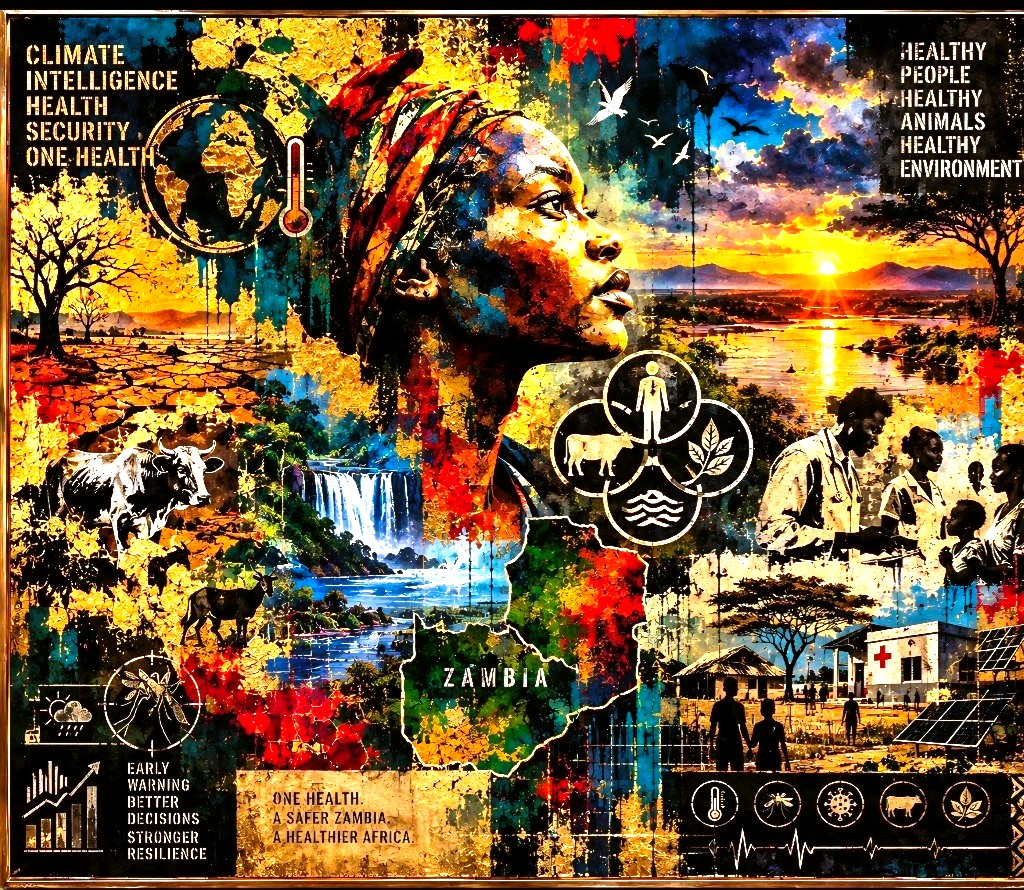
Existing Zambia-specific evidence demonstrates that climate variability is relevant to malaria epidemiology, while research on zoonotic pathogens supports stronger integrated surveillance and One Health research. The next step is to establish how these strands of evidence can inform disease-specific decisions and whether institutions can act on relevant information in a timely and accountable manner.
A climate-informed One Health governance architecture should therefore prioritise integrated surveillance, locally validated risk assessment, defined response pathways, sustainable financing, community participation and measurable performance.
The central proposition is that climate intelligence becomes a health-security asset only when institutions can translate it into timely, coordinated and equitable action. Testing this proposition in Zambia could generate evidence relevant to national policy and the wider African climate-and-health agenda.