IN A NUTSHELL Author's noteThe 7-1-7 framework is a practical approach for assessing and improving epidemic preparedness by targeting detection of a public health threat within seven days of emergence, notification to a responsible authority within one day, and completion of appropriate initial response actions within seven days of notification (WHO, 2023). Using an illustrative suspected rabies event in Ho Chi Minh city, this article shows how signals from communities, health facilities and veterinary services can trigger coordinated investigation, risk assessment, post-exposure prophylaxis and risk communication. The scenario is hypothetical and does not describe a documented outbreak. Drawing on WHO guidance and Vietnam's current surveillance regulation, the article proposes integrating 7-1-7 into existing event-based, indicator-based and community-based surveillance rather than establishing a parallel system (WHO, 2014; Vietnam MOH, 2026). Five priorities are recommended: national technical guidance and indicators; standardized event data and digital reporting; formalized human–animal–environment health coordination; implementation pilots in diverse provinces; and routine performance reviews. The One Health approach is particularly relevant for zoonotic threats (FAO et al., 2022). By identifying delays and enabling factors without assigning blame, 7-1-7 can help transform outbreak reporting into timely action and continuous system improvement. It should complement, not replace, legal reporting requirements or urgent clinical care

By Dr. Tham Chi Dung, MD., PhD.
Technical Expert for the Epidemic Preparedness and Response
Former Deputy Director, Research Institute of Health Sciences, Vietnam
From Detection to Action
Implementing the 7-1-7 Framework to Strengthen Vietnam’s Epidemic Preparedness and Response
By the same Author on PEAH: HERE
- Applying the 7-1-7 Framework: An Illustrative One Health Rabies Scenario
In a community in Ho Chi Minh city in the Southern Vietnam, a dog suddenly develops unusual behavior and bites a resident. The family seeks prompt medical assessment, but the incident has not yet been recognized by the surveillance system as a potential community-wide public health threat. Two days later, veterinary authority’s investigators suspected rabies in the animal, which is subsequently laboratory-confirmed. The following day, the information reaches the provincial Center for Disease Control (CDC), triggering a coordinated response involving healthcare workers, veterinary officers, local authorities and community representatives. The scenario adapts the One Health rabies example which demonstrates the importance of early recognition, rapid information sharing and cross-sector coordination (FAO et al., 2022).
The 7-1-7 framework provides three measurable targets: detect a public health threat within seven days of its emergence, notify the responsible public health authority within one day of detection, and complete appropriate initial response actions within seven days of notification (WHO, 2023).
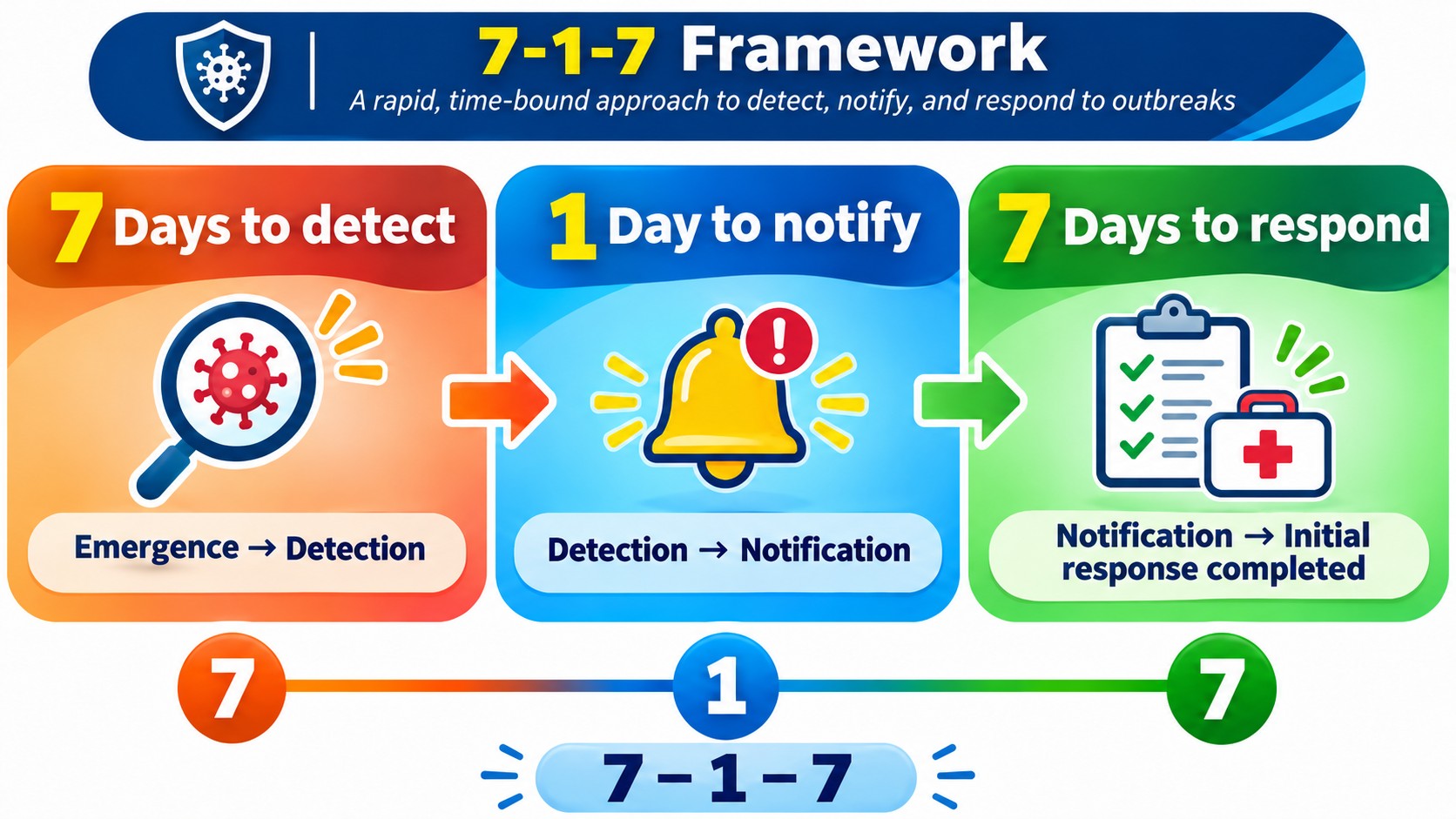
In this example, the event is first recognized on Day 2, notified on Day 3 and the initial response completed by Day 10. All three targets are achieved. However, achieving them requires more than recording dates; it requires a functioning surveillance and response system capable of transforming information into timely public health action (WHO, 2023).
The first step is collecting and documenting information. Community health workers, commune health stations, hospitals, laboratories and veterinary services should contribute to detecting unusual health events. Event-based surveillance (EBS), including community-based surveillance (CBS), can identify unusual signals, while indicator-based surveillance (IBS) monitors changes in disease patterns. The approaches complement one another (WHO, 2014).
For each event, health authorities document the date of emergence, first detection, first notification and completion of appropriate initial response activities. These dates allow the 7-1-7 intervals to be calculated and assessed. For endemic diseases such as dengue, emergence may be defined by exceeding a predetermined alert threshold; for a non-endemic disease, symptom onset in the first epidemiologically linked case may serve as the starting point (WHO, 2023).
The second step is rapid notification and coordinated action. Once the rabies event is detected, information must reach the competent health authority within one day. Veterinary and human health teams coordinate to identify exposed individuals, ensure timely post-exposure prophylaxis when indicated, investigate the incident and implement prevention measures. Crucially, immediate wound washing, clinical risk assessment and indicated prophylaxis must not be delayed pending animal testing or completion of 7-1-7 reporting (WHO, 2026).
The third step is completing the appropriate initial response. Actions may include field investigation, epidemiological analysis and risk assessment, laboratory confirmation, case management and infection prevention and control, community interventions, risk communication and interagency coordination. Not every event requires every intervention, but all response actions relevant to the specific event should be documented and completed as promptly as possible (WHO, 2023).
The fourth step begins during and after the initial response: learning from the event. Provincial CDC personnel and partner agencies review the timelines to identify what accelerated or delayed action. Was the warning recognized by the community? Was information transmitted rapidly? Were laboratory turnaround, transportation, staffing or cross-sector coordination barriers? These are the framework’s “bottlenecks” and “enablers” (WHO, 2023).
Finally, findings are translated into short- and long-term improvements. Immediate measures might include a shared Zalo communication group, the most popular social communication channel in Vietnam, clearer reporting responsibilities or refresher training. Longer-term solutions may include interoperable surveillance systems, workforce development, laboratory strengthening and dedicated financing. The purpose of 7-1-7 is not to penalize delays; it is to create a continuous learning process in which each event improves the response to the next (WHO, 2023).
- Five Priorities for Integrating 7-1-7 into Vietnam’s Health System
Vietnam has an established legal and operational framework for communicable disease surveillance and outbreak response. Circular No. 15/2026/TT-BYT, effective from 01 July 2026, includes provisions on surveillance, event-based information, risk assessment, alerts and outbreak response. The opportunity is therefore to embed 7-1-7 into existing reporting and response arrangements rather than introduce a parallel system (Vietnam MOH, 2026).
Five priority actions are recommended: (1) Develop national technical guidance and standardized indicators. The Ministry of Health, through the Vietnam Administration of Disease Prevention, should clarify milestone definitions, responsibilities across levels, data requirements and procedures for performance review. The 7-1-7 targets should supplement—not supersede—any shorter or otherwise legally required notification and response time limits (Vietnam MOH, 2026; WHO, 2023); (2) Integrate 7-1-7 into EBS, IBS and community surveillance. Provincial CDCs, commune health stations, healthcare facilities, laboratories and community collaborators should routinely capture key event dates. Digital tools, including Zalo mini-apps, web-based EBS platforms and standardized electronic forms, could support rapid reporting where feasible. Data should feed existing surveillance processes to minimize duplication and workload (WHO, 2014; Vietnam MOH, 2026); (3) Strengthen One Health coordination and accountability. Formal coordination arrangements should link human health, animal health and relevant environmental sectors. Designated contact points, rapid communication channels and joint risk assessment are particularly important for rabies, avian influenza and other zoonotic threats. Provincial authorities should periodically review performance in multisectoral meetings (FAO et al., 2022); (4) Pilot implementation before national expansion. Selected provinces and cities, including settings with ongoing EBS, IBS training and technical assistance, could test retrospective outbreak reviews, real-time tracking of new events, supportive supervision and documentation of lessons learned. Evidence from varied geographical settings should guide refinement of national implementation guidance (WHO, 2023); and (5) Institutionalize performance monitoring and continuous improvement. Each province should calculate the proportion of eligible events achieving each of the three milestones, identify recurrent bottlenecks and track corrective actions. Results can inform annual disease prevention plans, training, resource allocation and preparedness investment (WHO, 2023).
- Conclusion: Toward a Timelier and More Resilient Health System
The 7-1-7 framework offers Vietnam a practical opportunity to move from surveillance focused largely on reporting to a performance-oriented system connecting early warning with timely public health action. This direction is consistent with WHO guidance on early action reviews and its recommended integration of EBS and IBS (WHO, 2014; WHO, 2023).
Successful implementation will depend on national leadership, clear technical standards, stronger links between community and facility-based surveillance, effective One Health collaboration and appropriate digital reporting. Equally important is a supportive learning culture in which delays lead to system improvement rather than blame (WHO, 2023; FAO et al., 2022).
Ultimately, the value of 7-1-7 lies not merely in achieving three numerical targets but in ensuring that a warning signal identified in a village, hospital, laboratory or animal health facility rapidly leads to coordinated, proportionate action. By embedding this approach within existing systems and scaling it according to operational evidence, Vietnam could strengthen epidemic intelligence, preparedness and public health resilience.
References
Food and Agriculture Organization of the United Nations (FAO), United Nations Environment Programme (UNEP), World Health Organization (WHO) and World Organisation for Animal Health (WOAH) (2022) One Health Joint Plan of Action (2022–2026): Working together for the health of humans, animals, plants and the environment. Geneva: WHO. Available at: https://www.who.int/publications-detail-redirect/9789240059139/ (Accessed: 12 November 2026).
Ministry of Health of Viet Nam (2026) Circular No. 15/2026/TT-BYT dated 17 May 2026 detailing provisions of the Law on Disease Prevention. Official Government legal document portal. Available at: https://vanban.chinhphu.vn/?classid=1&docid=218141&orggroupid=4&pageid=27160 (Accessed: 12 November 2026).
World Health Organization (WHO) (2014) Early detection, assessment and response to acute public health events: Implementation of early warning and response with a focus on event-based surveillance. Geneva: WHO. Available at: https://www.who.int/publications/i/item/WHO-HSE-GCR-LYO-2014.4 (Accessed: 12 November 2026).
World Health Organization (WHO) (2023) Guidance and tools for conducting an early action review (EAR): Rapid performance improvement for outbreak detection and response. Geneva: WHO. Available at: https://www.who.int/publications/i/item/WHO-WPE-HSP-CER-2023.1 (Accessed: 12 November 2026).
World Health Organization (WHO) (2026) Rabies. WHO fact sheet, 17 September. Available at: https://www.who.int/news-room/fact-sheets/detail/rabies (Accessed: 12 November 2026).
—
Editor’s Note
On this topic on PEAH