Tapping Faith-Community Trust Reserves as a Tactical Strategy in Ebola Pandemic Control

Ebola viral disease requires community engagement by multisectoral alliances. During the West African pandemic of 2014-2016, we disseminated 35,000 culturally-appropriate booklets to faith communities in Liberia and adjacent countries. Local pastors, teachers and clinicians used them to promote health awareness and prevention. Booklets were shared with other faith communities. Revised booklets were shared in the 2018 Equateur outbreak in the Democratic Republic of the Congo. Here, we describe our approach and advocate for the inclusion of faith communities in public-health emergencies.  Inclusion interpolates public-health perspectives into faith communities and helps achieve our common goal of health equity

By Richard A. Nisbetta,1, E Julu Swenb, and M. Scott Gilpinc

a,1 University of Liberia-PIRE Center Africa, ranisbett@gmail.com  Corresponding author

b Discipleship Resources International of the United Methodist Church, Liberia juluswen004@gmail.com

c Wesley College and Foundation, Tanzania sgilpin@wesleycollegetz.com

Social Capital Formation in the West African Ebola Pandemic: Tapping Faith-Community Trust Reserves is an Essential Tactical Strategy in Outbreak Control


Ebola viral disease (EVD) is the quintessential infectious disease of poverty. It thrives where impoverished humans and animal hosts co-exist in close-quartered, resource-poor settings. It exploits the lack of modern hygiene, the absence of clinical protective barriers, and the compassion of caregivers. Community mobilization plays a pivotal role in EVD control.1  The 2018 Equateur outbreak in the Democratic Republic of Congo (DRC) began in early May. Media sources purport that EVD victims have left clinical quarantine and taken flight to faith communities, and otherwise sought prayers and healing from faith leaders.2

The West African Ebola Epidemic of 2014-2016 sickened more than 28,000 and took the lives of over 11,000 persons, with 11,000 cases and 4800 deaths in Liberia. Near the beginning of that epidemic, the Liberian Council of Churches proclaimed that the Ebola “plague” was a punishment from God for corruption and immoral acts (homosexualism [sic]) and called for prayer, fasting and repentance.3 Here, we review our efforts and the lessons learned from walking alongside the Liberian United Methodist Church (UMC) to inform national leadership, to conduct educational outreach, and to disseminate printed materials—grounded in an ecumenical ethos—among various national and transboundary faith communities. Our experience offers a pathway for incorporating frontline faith leaders of any religion into prevention and control efforts in any society, thereby aligning the goals of those partners seeking health equity.

The United Methodist Church (UMC) in Liberia has around 600 churches, 1,000 clergy and 240,000 congregants in the 15 Liberian counties. Moreover, there are about 16,000 students in UMC primary and secondary schools, 4,000 in United Methodist University, and the UMC operates a national acute care hospital along with primary care clinics in its 22 administrative districts.  To reach these end-users, we developed a booklet covering the natural history of EVD, previous outbreaks, symptoms, transmission and prevention.4  It contained a section of frequently-asked questions regarding transmission, prevention, and protection and was aimed at a general audience in a high-context society, utilizing local idioms and analogies. The UMC Liberia Publishing Team printed 6,000 booklets. Along with emergency food and hygiene supplies, the booklets were distributed in each of the 22 administrative districts around the country with larger allotments to those districts with more churches and clinics, and/or higher school enrollment. It was used in personal conversations, pastoral counseling, meetings with church groups/health committees, congregation-wide training and informational sessions, and in community-wide meetings sponsored by local churches, schools and clinics.

The booklets were shared with other faith communities including Baptists, Catholics and Muslims. Copies were distributed to Methodist partners in Sierra Leone and 30,000 copies printed in French were distributed to Francophone populations in Guinea, Cote d’Ivoire, Senegal, Nigeria, and Cameroon.  The French version was revised, and 5,000 copies tribute in the DRC by UMC partners in 2018.
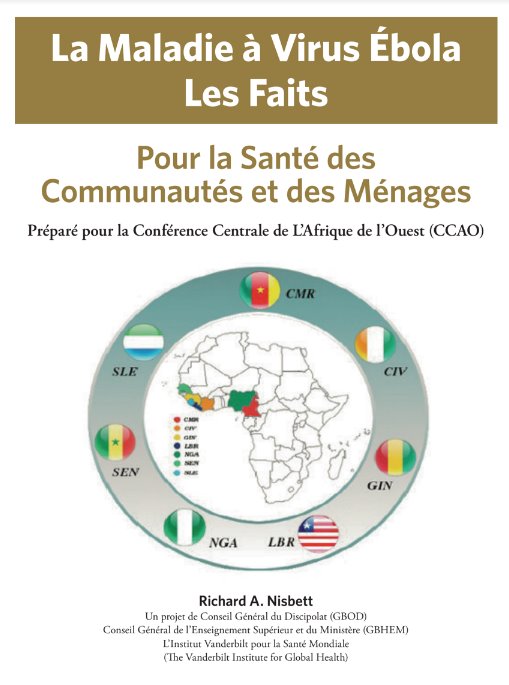
cover of the French version of the Ebola handbook discussed in the article

The advent of the West African EVD outbreak was marked by rumors, misinformation and fear-of-the-unknown. The booklet was disseminated when fear thrust faith leaders into health-leadership roles because government messaging was neither helpful nor hopeful. Official government communications were interpreted by locals as “There is no cure; don’t touch anyone or be intimate.” Naturally, the booklets were embraced, offering knowledge for empowerment and informed decision-making, and, most importantly, hope. As the booklets were deployed and re-supplied, those who had seen and used the booklets commented, in the aggregate, that it was “written in clear, simple style,” “easily understood,” was “devoured like it was hotcakes,” “answered our questions,” would have a “lasting role for teaching” and an “enduring impact” on church and society.

Madon et al. 5 aptly described the challenges that poverty poses for global-health implementation science as “a bewildering constellation of social constraints and health threats.” Globally, faith communities are seldom absent where poverty flourishes and faith leaders are often well positioned to act as cultural mediators. Faith leaders have high literacy and numeracy and sustaining commitments to service and provision of care. For example, during the EVD timeframe, members of our team conducted a health-oriented roundtable at a Nairobi, Kenya conference of 18 academicians representing the dozen Methodist theology schools in Africa. The unanimous sentiment was that health was not only a salient development issue for their clergy but also a vital part of their ministry and pastoral care duties. They expressed the desire for more information and training and recognized the need to work closely with public health and clinical partners in the provision of care, prevention and control.

In seeking to treat, prevent and control the infectious diseases of poverty, we must cultivate cultural competence and promote multi-stakeholder alliances; moreover, we must engage and empower faith leaders by including them in program design prior to, or at worst, at the very beginning of, health emergencies. Global-health practitioners in resource-constrained settings characterized by high medical and religious plurality must recognize that faith leaders are critical stakeholders who should be integrated into partnerships and should take an intersectoral and ecumenical approach to health care delivery, surveillance, prevention design and control activities. Though faith leaders are often quarantined, the fact remains that in the face of palpable fear and uncertainty, for people to take refuge in and recourse among their faith communities is both highly rational and predictable. As Oly Ilunga Kalenga, The DRC Minister of Health, wrote once the Equateur outbreak had been officially declared contained in late July 2018: “Church and traditional leaders are your best allies to carry public health messages that require communities to change age-old habits and challenge their traditions.” 6

Frontlines practice requires an expansive, inclusive perspective on medical cosmology, community dynamics, leadership structures, and the role of faith leaders as natural helpers. Best-practices public health offers preferential options for the poor.7  Frontlines practice facilitates social capital formation. When we align with the priorities of faith communities, we not only tap into their trust reserve of social capital as collateral but also we introduce public health perspectives into faith communities which enhances prospects for our shared goal of health equity.

Authors’ Statements and Declarations

RAN, the corresponding author, wrote the booklet and prepared the first and final drafts of the manuscript. EJS edited the booklet and oversaw Liberian printing and distribution and edited the submission. MSG coordinated the fund raising, oversaw USA printing of the booklets, arranged shipment and distribution to partners in other African countries, and edited the submission. All authors read and approved the final manuscript and are guarantors of the paper.

Acknowledgements

We’d like to thank active partners Dr. Sten Vermund, then Director of the Institute for Global Health at Vanderbilt University School of Medicine, and now Dean of the Yale University School of Public Health; Rev. Dr. John Innis, then Bishop of the Liberian Annual Conference (LAC) of the United Methodist Church (UMC) and now retired; Dr. Steve Bryant and Robin Pippin of the UMC Discipleship Ministries; and Dr. Amos Nascimentos of the UMC General Board on Higher Education and Ministry. We are grateful to the donors who made possible the printing and dissemination of "The Ebola Virus Disease Fact Book" including: Canterbury United Methodist Church of Birmingham, Alabama; EBSCO Industries of Birmingham, Alabama; Heartspring Methodist Foundation of Houston, Texas; Independent Presbyterian Church Foundation of Birmingham, Alabama; and The Thompson Family Foundation of Birmingham, Alabama. Dr. Yed Esaie Angoran of the West Africa Central UMC Conference of Côte d'Ivoire, translated the English version into French and was responsible for design, layout, and distribution of the Francophone version. Finally, we wish to express heartfelt admiration to the entire LAC Leadership team, LAC educators, clergy and community members for their courageous and inspiring efforts to defy EVD in Liberia by living their faith and bridging sectoral, denominational, agency, and international boundaries. You emboldened us to walk humbly alongside you and together we left a roadmap for all those who answer the call to serve.

Authors'information

All contact information for each author is on the title page.  Also below as follows:

Richard A. Nisbett, UL-PIRE Africa Center, The University of Liberia Capitol Hill 1000 Monrovia 10, Liberia  West Africa

E Julu Swen, United Methodist Church 12th & 13th Streets, Sinkor P.O. Box 10-1010 1000 Monrovia 10, Liberia

M. Scott Gilpin Wesley College P.O. Box 7756, Mwanza, Tanzania Banda St, Mwanza, Tanzania

Funding

This work was supported by private donations. No external funding supported this publication. Donations were raised for supplies, food and printing of the booklet.

Competing Interests

The authors have no competing interests or conflicts-of-interest.

Ethical Approval

The humanitarian effort was approved by the Bishop and Executive Board of the Liberian Annual Conference of the United Methodist Church. The booklet was distributed along with food and hygiene supplies. There were no human or animal research subjects.


References

  1. Kennedy SB and RA Nisbett, The Ebola Epidemic: A transformative moment for global health, Bulletin World Health Organ 2015;93:2; M Fallah et al. (2018), Preventing rural to urban spread of Ebola: Lessons from Liberia, The Lancet 2018 https://www.thelancet.com/journals/lancet/article/PIIS0140-6736(18)31435-1/fulltext?dgcid=raven_jbs_etoc_email, retrieved 25 July 2018; and P Piot and J Spencer,  From 1976 to 2018: reflections on early investigations into the Ebola virus, Transactions of The Royal Society of Tropical Medicine and Hygiene, 2018, https://doi.org/10.1093/trstmh/try088
  2. Ebola update Promed 2018:15, Case update, quarantine breaches, border controls, vaccine http://promedmail.org/post/20180524.5816349; Ebola update Promed 2018:16, Cases, DRC cultural factors, vaccine implications, case terminology http://promedmail.org/post/20180525.5817907; Ebola update Promed 2018:17, Case update, public fears, government responses http://promedmail.org/post/20180526.5820606
  3. Patheos 2014, Catholic Archbishop, https://www.patheos.com/blogs/progressivesecularhumanist/2014/10/catholic-archbishop-ebola-is-punishment-from-god-for-homosexuality/, retrieved June 8, 2018; and Daily Observer 2014, God is Angry with Liberia, https://www.liberianobserver.com/news/god-is-angry-with-liberia/ , retrieved June 8, 2018.
  4. Nisbett, RA, “Ebola Disease Facts for Community and Household Health,” Discipleship Resources International 2014 (digital copies in English and French are available from the corresponding author upon request).
  5. Madon T, KJ Hofman, L Kupfer, RI Glass (2007). Implementation Science, Science 2007 (318): 1728.
  6. Kalenga OL. We’ve halted the spread of deadly Ebola in Congo – so what went right? The Guardian 2018, https://www.theguardian.com/global-development/2018/jul/25/halted-spread-deadly-ebola-drc-oly-ilunga-kalenga?utm_source=esp&utm_medium=Email&utm_campaign=Global+Dispatch+collection&utm_term=282054&subid=12289974&CMP=poverty_matters_collection, retrieved 25 July 2018.
  7. Farmer, P, Pathologies of Power: Health, human rights and the new war on the poor. Berkeley: University of California Press, 2004; and H Saussy (ed.), Partner to the Poor: A Paul Farmer reader. Berkeley: University of California Press, 2010.

Health Breaking News 310

Health Breaking News Links, as part of the research project PEAH (Policies for Equitable Access to Health), aim to focus on the latest challenges by trade and governments rules to equitable access to health in resource-limited settings

Health Breaking News 310


G20 priorities to tackle the challenges of global trade governance and pursue the 2030 Agenda for Sustainable Development 

RCEP trade agreement negotiations update and statement 

International Association of Health Policy: Political Economy and Health – Open Lecture Series year III – Academic year 2018/2019 

‘Equity in Investments – a Need to Map the Research Landscape for Health’ by Michael Head 

After new commitments on untying aid, now it’s time for action 

Is the Donor Agenda for the SDGs Making Aid a Tool of Inequity? 

TranspariMED: working to end evidence distortion in medicine 

FDA fails to collect over one billion dollars in fines from law-breaking pharma companies and universities   

Transforming health policy through machine learning 

Prescription Drug Importation: New Federal Initiatives And The Case for State Action 

Key Hepatitis C Drug Licensed To Medicines Patent Pool, Access Expanded For LMICs 

WHO warns ‘urgent action’ is needed to tackle global misuse of antibiotics 

Of all human diseases, 60% originate in animals – “One Health” is the only way to keep antibiotics working  

Taking a systems-change approach to ending NTDs 

Barriers to access to visceral leishmaniasis diagnosis and care among seasonal mobile workers in Western Tigray, Northern Ethiopia: A qualitative study 

DR Congo Ebola outbreak ‘worst’ in country’s history 

DRC Ebola latest numbers as of 13 November 2018 

New measures and strong partnership having positive impact on Ebola response in the Democratic Republic of the Congo 

MSF calls on Global Fund Board to make urgent changes to prevent drug stock-outs and quality issues 

No freedom of choice in vaccination, top EU health official insists 

TAKING CONTROL OF TOBACCO IN INDIA 

A Foundation Zeroes in on the Nexus Between Equity and Mental Health

WMA CONDEMNS ‘SHAMEFUL’ MOVE TO BAN DOCTORS FROM WORKING 

Women, migration, and cross-border trade in Africa  

Study finds ‘significant decline’ in genital mutilation rates in girls 

Increasing newborn babies’ chances of survival 

Nutrition solutions lie beyond health 

“Science is still biased towards staple crops” 

Ripe for change: Ending human suffering in supermarket supply chains 

Deep Dive: Two of America’s Wealthiest Philanthropists Are Teaming Up to Protect the Oceans 

Using Data to Restore Land 

Fast-growing African cities at ‘extreme risk’ from climate change: analysts  

Inaugural Bloomberg American Health Summit To Convene Leaders, Innovators Tackling Nation’s Most Pressing Public Health Challenges 

Equity in Investments – a Need to Map the Research Landscape for Health

More information should be made available in equity terms to the global health community about how money invested in research for health is collectively spent and how much benefit emerges from the research itself

By  Michael Head 

Senior Research Fellow

Clinical Informatics Research Unit and Global Health Research Institute

Faculty of Medicine, University of Southampton, UK

Equity in Investments – a Need to Map the Research Landscape for Health


Billions of dollars are invested in health research every year, but we (the global health community) have very little idea in how that money is collectively spent and how much benefit emerges from the research.

It is, of course, important to have that data and a viewpoint on the research landscape. Knowledge of what has been funded will show the strengths within a portfolio, show where the skillsets and infrastructure lie, and where the collaborations are taking place. A description of the research landscape will also, importantly, show what hasn’t been funded. Where are the evidence gaps, and why? Is research not feasible in that setting? Does the technology not quite come up to scratch yet, but might do in five years’ time? Has no one really considered that question before and thus a key burden of disease been forgotten somewhat?

To provide some examples – in 2018 and via the Research Investments in Global Health study (ResIn), I co-authored a report covering $3 billion of pneumonia research funding across 2000-2015, awarded by funders in the G20 and EU nations.1 We showed how in sub-Saharan Africa, The Gambia was the country receiving the greatest focus for research related to pneumonia, whilst countries such as Chad and Central African Republic were involved in virtually no pneumonia research over the 16 year time-period of our dataset. However, there is certainly plenty of pneumonia in both countries.

Similarly, in 2017, we published an article in The Lancet Global Health that looked at malaria funding for both research, and for malaria control, across sub-Saharan Africa.2 Here, for both types of financing, countries across west and east Africa were clearly global health hubs and recipient of greater amounts of investment (for example, Tanzania, Uganda and Kenya), but Chad and Central African Republic were again lacking in being the focus of funding, despite these nations having a large burden of malaria-related disease.

Clearly, these two countries are very difficult to invest in. They have significant political and socio-economic difficulties, and little infrastructure or experience to do large-scale research. The answer cannot be to simply throw money at the problem. Investments must be smart, targeted, carefully thought out. I often finish my presentations with the phrase “We must invest wisely”. Our data can provide some answers in terms of quantifying the landscape and highlighting research strengths, and evidence and investment gaps. This data can then lead to conversations across a range of global health stakeholders about findings solutions (for example, small-scale in-country capacity building, or encouraging partnerships between universities in resource-poor settings with institutions in the global north). When considering the distribution of limited resources, in this case focusing on money, equity is important and we need better data to more fully consider the problem and apply solutions.

Through ResIn, we are currently working through an analysis of all infectious disease research 2000-2017. This will cover around 80 000 separate awards covering approximately $100 billion of research funding. We are likely to publish our findings in 2019, and believe that the dataset and results will be a useful resource for funders, policymakers and researchers across the globe.


Author

Dr Michael Head is a Senior Research Fellow based in the Clinical Informatics Research Unit and Global Health Research Institute at the Faculty of Medicine, University of Southampton, UK. He co-founded the ResIn (Research Investments in Global Health) study and has led the development of research investment analyses, presenting the study findings at WHO headquarters in Geneva, Wellcome Trust in London, and to European Commission colleagues in Brussels. He also has an interest in scabies research, and vaccines and the activity of anti-vaccination activists.

Funders

The pneumonia study was funded by the Bill & Melinda Gates Foundation, and the malaria project was funded by the Royal Society for Tropical Medicine and Hygiene.


References

1            Rebecca J Brown, Michael G Head. Sizing Up Pneumonia Investment. Southampton, 2018 DOI:https://doi.org/10.6084/m9.figshare.6143060.v1.

2            Head MG, Goss S, Gelister Y, et al. Global funding trends for malaria research in sub-Saharan Africa: a systematic analysis. Lancet Glob Heal 2017; published online June. https://www.ncbi.nlm.nih.gov/pmc/articles/PMC5567191/.


Health Breaking News 309

Health Breaking News Links, as part of the research project PEAH (Policies for Equitable Access to Health), aim to focus on the latest challenges by trade and governments rules to equitable access to health in resource-limited settings

Health Breaking News 309


What the 2018 Midterm Elections Means for Health Care 

What the Mid Term Election Results Mean for the United Nations  

Are there too many global health meetings, summits & declarations? 

Human Rights Reader 465 

How to Ensure That Women and Girls Count in Government Budgets 

A healthy future needs good impact assessments, today 

‘Why Health in All Policies Is a Necessity?’ by Gisela Abbam 

UK aid supports global efforts to tackle preventable maternal and newborn deaths 

Developing mobile health applications for neglected tropical disease research 

Digital Health and Health Systems of the Future 

The Role of Digital Strategies in Financing Health Care for Universal Health Coverage in Low- and Middle-Income Countries 

DRC Ebola: Latest numbers as of 6 November 2018  

African Countries Intensify Vigilance on Ebola 

Uganda Vaccinates Front-line health-workers against Ebola 

Ebola vaccine technology could speed up development of other vaccines 

The U.S. Government and Global Polio Efforts 

Old drains and dirty water: Zimbabwe’s chronic cholera crisis 

Health systems thinking: A new generation of research to improve healthcare quality 

Involuntary mental health treatment in the era of the United Nations Convention on the Rights of Persons with Disabilities 

WHO Guidelines: Management of physical health conditions in adults with severe mental disorders 

Lobbyism, health and the European Parliament – starting a conversation about corporate conflicts of interest 

WTO TRIPS Council: South Africa asks WTO members to share best practices to address excessive prices 

Report Finds “Overpatenting”, Overpricing Of Top Diabetes Drug In US 

A life-saving gene drug could hold families hostage with a $4 million price tag 

‘The Contradictory Case of EU SPC Mechanism and Waiver’ by Daniele Dionisio 

Should A Drug’s Value Depend On The Disease Or Population It Treats? Insights From ICER’s Value Assessments 

How air pollution is destroying our health 

Children at Risk: Why a Corporate Funder Is Taking on Climate Change 

Conflict at the Root of Food Insecurity in Africa  

PROFESSIONAL DEVELOPMENT COURSE ‘Engaging Evidence and Policy for Social Change’ From 15 January 2019 9:00 until 17 January 2019 17:00 

Why Health in All Policies Is a Necessity?

It cannot be overemphasised that improving the health of the population will not be achieved without a whole-system approach to health. Integrated healthcare delivery and health system strengthening are evidence-based approaches that have improved population health in varying degrees.  They enable sustainability and identify other factors that impinge on the improvement of health outcomes

 By Gisela Abbam MBA

Director, Strategic Partnerships

Abt Associates

Why Health in All Policies Is a Necessity?


One may ask, what do I mean by “health-in-all policies,” and why is it necessary?

Health in All Policies is an approach to public policies across sectors that systematically takes into account the health implications of decisions, seeks synergies, and avoids harmful health impacts, in order to improve population health and health equity”.

If we agree that human beings are the most important asset in any country and that investment in human resources improves productivity, then achieving good health for a population is a necessity.  For years it has been stated by many health professionals that health needs to be seen as an investment rather than a cost; but the challenge is determining the return on investment. For investing in health emphasises the need for investment in prevention and early diagnosis, the benefits of which are realised in the longer term.  Having health in all policies supports and promotes the health and well-being of the individual.  Perhaps more importantly, it further enables a cross-sectoral approach to addressing factors that can affect health, such as lack of housing, electricity, food security and poverty.  Other key factors include air pollution, which has an impact on health.

Mental health issues impose an enormous disease burden on societies across the world. Depression alone affects 350 million people globally and is the leading cause of disability worldwide. Half of all mental illness begins by the age of 14, but most cases go undetected and untreated.

Every sector, be it energy, housing or agriculture need human resources to operate and deliver results.  Ensuring that people are healthy and fit for work requires prevention, early diagnosis and treatment of diseases and conditions as well as a functional and effective primary care system.  Increasingly, children and youth are developing health issues, and healthy ageing is becoming a challenge.  These require interventions through schools and local communities.

There is now globally a long list of health issues that can affect population health.  These range from global health security to communicable and non-communicable diseases, which includes mental health, neglected tropical diseases and the list goes on………

The point is, tackling health issues needs be done in its broadest sense to address population health. This requires all sectors working together to achieve this. It cannot be overemphasised that improving the health of the population will not be achieved without a whole-system approach to health. Integrated healthcare delivery and health system strengthening are evidence-based approaches that have improved population health in varying degrees.  They enable sustainability and identify other factors that impinge on the improvement of health outcomes.

The benefits of health in all policies include enabling a healthier and more productive population; earlier diagnosis and treatment which may reduce premature deaths; and increased public awareness of health and health promotion.

The World Bank’s new Human Capital Index has for the first time determined that investment in health and education are key factors behind the economic growth and poverty reduction rates in several countries in the world.

The rankings, based on health, education and survivability measures, assessed the future productivity and earnings potential for citizens of 157 of the World Bank’s member nations, and ultimately those countries’ potential economic growth. It found that on average 56 percent of children born today will forego more than half their potential lifetime earnings because governments were not investing adequately to ensure their people are healthy, educated and ready for an evolving workplace. One solution is to institute health in all policies, so all national initiatives include a pre-health impact assessment.

In 1969, Finland had the second highest cardiovascular mortality in the world — 643 of 100,000 men aged 35 to 64 annually.  The numbers were so striking, so high compared to the rest of the world, that the public health authorities couldn’t help but take note. Finland’s death rates from coronary heart disease were two or even three times those of other European countries and Japan.  Today, the rate is one tenth of that.

Health monitoring, reducing smoking and improving dietary habits have had a huge impact on their non-communicable disease burden.  The Finnish educational system provides health education, physical activity and free healthy school meals.  Six years ago, one in every five-year-old children was overweight, but through health interventions in schools, the proportion of five-year-olds who are overweight has been halved. The agricultural sector promotes the production of healthier foods, and the Ministry of Finance carries excise duties on soft  drinks, alcohol and tobacco. The implementation of health in all policies has produced good results for Finland.

Developing an implementation plan for increasing access to healthcare for the population involves prevention and health promotion initiatives, which cannot be achieved by the ministries of health alone.  In conclusion, I reiterate that ensuring health in all policies, and successfully implementing the policies, will contribute to the economic advancement of any given country.


Reference links

http://www.euro.who.int/__data/assets/pdf_file/0007/188809/Health-in-All-Policies-final.pdf

http://www.worldbank.org/en/events/2016/03/09/out-of-the-shadows-making-mental-health-a-global-priority

http://www.who.int/mental_health/en/

http://www.abtassociates.com/node/13677

http://www.worldbank.org/en/publication/human-capital

http://www.who.int/features/2015/finland-health-in-all-policies/en/


The Contradictory Case of EU SPC Mechanism and Waiver

This article turns the spotlight on concerns that undue pressures on the European Council are undermining progress on a workable SPC (supplementary protection certificate) waiver legislation for medicinal products  in an attempt to limit competition and give non-EU pharmaceutical companies strong advantage over EU-based generic and biosimilar manufacturers

By  Daniele Dionisio

PEAH – Policies for Equitable Access to Health

The Contradictory Case of EU SPC Mechanism and Waiver


The European Union (EU) Regulation EC 469/2009 concerning the  supplementary protection certificate (SPC) mechanism for medicinal products allows pharmaceutical manufacturers to extend the twenty-year patent protection on their medicines by an additional five years.

SPC introduction was justified in order to ‘meet the innovative pharmaceutical concern that they were no longer given a fair opportunity to recover their Research and Development efforts and investments’ , while taking into account thatthe period that elapses between the filing of an application for a patent for a new medicinal product and authorization to place the medicinal product on the market makes the period of effective protection under the patent insufficient to cover the investment put into the research’.

On the downside, SPCs unfortunately serve as a monopoly strategy whereby once a pharmaceutical company has patented minor changes with no added therapeutic benefit (the so called ever-greening mechanism) to an existing medicine, the same company will expectedly apply for an SPC on those minor changes, so expanding its unfettered control on the market, while getting rid of the risk of generic competition.

Relevantly, SPC terms make it clear that, while EU-based manufacturers of generic or biosimilar medicines are not allowed to produce generic or biosimilar versions of these drugs for sale in the EU during that time, they are also not allowed to export these medicines to nations where the SPC is not in force, nor can they manufacture and store up medicines for the EU market before the day of SPC expiry.

So compounded, such an extended monopoly protection has undermined access to affordable generic drugs and biosimilars in Europe and lead to spiralling prices for lifesaving medicines , while exhausting the national budgets and barring patients from non-discriminatory access to treatments.

This is without prejudice to the fact that SPC rules do not apply to non-EU manufacturers. As said…a biosimilar or generic manufacturer in Russia, India, the US, Canada or China can, for example, produce medicines in advance of day-1 of the EU SPC expiry. This gives them a considerable advantage on EU manufacturers…’.

All things considered, no wonder in September 2017 thirty-three civil society organisations recommended the European Commission (EC) to abolish the SPC mechanism or, at least, strongly improve its transparency and equity,  in alignment with the Report of UN High Level Panel on Access to Medicines.

Under these circumstances and a previous request by the EU Council, the EC engaged in reviewing the Regulation EC 469/2009, and a proposal for a minimal SPC manufacturing waiver was released earlier this year. The current proposal would not allow EU-based manufacturers to prepare for Day 1 Launch in advance of SPC expiry in the EU, but only for export to non-EU countries where the SPC does not apply.

In the face of this, Medicines for Europe, on behalf of the EU’s generic and biosimilar medicines manufacturers, just called for a more comprehensive waiver including an immediate applicability to existing SPCS and a Day-1 Launch provision to let generic and biosimilar companies produce in the EU and roll-out in the EU market with no delay after the SPC expiry, so overcoming the long lead-in times needed to manufacture medicines.

Reportedly, this waiver, if comprehensively and correctly applied,  ‘…should generate huge opportunities for Europe, with 25,000 additional jobs, savings in the European healthcare system of € 3.1 billion and additional net sales for the EU pharmaceutical industry’.

Disappointingly, vested interests look like they  would run contrary to these opportunities currently under discussion by the EC and the Council. Word is spreading, indeed, that undue pressures on the European Council are undermining progress on a workable SPC waiver legislation aligning with the minimal EC proposal above (let alone a broad-minded, comprehensive one), in an attempt to limit competition and give non-EU companies strong advantage over EU-based generic and biosimilar manufacturers.

No doubt, concerns also apply to the purposes of a closed-door meeting held in Brussels on 23 October by the US Patent and Trademark Office, the US Trade Representative and the US Department of Commerce with EU government officials purportedlyto convey the position of the US commercial bodies and representatives to EU officials on the introduction of an SPC manufacturing waiver in Europe’.

All things taken together, how do the circumstances highlighted so far attune with EU interest in backing jobs, economic savings and additional sales for the EU pharmaceutical industry, while not disregarding the European Council’s recognition (17 June 2016 paragraph 19) of ‘the importance of timely availability of generics and biosimilars in order to facilitate patients’ access to pharmaceutical therapies and to improve the sustainability of national health systems’?


Health Breaking News 308

Health Breaking News Links, as part of the research project PEAH (Policies for Equitable Access to Health), aim to focus on the latest challenges by trade and governments rules to equitable access to health in resource-limited settings

Health Breaking News 308


What’s at stake as EU, Africa, Caribbean, Pacific, negotiate new accord 

Opinion: New name but same mistakes in Compact With Africa 

Is the TPP worth it? 

Towards Health Sustainability in Europe – a public health narrative for a multilevel & multisectoral approach  

UAEM: In ‘Historic” Shift, Universities In Canada Adopt Licensing Promoting Access To Medicines 

New Report: Mitigating Patent Linkage To Promote Medicines Access In LMICs 

EPHA 2018 Universal Access and Affordable Medicines Forum Brussels 20 November 2018 

Seminar on access to quality-assured medicines Brussels 20 November 2018 

Should we respect patents or people? 

The ITM symposium on 40 years PHC: is there a doctor in the house? 

US Releases New Medicare Drug Plan To “Pay The Prices Other Countries Pay” 

Symposium [Human] Resources, Research, Rights: Ethical dilemmas in Global Health Amsterdam 9th November 2018 

Does supportive supervision enhance community health worker motivation? A mixed-methods study in four African countries 

1a Convention del Management della Sanità Italiana Roma 7-9 novembre 2018 

Hunger stalks Asia’s booming cities – U.N. agencies 

Ebola DRC: Latest numbers as of 1 November 2018 

Cholera Threatens a Comeback Worldwide  

Rapid shift from global to national purchase of TB drugs increases risk of stockouts and use of drugs of unknown quality 

5-year-plan to bring HIV vaccine to market 

During A Flu Epidemic, Dispensing Flu Vaccines at Pharmacies Could Save Lives and Costs 

Yes, China’s Lending Is a Problem for Debt-Vulnerable Countries 

Local Angle: A Community Foundation Making a Big Push for Health Equity in a Small State 

Human Rights Reader 464 

COMUNICATO STAMPA: IL DECRETO IMMIGRAZIONE E LE IMPLICAZIONI PER LA SALUTE 

The Advisory Board to the Emergency Support Fund for Key Populations Starts to Function 

The 1st global WHO conference on Air Pollution and Health in Geneva 

Gas companies face Californian wipe-out, say S&P, Moody’s 

Highlights: An energy industry view on moving toward a lower carbon future 

Towards higher CO2 limits to protect the climate and our health 

Banning cars in major cities would rapidly improve millions of lives 

Health Breaking News 307

Health Breaking News Links, as part of the research project PEAH (Policies for Equitable Access to Health), aim to focus on the latest challenges by trade and governments rules to equitable access to health in resource-limited settings

Health Breaking News 307


New global commitment to primary health care for all at Astana conference 

WHO: Primary Health Care (PHC) 

Declaration of Alma-Ata International Conference on Primary Health Care, Alma-Ata, USSR, 6-12 September 1978 

HH Pope Francis and WHO Director-General: Health is a right and not a privilege 

Global Conference on Primary Health Care 25-26 October 2018 Astana, Kazakhstan: LIVE 

Renewing commitment to Primary Health Care – the key role for research to accelerate Universal Health Coverage through Primary Health Care 

The TDR Gateway: a new way to publish the science of solutions. Launch date: 19 November 2018 

Building a movement for health – a tool for (health) activists 

Building a movement for Health  

G77+China Plan To Take UN TB Declaration Forward: Increased Resources, Access To Medicines 

Medical Crowdfunding’s Dark Side

Activists interrupt TB conference opening ceremony to call on J&J to cut price of TB drug in half, to one dollar per day 

Activits urge national TB programs and treatment providers to discontinue use of harmful injectable agents in TB treatment 

Activists call on countries and donors to immediately scale up use of life-saving TB LAM test 

Talking HIV: Telling people about your HIV status 

Near-Monopolies On HCV Diagnostics Curb Competition, Keep Prices High, Research Finds 

Polio experts ‘owe it to the children of the world’ to wipe out the disease 

Cholera returns to Yemen, with powerful allies  

US Interference In EU SPC Manufacturing Waiver “Unacceptable,” Says EU Generic Industry Group  

What’s needed to do a better job of pre-empting disease outbreaks 

Nutrition gets a moment at the World Food Prize as global hunger rises 

World hunger has risen for three straight years, and climate change is a cause 

What staying cool has to do with eradicating poverty in India 

Pregnant women in Nigeria are shunning medical centers. Here’s why. 

‘Discrimination and Stereotype in the Global-North and -South Nation-States: the Major Interlope to Universal Health Coverage for Refugees and Other Vulnerable Immigrant Persons’ by Michael Ssemakula 

Africa Near the Bottom of World Bank’s New Human Capital Index 

Integrate regionally for stronger, sustainable growth in resource-rich sub-Saharan Africa 

Climate litigations set to rise globally on back of IPCC report 

Climate science gets precise enough for legal action 

Discrimination and Stereotype in the Global-North and -South Nation-States

This paper explores the gaps in access to health for refugees and other migrant vulnerable individuals due to the discrimination and stereotypes in the host countries. A refugee is somebody forced to flee his home country with a strong justifiable fright of being oppressed and victimized on basis of ethnicity, race, religion, sexual orientation, nationality and a member of a specific societal assemblage or political ideology 

 By Michael Ssemakula

Health Rights Researcher & Advocate

Human Rights Research Documentation Center (HURIC) & PHM-Network, Uganda

Discrimination and Stereotype in the Global-North and -South  Nation-States

The Major Interlope to Universal Health Coverage for Refugees and Other Vulnerable Immigrant Persons


The exponential paranormal jump-pace at which the present-day refugee crisis is exacerbating the back-and-forth unparalleled international migration, is acutely awe-inspiring and becoming a chief post-colonial era humanitarian integral complex anthem. This is intensely overshadowing the contemporary global and continental states managers’ comprehensive policy and plan frameworks on population planning. This has been allied with weighty-unrelenting challenges to get appropriate human rights-centric approaches to refugee discrimination, stigmatization and other dehumanizing human rights abuses against their dignity from dogmatic chauvinistic and xenophobic prejudist evacuee-host republics. Legions-upon-legions of refugees, asylum seekers and migrants arrived in the European Union state members in 2015. The sporadically skewed growing influx of susceptible populaces postures voluminous challenges to the host-foreign-fatherlands in the wave-length of preparedness and pliability of health systems and access to vital primary and emergency health care services.

This paper explores the gaps in access to health for refugees and other migrant vulnerable individuals due to the discrimination and stereotypes in the host countries. A refugee is somebody forced to flee his home country with a strong justifiable fright of being oppressed and victimized on basis of ethnicity, race, religion, sexual orientation, nationality and a member of a specific societal assemblage or political ideology. Here the refugee is assumed to be outside the country of his nationality, and due to fear, he is unwilling to avail himself to the jurisprudence protection of his State.

In regards to the report on ‘Refugees: towards better access to health-care services’ (Etienne V Langlois, 2016), the migration crisis is one of the most pressing global challenges, as worldwide displacement is now at the highest level ever recorded. Latest global estimates by the United Nations Commission for Refugees (UNHCR) show that 59.5 million people are forcibly displaced as a result of persecution, conflict, generalized violence, or human rights violations. The estimated refugee population reached an unprecedented 19.6 million individuals worldwide in 2015 – half of them being children and the number is steadily increasing, with Syria, Afghanistan and South Sudan as the leading countries of origin of refugees. A lengthy drought preceded the Syrian crisis that led to an enormous movement of people into cities and contributed to instability. Moreover, in South Sudan, due to the continued power hunger and political divide through coup d’état attempt accusations from President Salva Kiir against his former deputy Riek Machar, South Sudanese Civil War’s existence has been eminent between the government forces and the opposition forces which has claimed lives of over 300,000 people with over 2.1 million of those internally displaced, and over 1.5 million having fled to neighboring countries, especially to Kenya, Sudan, and Uganda, according to UNHCR  (UNHCR, 2018) and World Vision reports on countries with the highest number of refugees (Vision, 2018). Furthermore, reports show Uganda was implicated in exiling hundreds of LGBTI populace to Kenya after passing the harsh Anti-homosexuality Bill in 2014, which made Kenya a safe haven for this key population till many were settled in Europe and North-America as asylum seekers to save their lives from inhumane and homophobic moralists’ persecution in Uganda.

Refugees experience conditions of societal exclusion and dementing stereotypes due to their feeble perceived status by society thus facing ostracism, vulnerability, marginalization, poverty, stigmatization and humiliation which heightens discrimination and heavy trauma of displacement (thereby extremely affecting their psychological health and emotion intelligence, including women, children, and older people). Research shows refugees frequently have severe psychological health complications and trauma symptoms, especially depression due to the status labelled on them, immense deportation fear and post-traumatic stress disorder (PTSD), related to prearranged violence, torture, human rights defilement, relocation, brutal torture, traumatic migration experience and other forms of violence. As such, refugees  experience a range of bodily problems and disabilities, including malunited fractures, soft tissue wounds, neuropathies, head injuries, and epilepsy. Refugees also suffer from a heavyweight burden of undernourishment and anemia, curable Non-Communicable Diseases (NCDs) intensified by inadequate access to regular medication, and transmittable diseases. Right to free health care for refugees is typically constrained in host states with overwhelming divergence in entitlements between refugees or migrants and the host nation-citizenry which encumbers the refugees access to health care. Literally asylees are granted delimited health care accessibility, habitually with partial access to emergency medical care, pregnancy, childbearing, and vaccination services. The ostracization from health care is worsened by the illegal status of many undocumented refugees, information barrier and awareness about the obtainability of host country’s medical services due to insufficient provision of language translation services, limited transport access, traditionally insensitive care and financial constraints to access social security services such as  insurance services.

Overall, these circumstances do represent a hindrance to a full-bodied approach to elevation of Universal Health Coverage (UHC) to refugees and other migrant vulnerable persons. Therefore, in a bid to stimulate UHC and promote the right to the highest attainable standards of health for all individuals (as enshrined in the article #12, of the International Covenant on Social Economic and Cultural Rights-ICSECR), some remedies are proposed in this article to narrow the gap in access to health for the refugees and other susceptible migrant persons:

-Strengthening regional unification of registration and anti-discrimination policies to dismantle health exclusion. In the long-run, this should become a robust appropriate measure to benchmark the success level of the drive to promote access to health for refugees, and trim down health service unreachability and bureaucratic propensities involved in documentation of refugees to ease their legal recognition and access to the host country’s health care services.

-Strong re-echoing of pre-onset orientation. Programmes that encompass effective and holistic pre-departure training for refugees should be redesigned to enlighten the refugees on the destination journeys they are yet to take; this should be backed by basic host country linguistic training with the help of language translators to streamline and abridge service accessibility.

-Reinforcing and widening social security coverage for all. This would include broadening of the insurance options, whereby newly inclusive well-streamlined insurance options support refugees and other vulnerable persons such as asylees and undocumented immigrants access to health care. This can be attained through resilient regional integrated states funded comprehensive health insurance frameworks through low-fee insurance plans with minimal stringent administrative procedures. Many insurance stratagems have often commended vulnerable immigrants to financially pay to some level in order to access health care related services. Unfortunately, that can’t be feasible to such vulnerable society stratas unless supported by the countries in region blocs as suggested above.

-Strengthening service providers training and preparation. Providers themselves need a further holistic capacity training to properly care for the refugees especially in regards to counseling and trauma management. The center of focus should be pointed towards cultural proficiency to better existing services as well as inventing new services. Some providers insufficiently understand the current policies on health care access and might turn refugees and other immigrants away based on false information. Henceforth, there’s a need for an additional training to keep providers upbeat to the legislation dynamics related to health access.

In conclusion, several barriers across-the-board that impede the drive to promote health care for refugees and other vulnerable immigrants are still eminent. These barriers are not only administrative and legal in nature but correspondingly incorporate challenges that inherently involve discrimination and stereotype due to the bigotry perceived status of the refugees. Barriers are worsened by exclusion and segregation health policies against non-citizenry strata in host countries as a result of the inadequate social and financial assets.


References

Etienne V Langlois, A. H. (2016). Refugees: towards better access to health-care services. London: The lancet.

UNHCR. (2018). FORCED DISPLACEMENT IN 2017. Geneva: UNHCR.

Vision, W. (2018, June 26). Forced to flee: Top countries refugees are coming from. Retrieved from World Vision: https://www.worldvision.org/refugees-news-stories/forced-to-flee-top-countries-refugees-coming-from


Health Breaking News 306

Health Breaking News Links, as part of the research project PEAH (Policies for Equitable Access to Health), aim to focus on the latest challenges by trade and governments rules to equitable access to health in resource-limited settings

Health Breaking News 306


PHM: Alternative Civil Society Astana Declaration on Primary Health Care 

Global Conference on Primary Health Care in Astana, Kazakhstan, October 25-26, 2018 

PHM: Building a Movement for Health 

‘Private Players in the Growth Paradox of Health Service Provision and Advancement in Uganda’ by Michael Ssemakula 

“The People’s Prescription”: New Report Calls For Value Creation Instead Of Value Extraction In Pharmaceutical R&D 

Antimicrobial Resistance At The World Investment Forum: UNCTAD, WHO Join Forces 

Presentation of GARDP by Dr Manica Balasegaram, Executive Director 

Register for REVIVE/GARDP upcoming webinars on antimicrobial drug development and catch-up on those you may have missed 

Towards national systems for continuous surveillance of antimicrobial resistance: Lessons from tuberculosis 

Trump administration and Big Pharma square off over proposal to televise drug prices 

Research Group Identifies Over-Patenting Of Pharmaceuticals In India, Calls For Patent Reform 

DNDi E-news October 2018 

Statement on the October 2018 meeting of the IHR Emergency Committee on the Ebola virus disease outbreak in the Democratic Republic of the Congo 

Ebola DRC latest numbers as of 16 October 2018 

The danger is clear in DRC Ebola outbreak 

Zambia on alert to quash future Ebola cases 

Ebola experts pulled from Congo amid ongoing outbreak 

Polio eradication target at risk as new cases recorded in Africa 

To eliminate TB we need imagination and ambition 

Cooks among TB-free nations 

A new public-private partnership drug stirs hope to curb maternal mortality 

The Drive To Quality And Access In Rural Health 

Farm and food policy innovations for the digital age 

World Food Day 2018: The elusive quest to end hunger  

Malnutrition is a staggering global burden – we must give new meaning to the food we eat 

True Cost of a Plate of Food Around the World 

Housing First: A Funder Boosts a Promising Model to Address Homelessness in Hawaii 

Reducing inequality: what is your country doing to tackle the gap between rich and poor? 

That Dire New Climate Report is a Call to Action for Every Funder. Here’s What Needs to Happen 

EU, Canada Officials Review CETA Performance, Endorse Recommendations on Climate and Gender 

Bill Gates launches EU clean energy ‘breakthrough’ fund in Brussels